EMQ » April – June 2024 » Volume 60 Issue 2
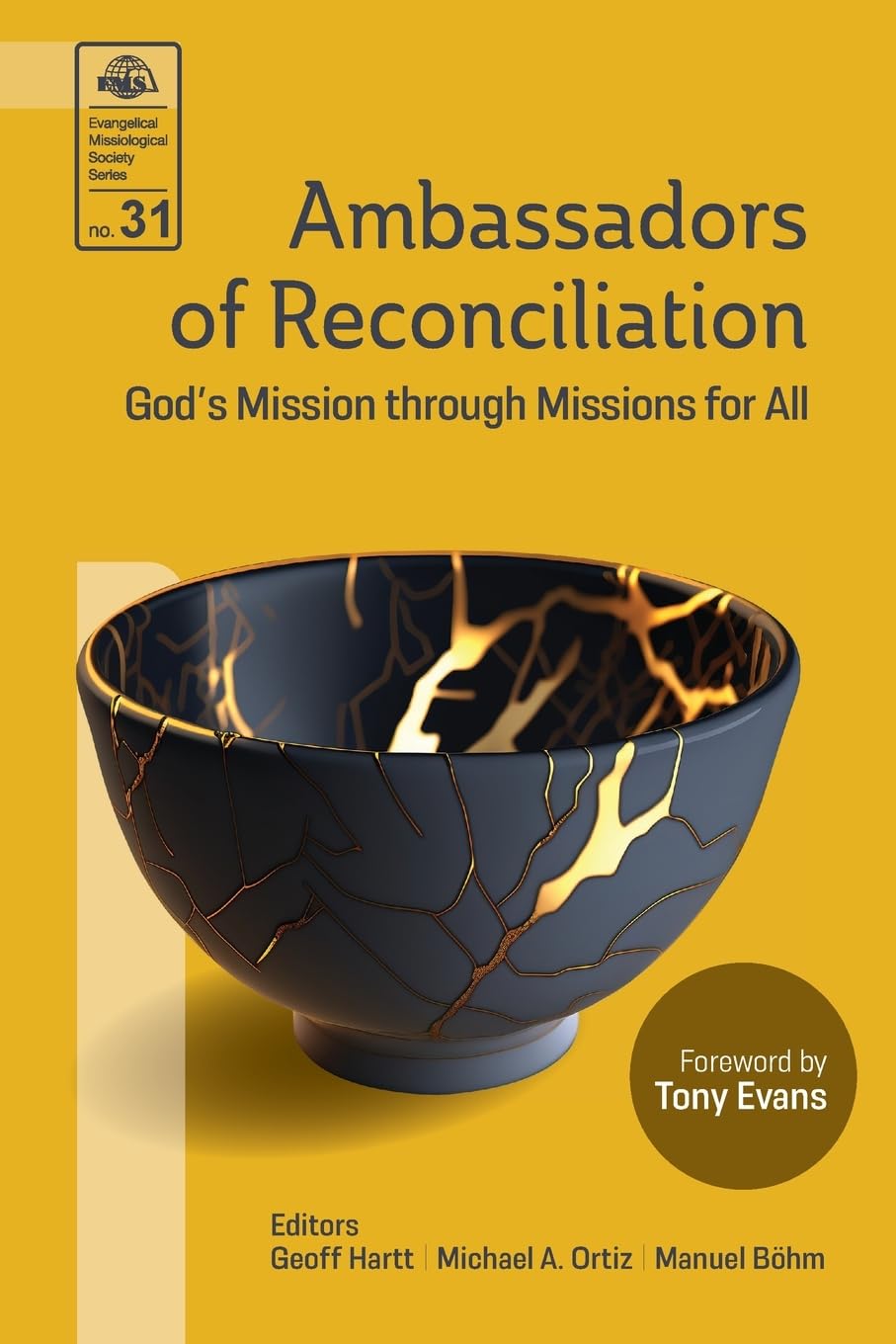
Ambassadors of Reconciliation: God’s Mission through Missions for All
Edited by Geoff Hartt, Michael A. Ortiz, and Manuel Böhm
Evangelical Missiological Society Series #31 William Carey Publishing, 2023
246 pages
US$19.99
*As an Amazon Associate Missio Nexus earns from qualifying purchases.
Reviewed by Kyle D. Frohock, PhD student, Center for Missiological Research, Fuller Theological Seminary, Pasadena, California, and development and intercultural engagement director for The Wesley Heritage Foundation, Midland, Georgia.
Billions of Christians around the world gather at Christmas celebrations each year with lyrics such as Hark! The herald angels sing glory to the newborn King, peace on earth and mercy mild, God and sinners reconciled. And yet,our weary world persistently reels from escalating violence, enmity, and division. On this side of the cross, resurrection, and furor of Pentecost, the church might ask, “What is wrong here?”
Ambassadors of Reconciliation suggests that not only is our world broken, but so is our missiology. Others have sounded similar alarms recently – for example, the Lausanne movement in 2004 and 2011, the World Council of Churches in 2005 and 2022, and the Catholic Church in 2013. This edited volume of the Evangelical Missiological Society’s 2022 Compendium seeks a new paradigm for mission “that brings holistic transformation” (xiii) beyond a “reductionist view of the Great Commission” (xv) that has dominated evangelical mission studies and practice for generations. The book argues an urgent thesis: Reconciliation is the mission of God (missio Dei), and the church is sent to represent, and not simply to proclaim, “his kingdom in this world” (xiv).
Reconciliation as a new paradigm for mission emerges from a missional reading of the Bible. Anchor texts such as 2 Corinthians 5 and Colossians 1 frame the Bible’s narrative arc. A holy and loving God works to overcome our “alienation and enmity to restore relationship and live in peace” with God, one another, and all of creation (27). Peace on earth is understood to be a derivative of God and sinners reconciled which yields a love for God that will naturally then “incarnate the love and compassion and justice and reconciliation of Christ” with one’s neighbors (xiv). This movement serves to organize the book into its sections: reconciliation theology (part 1), reconciliation practices (part 2), and reconciliation case studies (part 3).
Part 1 skillfully recenters God’s multi-directional (holistic) mission in relationships – between God and people; people and people; and God, people, and creation – which are “inseparably related to and drawn into the life of the triune God” (50). Part 2 introduces an integrated and holistic approach of discipleship as reconciliation that is dynamic, personal, humble, gracious, and hospitable – in a word, Christological, “deliberately and radically breach[ing] the barriers” that alienate and disintegrate (113).
Part 3 provides compelling evidence from diverse contexts for reconciliation as mission. I found James Pursley’s account of reconciliation among Turks and Armenians in the Turkish world especially noteworthy, representing a moving synthesis of the book’s claims and testimony of the power of the gospel to wholly reconcile and transform communities ravaged by their “communion of hate” (154). Are we, as Christ’s ambassadors, willing to join Christ in his mission, who in the words of Aubry Smith “welcomed his enemies into his own family with his blood” (118)?
Ambassadors of Reconciliation is an essential resource for church and denominational leaders, mission scholars and practitioners, and students of mission who consider Christ the hope of the world and seek to answer his call to join his saving mission for all.
For Further Reading
Roadmap to Reconciliation 2.0: Moving Communities into Unity, Wholeness and Justice by Brenda Salter McNeil (InterVarsity Press, 2020).
The Journey of Reconciliation: Groaning for a New Creation in Africa by Emmanuel Katongole (Orbis, 2017).
Whole and Reconciled: Gospel, Church, and Mission in a Fractured World by Al Tizon (Baker Academic, 2018).
EMQ, Volume 60, Issue 2. Copyright © 2024 by Missio Nexus. All rights reserved. Not to be reproduced or copied in any form without written permission from Missio Nexus. Email: EMQ@MissioNexus.org.