EMQ » April – June 2024 » Volume 60 Issue 2
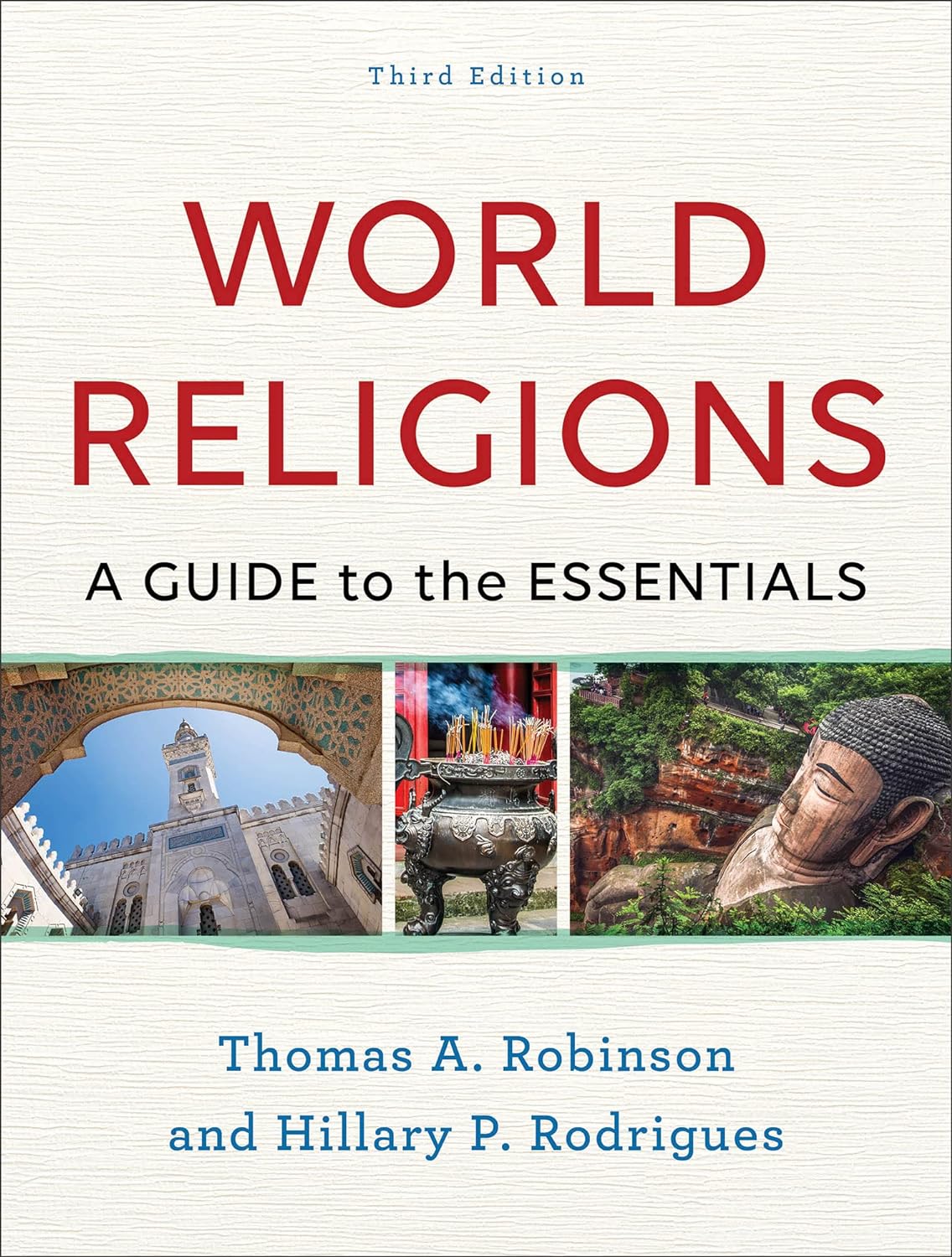
World Religions: A Guide to the Essentials
By Thomas A. Robinson and Hillary P. Rodrigues
Third Ed., Baker Academic, 2022
369 pages
US$40.00
*As an Amazon Associate Missio Nexus earns from qualifying purchases.
Reviewed by Dr. Ryan Klejment-Lavin, associate professor of intercultural studies at Columbia International University in Columbia, South Carolina.
The market for textbooks for courses in world religions might be crowded, but Thomas A. Robinson’s and Hillary P. Rodrigues’ new edition of World Religions: A Guide to the Essentials should be afforded room. Robinson and Rodrigues set out to present a clear and condensed portrait of major religious traditions.
In that attempt, they are quite successful. Shunning any type of confessional approach, the authors choose to discuss each religion neutrally and charitably. Robinson and Rodrigues discuss both the ideals of the various religions and how the religions are practiced in reality.
The book is divided into two main sections: Western Religions and Eastern Religions. After a treatment of Ancient Religions, the book begins with The Western religions, which include the so-called Abrahamic faiths: Judaism, Christianity, and Islam.
The Eastern religions section includes the two largest Eastern religions, Hinduism (which the text correctly considers a blanket term) and Buddhism, but also includes several other major East Asian and South Asian religions. Jainism, Sikhism, Chinese Religions, and Japanese Religions all are discussed in their own chapters respectively. The final chapter discusses a host of other religions and major religious subgroups, such as Bahai, Native American indigenous religions, and Christian sects.
Each chapter discusses the history, sources, texts, sects, tenants, and distinctives of each religion. Especially helpful are the graphics explaining key theological terms for each faith. The book is strengthened by the contributions of several other scholars who are experts in some of the specific faiths.
One impressive inclusion in the text is the discussion of ancient religions, particularly from the ancient Near East. This section helps the reader to better understand the historical context in which Judaism – and by extension, Christianity and Islam – developed, and is not commonly found in world religion textbooks.
If the book is lacking anything, one could argue that the absence of African Traditional Religions keeps the text from capturing a large group of religious believers. However, in a brief treatment of major world religions, it is understandable that some omissions are necessary.
This book would be an excellent choice for a textbook for an introduction to world religions undergraduate course, as well as a helpful resource for anyone interested in world religions. While some Christians would rather take a confessional approach to world religions, this book succeeds in its goal to provide clear and neutral portrayals of each of the faiths discussed.
For Further Reading
Neighboring Faiths: A Christian Introduction to World Religions by W. Courdan (InterVarsity Press, 2012).
The Quest of World Religions: An Introduction and Anthology by J. Studebaker (Cognella, 2024).
EMQ, Volume 60, Issue 2. Copyright © 2024 by Missio Nexus. All rights reserved. Not to be reproduced or copied in any form without written permission from Missio Nexus. Email: EMQ@MissioNexus.org.