EMQ » April–July 2024 » Volume 60 Issue 2
Summary: In the heart of South America, the Ammi Training Center brings people from diverse tribes together for discipleship and ministry training. Graduates leave with life-long friendships and ready to reach Brazil’s many ethnic groups still waiting to hear of God’s love.
By Trudy Seng, Meiry Yakawa, and Vera Bergson
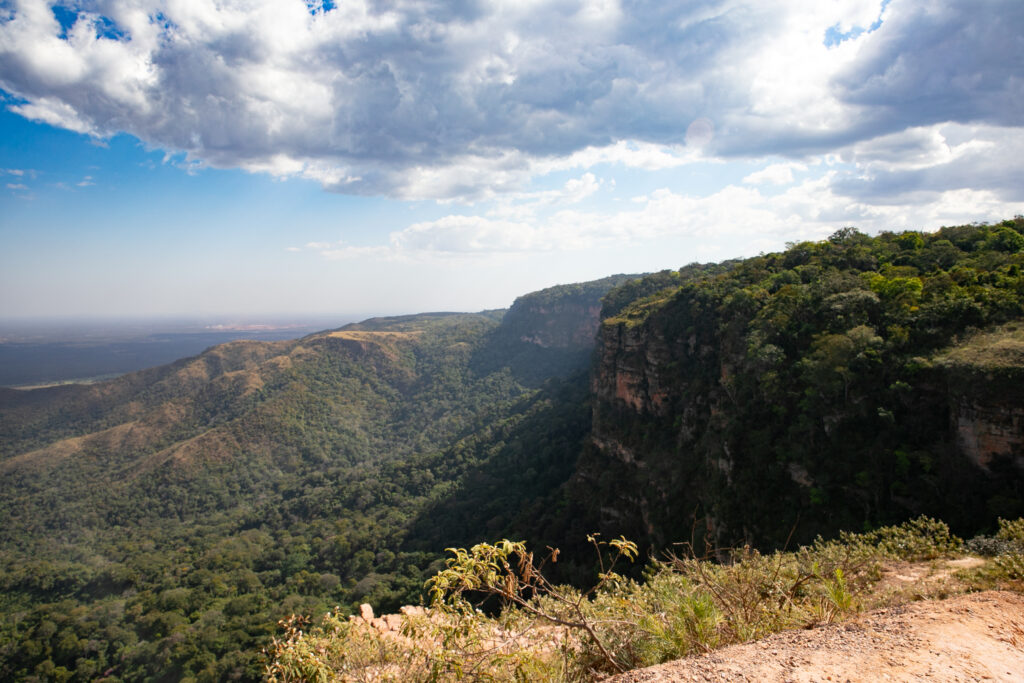
Chapada dos Guimãres has fired the imaginations of many anthropologists, archeologists, and tourists. Recently it has stirred the heart in another way. Local lore claims it to be a place of magic and intrigue. This quaint and lovely little town in south-central Brazil nestles above walls of red sandstone hovering over an exuberant garden of trees. Camouflaged by lush vegetation are gorgeous waterfalls and singing streams only the curious discover.
It is officially recognized as the center of South America and divides the waters of two great rivers – the Paraguay and the Amazon – one flowing north and the other south. It holds deep mystical meaning for the hundreds of Indigenous people groups scattered over the vast area. Centuries ago, their gaze took in vast, yet unspoiled, plateaus and forests that had been their habitat for centuries. So though great rivers flowed apart, Indigenous people met in this place, though not always for peace.
In this beautiful setting, the Ammi Training Center[i] became a new meeting place where many of the offspring of the ancient peoples of this land gather together for worship drawn by a deeper call. It was to be a place where members of Brazil’s more than 300 Indigenous groups could meet their parentes (a term meaning relative and used to refer to other Indigenous groups).
It was to be a true home away from home where they could get to know the Creator God who revealed himself through his Son Jesus Christ. People once divided by ethnic race, fear, and hostility towards each other, could join a greater and multi-ethnic family with a beautiful single focus.
Ammi’s Beginnings
The birth of the school began in sorrow. My husband, Wes, and I (Trudy) had been immersed in just such a school located about five hundred miles south. But in 1994 a situation arose that tore the people apart and pushed us out of this cherished ministry. On the advice of South America Missions (SAM) directors, we accepted the challenge to move north to begin a new training center.
A mission property, originally purchased for a camp ministry, located in Chapada dos Guimãres, became the campus for the new endeavor. Three other couples moved as well, one of whom was Henrique and Corina Dias Terena, both alumni of the former school and from the Terena Indigenous community. Henrique had become a respected church leader in his own and other Indigenous communities.

We learned many valuable lessons down south, not the least of which was the realization that our place in missions had to change radically. Indigenous people who had embraced Christianity were highly qualified and infinitely better at communicating and relating to their parentes than outsiders would ever be.
Foreign missionaries had to learn to take a back seat and allow their Indigenous brothers to forge ahead, unhindered by cultural clumsiness, and strange mannerisms. Slowly, a new central vision emerged: Indigenous people, teaching and discipling Indigenous parentes would become the main force to reach Brazil’s many ethnic groups still waiting to hear of God’s love. Foreigners would disciple by serving and the Indigenous people would take their place as leaders, communicators, and disciplers.
Plans for the new school program quickly grew and took shape. Wes had been struck by the graphic story of Hosea and a gracious “name change!” God declares: “… I will say to those who were not My people, (lo ammi) You are ammi – My people!’ And they will say, “You are my God!” It is a fascinating fact that most Indigenous people use a term in their language that means exclusively “the people.” God uses an inclusive term where He refers to his people. Ammi was quickly adopted as the name for the school, including underneath the caveat, “by the mercies of God.”
Preparing Indigenous Pastors
Since its founding in 1995, the Ammi Training Center has trained 160 Indigenous people from 40 different Brazilian ethnic groups. Around 70% of these graduates are working in a wide range of ministries from Bible translation to pastoring to missions or in leadership positions in their communities such as chiefs, teachers, and health professionals.
Edimar Pereira Lili, from the Terena ethnic group, is one of the graduates whose ministry history is rooted in Ammi. He now pastors the Córrego do Meio Evangelical Church congregation in the Terena village in the southern Brazilian state of Mato Grosso do Sul.
In 1998, Edimar was part of Ammi’s second graduating class. He recalls that Professor Cullen Rast, in his Christian orientation class, was the first to tell him, “Your calling is pastoral.” Four years after graduating from Ammi, Edimar became the head pastor of a church at only 22 years old.
This presented many challenges because in Indigenous culture, young people don’t usually teach their elders. However, the advice and guidance he received at Ammi helped his development as a pastor.
“And little by little, following everything I had learned at Ammi, I gained the respect of the community,” says Edimar. “At Ammi, relationships between colleagues, the importance of teamwork, Christian character and discipleship are very much encouraged. These ingredients I continue to apply in my ministry, along with the example I had from my teachers of commitment and integrity.”
Edimar made note of the influence of teacher and missionary Wes Seng – the director of Ammi during Edimar’s time at Ammi. He says that Wes always guided by gentleness and wisdom. Today, Edimar follows this example as an Indigenous pastor in his daily life. Edimar explains that the spiritual formation he received at Ammi was fundamental to understanding the Church’s missionary calling, a teaching he always tries to put before his congregation.
But it wasn’t just the pastoral vocation that Edimar discovered at Ammi. He met his wife Elizabete Dias during his studies, and they married and had a son, Paulo Marques Lili Neto, now 22. Unfortunately, cancer took Elizabete into the arms of the Lord two years ago. Even so, Edimar continued to live in the Terena village and serve his community as a pastor, and he continues to contribute to Ammi by sharing his testimony at conferences.
Expanding the Indigenous Church
CONPLEI[ii] (the National Congress of Evangelical Indigenous Pastors and Leaders, conplei.org.br) officially launched at Ammi. And in 2002, Henrique Dias Terena became its president. CONPLEI is an Indigenous evangelical movement with a focus on building “a genuinely Indigenous biblical church.”
It has gained national awareness, respect, and even the attention and ear of government entities where it raises a strong voice on behalf of Indigenous rights to make personal choices and decisions regarding Christianity. Its influence has also extended into international space, challenging, and awakening other Indigenous groups in South America to launch ahead in the strength of the Lord to take his message to those who have not heard.
Not long after Henrique began leading CONPLEI, he and an Ammi ministry team went to a Bakairi village where Adriano Bakari lived. At the time, Adriano was only 13, and this was his first exposure to both Ammi and CONPLEI. Five years later, in 2007, he decided to go to Ammi to discover God’s purpose for his life.
More than nine different ethnic groups were represented on the campus when he arrived. The common language between all of them was Portuguese. He says that was a real culture shock to him! The language and cultural differences sometimes made relationships difficult. But he says that the interaction in the dormitory and in the classroom forced him to overcome those obstacles. Now he sees all of that as part of God preparing him for cross-cultural ministry.
In his first chapel service at Ammi, Adriano remembers hearing a missionary (David Greiman), talk about the 92 ethnic groups in Brazil that had not yet heard about Jesus. He challenged the students to consider if God may be calling them to minister to one of these groups.
“I knew that message was for me,” Adriano explains.
In one of his classes, a missionary (Steve White) persuaded him to translate a verse of Scripture into his language for the first time. Then another missionary (Dr. Paulo Nascimento) gave Adriano further encouragement telling him he had the gift of translation.
Adriano graduated from Ammi in 2009. Two years later he went to Mission Além (wycliffe.org.br), an affiliate of the Wycliffe Global Alliance in Brazil, to study linguistics. From there he answered God’s call to serve an unreached people group in Bible translation. He said his training at Ammi, especially in the anthropology classes, significantly helped him in his linguistic studies and later in his missions work.
Adriano told God that he did not want to do the work alone, and he prayed for a companion in the missionary work. In 2012, when he was assisting in a language acquisition class at Alem, he met Ruth Kelli, who had a calling to work with the same people group. In 2013, they married and then moved to the village where they have been for nine years. Since then, their family has grown. They have three daughters, Sofia, Helena, and Aurora.
In the village, they have taught the community to read and write their language. They are also teaching them translated Bible stories while helping with the translation. Today there are only four books of the Bible left to be translated thanks to a growing team that has invested in the work. A small church has also been planted.
“As we say among the [Ammi] graduates: When we leave Ammi, Ammi stays with us: its routine, the liturgy of the services, the devotional life, the example of the missionaries in their time of work, persistence and faith, and God’s provision in financial problems,” shares Adriano. “Finally, I learned from Ammi the importance of having a personal life with God. It’s no use having lots of gifts without an intimate relationship with God.”
Continuing to Strengthen God’s People
The aim of the Ammi Training Center remains the same: disciple followers of Christ so that there is an impact on strengthening the Indigenous church. And our focus continues to be on preparing men and women to teach the word of God to others.
While our vision is unchanged, our dynamic ways of teaching have adapted. Over the years, more Indigenous teachers have joined Ammi’s staff, and today I (Meiry) lead Ammi as an Indigenous woman of the Bakairi-Kura people. These shifts have influenced Ammi’s curriculum and teaching methods. At the same time, we remain committed to teaching the truth of God’s words in ways that have the greatest impact for Indigenous communities.
God continues to work as students apply what they learn to their lives and allow God to transform them into the people that he created them to be. He also strengthens those of us who continue to serve Ammi, helping us to see that serving him is worthwhile.
Ammi could only have come of age with the cooperation and dedication of many gifted colleagues – Indigenous, national, and foreign. Bible translators and teachers in many fields have all contributed to its development.
Every year, at the end of the school year, Ammi holds a conference in which the graduates are invited to share testimonies about how Ammi helped them in their formation and spiritual growth. Most of them say that once they are part of Ammi, they are always “Ammi’s family,” and relate with emotion how what they have learned has helped them to carry out God’s will in their lives.
At the heart of Ammi, God – the artist and poet –chiseled out this place where he draws people from all over to come learn and accept their place in a family, forming bonds far deeper than human blood ties. The blood of Jesus unites them.
People, formerly sworn enemies and killers, now dance together in a “magic” pow-wow circle of joy and praise to their Creator and Savior. God says to them: You are my people (Ammi)!’ And they respond, “You are my God!”
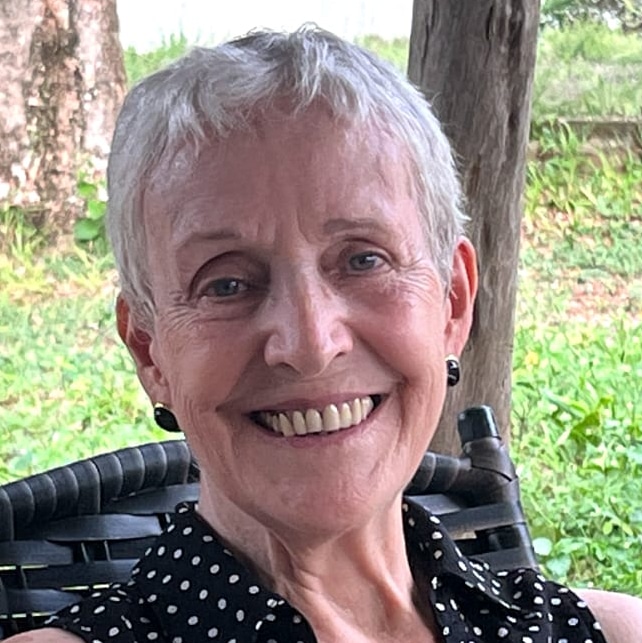
Trudy Seng (trudyseng@gmail.com) was born in Argentina, the daughter of missionary parents. At two years old, her parents moved to Brazil where she lived until leaving for Canada for boarding school and later, Bible School. There she met and married Wes Seng. They have served with South America Mission (SAM, southamericamission.org) in Brazil among Indigenous people groups since 1971.
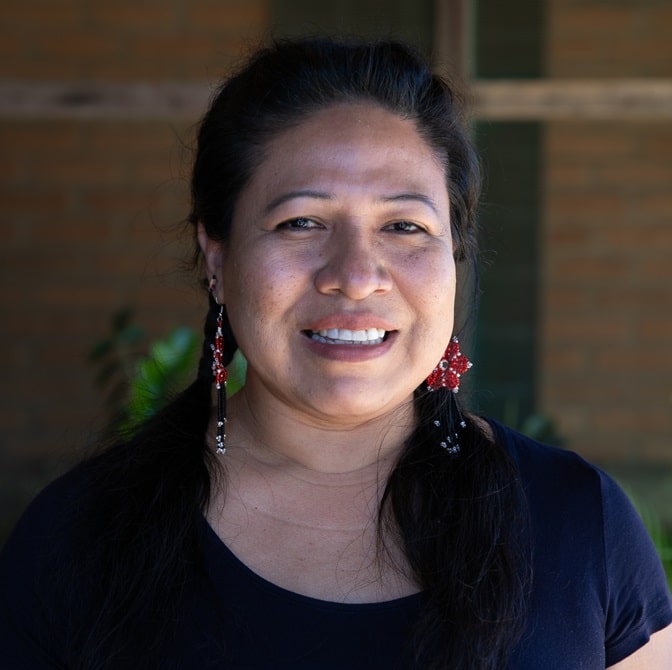
Meiry Yakawa (mpyakawa@gmail.com) is a missionary with Missão SAIM (missaosaim.com.br) and the director of the Ammi Training Center. She is also an Ammi alumna and came on staff as a teacher in 2007. She has completed further studies in linguistics and cross-cultural education. Meiry is from the Bakairi-Kura people group in Mato Grosso, Brazil, and grew up on the Bakairi reservation. She returns annually to spend time with her family.
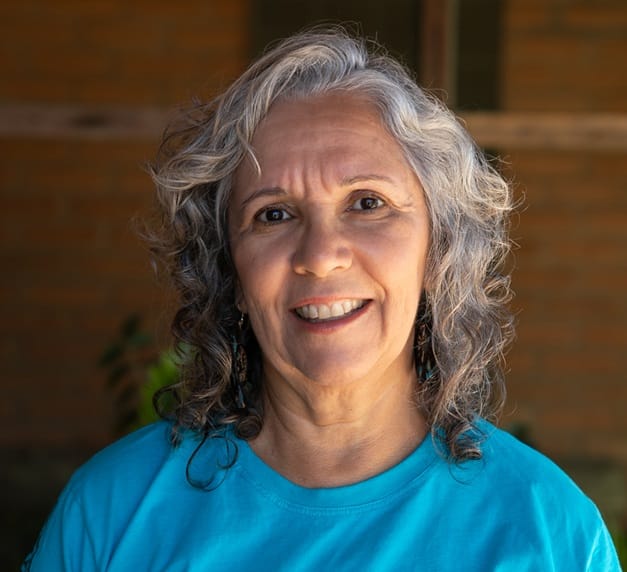
Vera Bergson (vdbergson@yahoo.com) was born in Brazil. She studied journalism at the Faculty of Communication in Santos (SP), and later moved to the US where she met her husband, Don. In 2004, they joined South America Mission (SAM, southamericamission.org), and in 2007, they moved to the Ammi Training Center, in Chapada dos Guimarães. She is currently Ammi’s academic coordinator. She and Don have two children: Filipe and Amanda.
[i] Learn more about AMMI on the South America Mission website: https://southamericamission.org/donate/ministries/ammi-training-center/.
[ii] Conselho Nacional de Pastores e Lideres Evangélicos (National council of evangelical pastors and leaders).
EMQ, Volume 60, Issue 2. Copyright © 2024 by Missio Nexus. All rights reserved. Not to be reproduced or copied in any form without written permission from Missio Nexus. Email: EMQ@MissioNexus.org.