EMQ » January – April 2024 » Volume 60 Issue 1
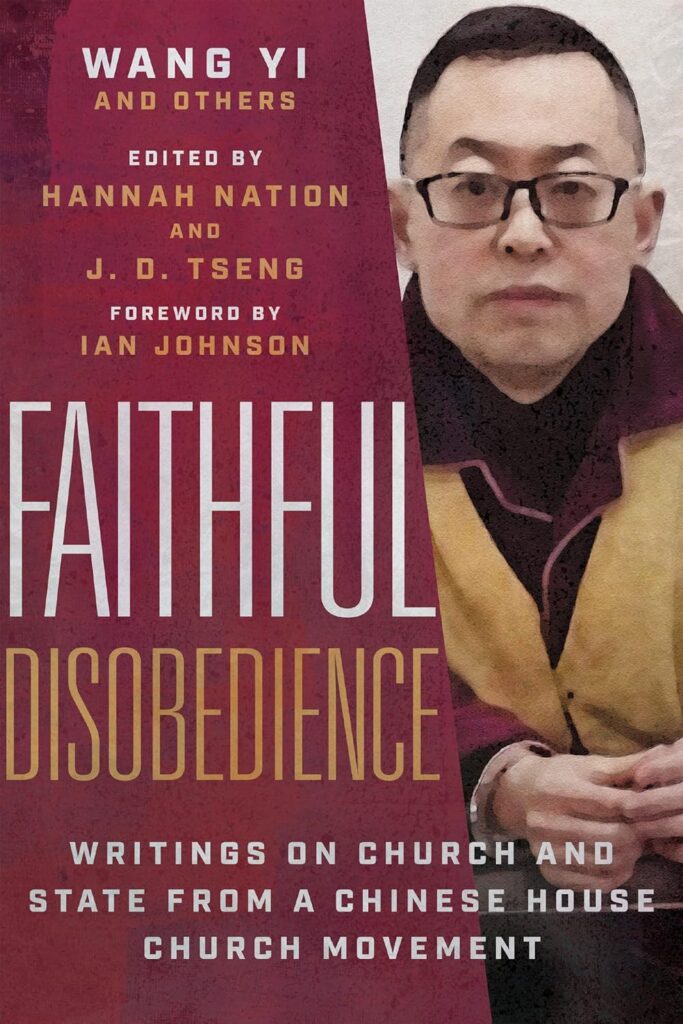
Faithful Disobedience: Writings on Church and State from a Chinese House Church Movement
By Wang Yi and others
Edited by Hannah Nation and J. D. Tseng
InterVarsity Press, 2022.
288 pages US$28.00
*As an Amazon Associate Missio Nexus earns from qualifying purchases.
Reviewed by Richard Cook, professor of church history and missions at Logos Evangelical Seminary in El Monte, California, and a former missionary in Taiwan.
Wang Yi is a colorful leader of the house church movement in China who is currently incarcerated for nine years by the Communist government. These articles, translated from Chinese to English, make his writing available to a broad audience. In this ambitious project, the editors, Hannah Nation and J. D. Tseng (a pseudonym) put forward the writings of Wang Yi as a vital contribution to the broader historic discourse on church and state. “These essays can be seen as specific to China but are also reflections of a remarkable explosion of faith that is taking place in many countries” (xvi).
Wang Yi is the primary contributor, but there are several articles by other Chinese pastors. The editors endeavored to locate bibliographic sources, but they ask for patience from their readers as Wang Yi customarily relied on a large “corpus of unpublished, uncatalogued, and sometimes apocryphal stories and documents of the early Chinese house church” (11). The lack of scholarly rigor, however, is made up for by the lucid and passionate ideas and writing of Wang Yi. The editors also provide abundant and helpful resources for readers unfamiliar with China, including a timeline of modern China, a glossary, an index, and informative footnotes.
Hannah Nation opens with a biography of Wang Yi. Born in 1973, he graduated Law School in 1996 and began teaching Law at Chengdu University. He quickly became a nationally recognized human rights advocate, regularly publishing articles online. Along with his wife, he was baptized in 2005, and they began a Bible study in their home. Among other honors, Wang Yi met President George W. Bush at the White House in 2006. He resigned from Chengdu University in 2008 and founded his Early Rain church. Even as his theology matured, he continued to write on human rights. He became somewhat controversial as some Chinese church leaders preferred to distance themselves from him and his rhetoric.
The 22 articles are divided into three parts, “Our House Church Manifesto,” “The Eschatological Church and the City,” and “Arrest and the Way of the Cross.”
Hannah Nation notes that many have stated that Wang Yi’s most important work is Chapter 14, “History Is Christ Written Large.” He builds upon insights from the twentieth-century philosopher Eric Voegelin, that history is Christ written large.
He opens with a dramatic encounter when he was arrested. The officer inquired, “Have you ever engaged in activities that try to subvert state power?” Wang Yi asked if prayer counts as subversion of state power. Wang Yi admitted to prayer, but insisted, “prayer is the secret weapon of the church, the atomic bomb of the church” (180). He uses Colossians 1:15–20 to discuss that “God uses history to write about his saving grace” (180).
The editors succeed in bringing Wang Yi’s clarion voice to the global church. It is controversial, and readers will sometimes disagree. However, this book belongs on the bookshelf of students of church and state.
For Further Reading:
Faith in the Wilderness: Words of Exhortation from the Chinese Church edited by Hannah Nation and Simon Liu (Kirkdale, 2022).
Darkest Before the Dawn: A Brief History of the Rise of Christianity in China by Richard R. Cook (Pickwick, 2021).
EMQ, Volume 60, Issue 1. Copyright © 2024 by Missio Nexus. All rights reserved. Not to be reproduced or copied in any form without written permission from Missio Nexus. Email: EMQ@MissioNexus.org.