EMQ » January – April 2024 » Volume 60 Issue 1
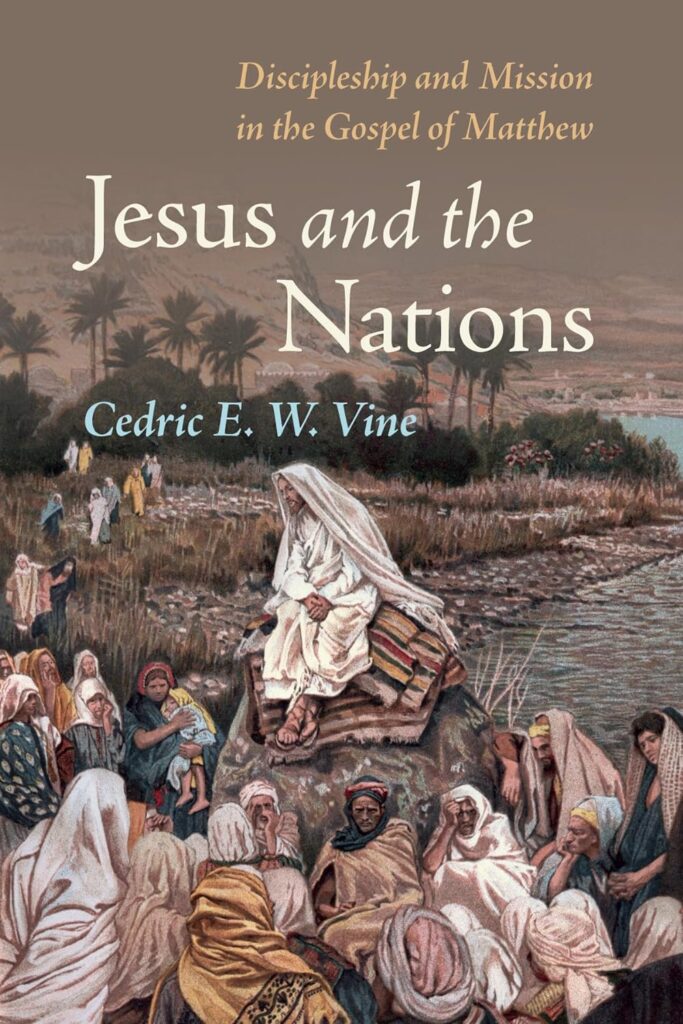
Jesus and the Nations: Discipleship and Mission in the Gospel of Matthew
By Cedric E. W. Vine
Pickwick Publications, 2022
167 pages
US$26.00
*As an Amazon Associate Missio Nexus earns from qualifying purchases.
Reviewed by Ed Scheuerman, professor of intercultural studies, Lancaster Bible College, Lancaster, Pennsylvania, having previously served with Pioneers for 23 years in Southeast Asia.
What does it look like to be a disciple-maker of Jesus Christ? In Jesus and the Nations: Discipleship and Mission in the Gospel of Matthew, Cedric Vine develops five identities of Jesus in the book of Matthew. These five identities provide Christians with models to emulate.
Vine’s scholarly work brings the reader deeply into Matthew, focusing on how Jesus was each of the following: prophet, righteous person, disciple, wise man, and scribe. Each of these is developed in a separate chapter, concluding with implications for how each can be lived out in one’s discipling of others. “Imitation of Jesus is the key” (7).
Much appreciated is Vine’s focus on how “Discipleship must be understood in the context of mission and mission in the context of political theology” (8). This helps to distinguish discipleship from simply helping others be better Christians. The missional emphasis must not be diminished.
The first role addressed, that of a prophet, emphasizes how “the prophet is the catalyst that starts the process of national transformation” (16). The prophet not only denounces but also casts a vision of renewal (25).
“Righteous persons are to strive to be righteous not for the purpose of achieving personal salvation but for the purpose of saving their communities from judgment” (67). For the disciple-maker, this role is a significant challenge. Those who claim that they cannot disciple others because they are not spiritually mature enough need to recognize that they, too, are seeking to become a righteous person even as they call others to walk this journey with them.
“If the role of the prophet is to call the community back to God and that of the righteous person is to nudge it toward righteous behavior, the role of the student-teacher … is to preserve the teachings of the master teacher” (69). This is where the more traditional approach to discipleship is realized – that of imparting knowledge for learning and living.
But knowledge for its own sake is insufficient. Wisdom is needed to consider the best path forward for both the disciple-maker and those being discipled. “The idealized wise man … is also the object of revelation concerning God’s plan for the future … particularly during periods of great suffering” (108–109).
Finally, “the missional purpose of Matthew’s idealized scribe is to promote the law of their king” (121). The scribe aspect of discipling echoes the call to obedience, knowing that it is our Lord Jesus that we follow.
The book is a solid academic study in the gospel of Matthew, looking at it through the lens of discipleship. At times, it gets a little bogged down with background. But this book would serve well as a textbook for a discipleship class as well as a personal reflection for those wanting to grow in their understanding of what discipleship entails. “The Evangelist has written the Gospel in such a way as to encourage his readers to participate in mission” (164).
For Further Reading:
The Missionary-Theologian: Sent into the World, Sanctified by the Word by E. D. Burns (Christian Focus, 2020).
Theology of Mission: A Concise Biblical Theology by J. D. Payne (Lexham Press, 2022).
EMQ, Volume 60, Issue 1. Copyright © 2024 by Missio Nexus. All rights reserved. Not to be reproduced or copied in any form without written permission from Missio Nexus. Email: EMQ@MissioNexus.org.