EMQ » July–September 2023 » Volume 59 Issue 3
[mepr-show rules=”100329″]
Summary: When someone becomes a missionary with a raise-your-own-support type of agency, they are taught how to make phone calls and talk to people to create their ministry team. But this process could be accelerated if potential partners could also discover missionaries who matches their interests. What if there was a website/app that could help missionaries and potential partners find one another?
By Kevin Horan
There are two major challenges with our current process of sending out missionaries: (1) it takes a long time for missionaries to raise support. It is a tough job recruiting missionaries in the first place, but then it often takes 1–2 years of raising support before they can get to work, if they make it at all; (2) Too few Christians are giving to support the Great Commission, and thus miss out on the abundant rewards promised in the Bible.
What if one solution could address both challenges? Missionaries and ministry partners finding each other is a classic matching problem. It is similar to matching employees to employers, singles to other singles, drivers to those needing a ride, and so on. In all these cases, both sides make an effort to find their match. An employer must expend effort to find a good employee, and if someone wants to be employed, they must search for a good employer.
But in missions, we do it slightly differently. Only the missionary does the searching! When someone becomes a missionary with a raise-your-own-support type of agency, they are taught how to make phone calls and talk to people to create their ministry team. This is all good of course. But this process could be accelerated if the other side also made a similar effort to find missionaries to partner with. These potential partners have a problem though. If they want to look beyond their friends, family, and church for a missionary who matches their interests, how do they find them?
What if there was a single solution that has the potential to address both challenges? Our solution is essentially an online matching service for missionaries and ministry partners. It provides a missing tool needed to help generous believers find missionaries matching their interests, allowing the matching problem to truly be solved in both directions.
The Support Raising Challenge
Partnership development through personal relationships can be highly effective and rewarding, but it also has many challenges.i In American culture, and many other cultures, money is a taboo subject, making it very awkward for missionaries to raise the subject.ii
In cultures where Christianity is not widely embraced, the prospective missionary may know very few generous Christians in their circle of friends and family, leaving little prospect for sufficient regular support to undergird their ministry. For those in poorer communities, the combined, sacrificial, commitment of their friends and family may still not provide the prospective missionary with adequate support. As the “from the West to the rest” missionary model fades, and more missionaries are being sent from other countries, these challenges are compounded.iiiiv
Another facet of this problem is that only a small percentage of Christians support a missionary directly. Many feel that tithing to their church is enough. But most churches do not provide missionaries with more than 10% of their monthly needs. Out of all the money given to the global church each year, only 5.7% goes towards foreign missions.v
With these challenges, it takes many prospective missionaries years of support raising before they are released to start the work God has called them to, and many remain perpetually under-funded. Some who sense God’s call are so intimidated by the process that they never even start. Other prospective missionaries give up along the way, and their failure discourages others who know them from considering mission service.vi
God is able to provide the funding needed for every missionary he calls, but he uses people to meet those needs. As fewer and fewer people respond to the call to support missionaries, and the infrastructure is lacking to assist them in finding a good match, the challenges above are compounded. It therefore becomes even more important that we, as a global church, pursue every possible method to ensure missionaries can get to the work God prepared for them in advance. Finding partners through personal relationships is and always will be a vital method of partnership development and will continue to account for the majority of most missionaries’ partners. But it is not the only available pattern.
Engaging the Other Direction
Christians can be considered in three broad categories: (1) those generally unaware of missions, (2) those who are content to give generally toward the Great Commission, and (3) those who want to give strategically toward a specific aspect of the Great Commission. This last group of Christians we refer to as strategic partners, for whom our solution is most effective. However, we also hope to improve engagement with the other two groups.
A strategic partner is someone who has decided on their own to support specific missionaries based on their ministry goals more than past relationship. The strategic partner might be trying to develop and maintain a missions portfolio, meeting a variety of goals. Given this strategic mindset, the strategic partner is interested in finding missionaries and prospective missionaries dedicated to those same goals.
For example, someone might have a heart for a particular country and want to support missionaries serving there. Or they might feel that there is a real need for tech workers in missions. Another person might want to support missionaries reaching a particular people group, such as among Muslims or the unreached. We have encountered several such partners along our own partnership development journey. They found us and wanted to support us because of the work we were doing.
Strategic partners often make great partners for missionaries because of their personal interest in the work the missionary is doing. Strategic partners usually read their missionaries’ newsletters and are more likely to offer encouragement and extra support.
But strategic partners face a problem. They have a desire to invest in missionaries working toward specific goals but have very limited resources available to assist them in finding missionaries who match those goals. Most agencies that provide information on their website regarding their missionaries assume those visiting their website already know the name of those they are interested in. This assumes the personal relationship method of support-raising.
For some goals, searching for organizations that match their goals is sufficient. One example would be someone wanting to invest in Bible translation. But many other goals are too specific to be satisfied just by identifying a compatible organization.
For example, suppose someone wants to support a missionary employing IT skills. How would they find one? They could contact one mission organization after another asking if, by chance, they have a missionary doing IT work who needs support. Or they could visit numerous mission agency websites hoping they list job skills for their missionaries and their support levels. Both approaches are very labor-intensive.
Even if visiting every organization’s website were a possibility, most organizations do not provide a searchable list of missionaries. Often a list is not even available for browsing. In some cases, information about the work missionaries are doing is unavailable to protect missionaries serving in sensitive locations. This is completely understandable, but not applicable to all missionaries.
Searching among one’s church, family, and circle of friends is another avenue. But typically, that pool of missionaries will not be large, and may not contain missionaries that meet the strategic partner’s goal. If it does, the strategic partner may still want to invest in more missionaries beyond those with whom they happen to have a direct, personal contact.
Due to the challenges of finding missionaries based on their goals and roles, strategic partners have been under-engaged and remain a fruitful potential source of new ministry partners.
Our Solution
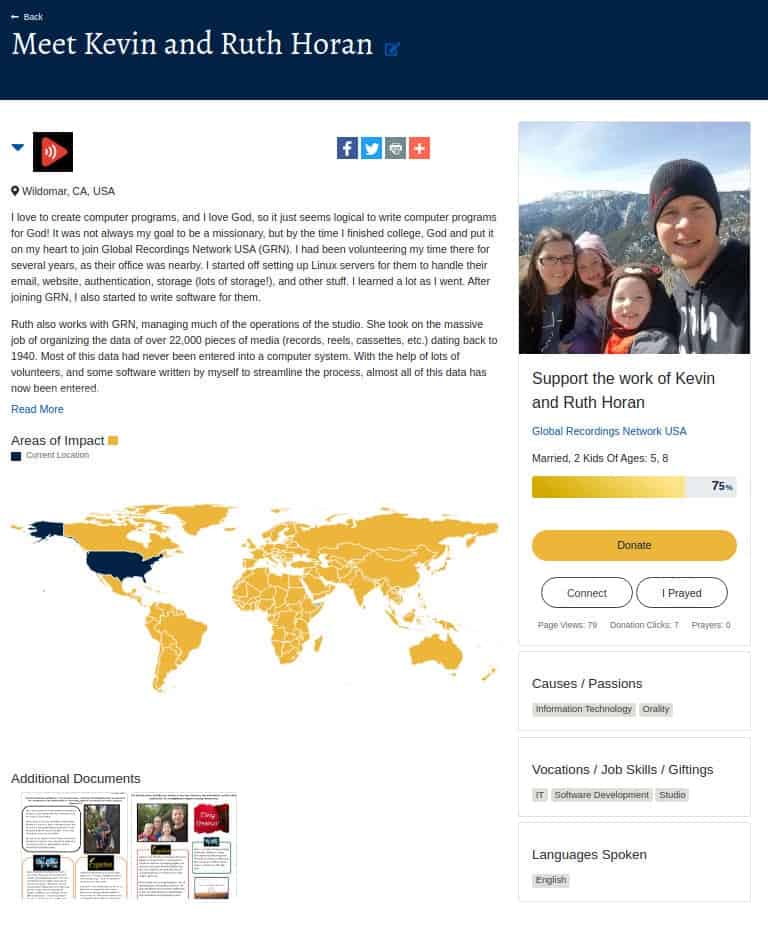
To address these two major challenges, we have created a website and app where missionaries from any organization can describe their ministries in detail in a structured way. Users of the website can then use an extensive set of filters to find missionaries meeting their criteria. We refer to these missionaries as workers, as in the verses Matthew 9:37–38: “Then he said to his disciples, “The harvest is plentiful but the workers are few. Ask the Lord of the harvest, therefore, to send out workers into his harvest field.” The website/app is called Ergatas (ergatas.org), from the Greek word for “workers” in Matthew 9:38.
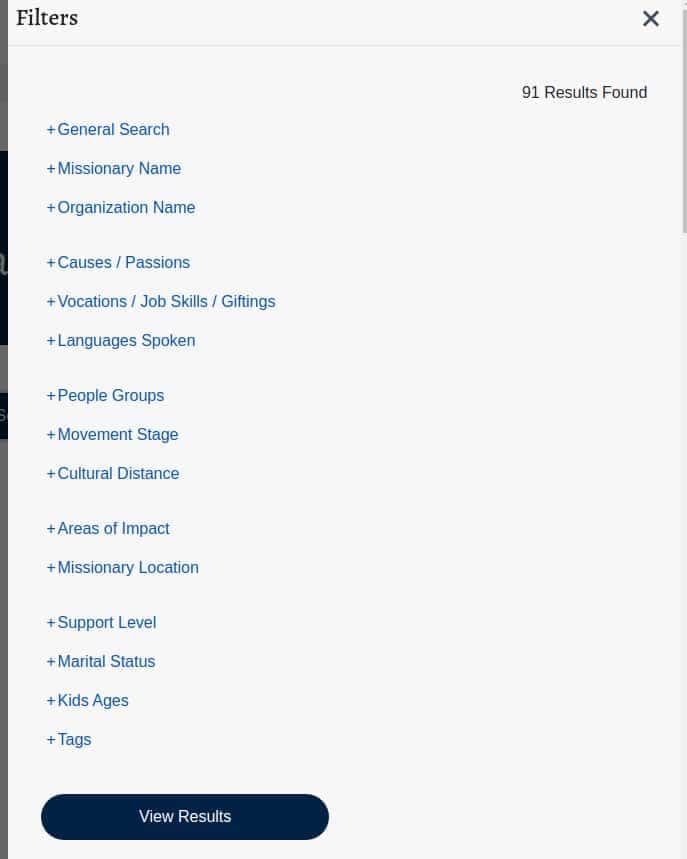
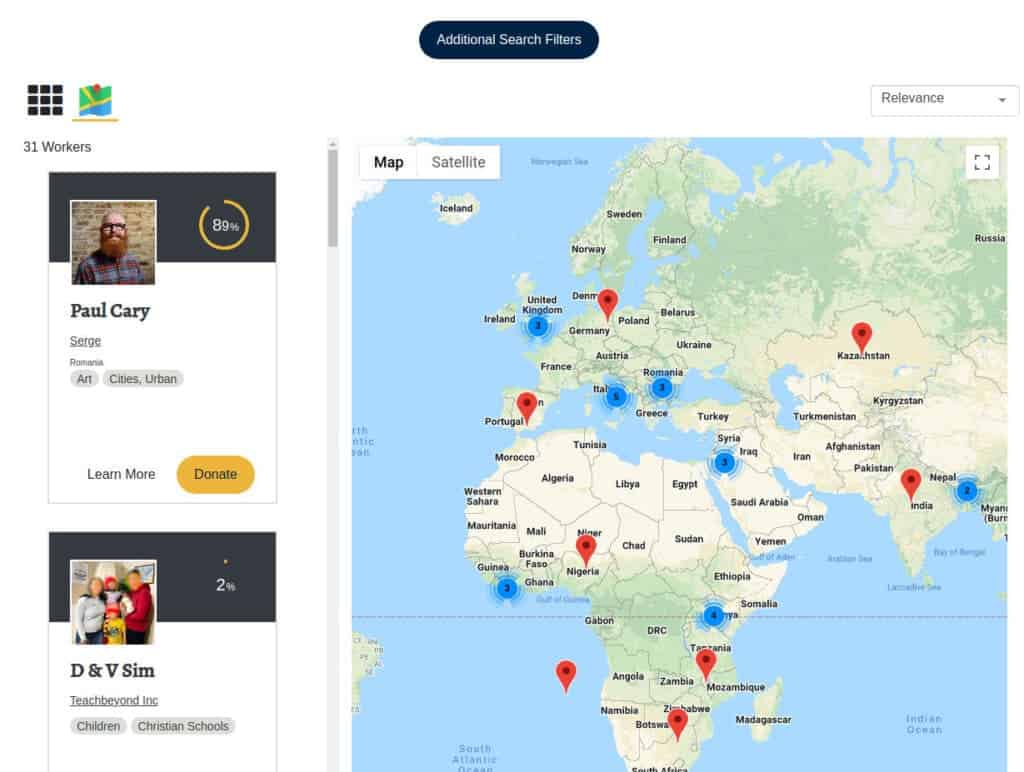
Figure 10.2 – Search by location.
The website allows users to search by attributes such as: location of the worker, areas of the world where their work is making an impact, what people group(s) they are working with, what language(s) they speak, how similar is their own culture to that of the people they are reaching, and many more.
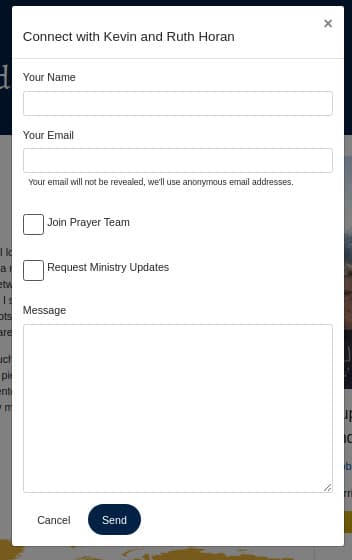
Users can communicate anonymously with a worker using an in-app messaging system that keeps the emails of both sides hidden. Visitors can ask questions and get to know the worker. They can request to sign up for the worker’s newsletter or prayer list and indicate if they have prayed for the worker. We believe a developing relationship is a good pathway to partnership.
If a user does decide to partner financially with the worker, the donate button sends them to the worker’s organization’s website to make the donation. We do not take any fees from the donation. Sending users to the organization’s website also instills confidence that the organization knows who this worker is and is providing accountability for the workers funds.
Benefits
There are many valuable uses for such a service as this. As we have mentioned, this technology is directly aimed at helping strategic partners find workers they can become passionate about partnering with. This technology can also help workers raise their support more quickly by enabling them to engage a wider audience with their ministry and be found by partners that they might never find through their limited relational network. This may be especially valuable for workers being sent out from non-Christian friendly countries.
Beyond these two primary benefits, there are many secondary benefits. Ergatas provides technology that can facilitate workers networking with each other. Two workers from different agencies may be working near each other without ever knowing it. But they may find each other on the map view in Ergatas or by using the search filters. Or a worker might reach out to someone working with a similar people group to gain advice on what methods worked for them. The possibilities are endless.
Ergatas is an agency-independent service that people can be directed to immediately after learning about missions, either from a class or presentation. It is at such times that their interest in missions may be most piqued but often fades if no action is taken quickly. By directing them to Ergatas right away, that piqued interest can be taken advantage of. This could be especially beneficial to mobilization agencies, who often offer the call to go, give or pray after a presentation. It seems likely that many being mobilized will find a deeper connection for prayer or giving by using Ergatas to find a worker who matches their interests in some way.
Another exciting part of the Ergatas platform is linking workers to corresponding Joshua Project pages whenever the worker indicates a people group or language they are working with. Anyone looking at a people or language group on the Joshua Project website can now follow a link from Joshua Project to a page on Ergatas listing workers already engaging with those people or language groups.
Church missions committees can benefit from a tool like Ergatas. While starting off supporting workers from their own church, such committees can use Ergatas to identify additional workers that match the church’s strategic goals.
Christians also benefit from using Ergatas. By finding workers with whom they share a passion or interest with, they will experience a greater sense of connection and feel like they are really part of their ministry. As they start to give financially, they will experience their faith growing as they see God provide for their own financial needs, despite their giving. They will increasingly enjoy the blessings promised in the Bible to cheerful givers.vii We have experienced such things in our own lives as we have grown in our giving. The overall spiritual health of the Church would be greatly improved if more Christians were giving, even if they start off small.
Potential Concerns
It is worth asking what might be learned from previous efforts along similar lines? One of Ergatas’ strategic consultants was directly involved in two prior efforts which attempted to connect donors with missionaries, both around 10 years ago. One started in 2011 and had a much narrower focus, inviting people to make small gifts to missionaries as an encouragement to the missionary, like “buying them a coffee.”viii The other project had a broader scope but because of high monthly expenses was not able to endure long enough to reach critical mass (where enough workers are represented to provide helpful search results to most site visitors).
Neither of these projects had the level of search capability now implemented in Ergatas, making it difficult to find someone with a shared passion and negating much of the benefits of such a service. Without good search capabilities, such a service simply provides a lengthy list of names and faces with little further direction for choosing among them.
Ergatas does not depend on donations or fees and is thus financially stable already. By taking advantage of non-profit benefits offered by many technology companies, and the founder’s technical skills, Ergatas is able to provide its service with minimal monthly expenses and still have plenty of capacity to scale.
One concern with a service like Ergatas could be that prospective missionaries might lean on it as an easy way out of personal support raising among their existing relational communities – just create a profile on Ergatas and sit back and wait for the money to roll in! While that would certainly be nice, we do not anticipate Ergatas contributing more than 10% or so of a worker’s monthly support. It is therefore imperative that workers continue employing other partnership development methods, and we encourage this mindset on the site.ix
Conclusion
Ergatas has the potential to help workers raise their support more quickly and engage more Christians in the Great Commission.
The time is ripe for a service such as Ergatas. While Gen X might be comfortable online and offline, millennials and Gen Z live much of their lives online and are more accustomed to finding what they are looking for online, rather than through a phone call or person-to-person. As donations from older generations decline, it is imperative to employ new methods to engage the next generation where they are, online.

Kevin Horan (kevin.horan@ergatas.org) earned his PhD in computer science in 2011 and then became a supported missionary doing IT work and software development. In 2020 Kevin founded Ergatas.
Possible Pull-Quotes Include (choose no more than 3)
- Finding partners through personal relationships is and always will be a vital method of partnership development and will continue to account for the majority of most missionaries’ partners. But it is not the only available pattern.
- Could be shortened to: Finding partners through personal relationships is and always will be a vital method of partnership development … . But it is not the only available pattern.
- Due to the challenges of finding missionaries based on their goals and roles, strategic partners have been under-engaged and remain a fruitful potential source of new ministry partners.
- Could be shortened to: Due to the challenges of finding missionaries based on their goals and roles, strategic partners have been under-engaged… .
- … this technology is directly aimed at helping strategic partners find workers they can become passionate about partnering with.
EMQ, Volume 59, Issue 3. Copyright © 2023 by Missio Nexus. All rights reserved. Not to be reproduced or copied in any form without written permission from Missio Nexus. Email: EMQ@MissioNexus.org.