EMQ » July–September 2023 » Volume 59 Issue 3
[mepr-show rules=”100329″]
Summary: Missions leaders and practitioners see the need for digital solutions, but they may be overwhelmed by the vast amounts of apps, tools, and strategies. The digital landscape for missions is key for collaboration as many ministries, including those who have built their own tools or platforms, can share their resources to collectively take the gospel to new peoples and places.
By Andrew Feng and Nick Wu
Technology advances so rapidly that many find it difficult to keep up with the latest apps, tools, or strategies. While the COVID-19 global pandemic encouraged many to adapt to digital transformation, after three years, new tech continues to surface. From artificial intelligence to blockchain, new digital resources and strategies are becoming increasingly accessible to society.
The market is saturated with thousands of products and services. At the same time, some missions agencies want to invest in developing their own tools. This can be a time-consuming and costly process. And when they focus on creating Christian versions of big tech tools, ministries can be left with underperforming products. This gets amplified when multiple agencies follow suit or develop the same kinds of products in competition with one another.
The Great Commission is not a solo mission. Taking the gospel to all nations is a collective effort we do together and in partnership with God. In the same way, digital technology in global missions needs collaboration. Collective innovation and discernment ensure it will be used strategically and effectively.
Indigitous (indigitous.org) is a network of digital missionaries who are using technology to catalyze the spread of the gospel where it is not known. Working in collaboration with the Lausanne Movement (lausanne.org), our network has researched the digital landscape, including current and emerging tools and strategies. By sharing what we’ve learned, we hope to help mission leaders and practitioners gain an initial understanding of available resources, consider innovation, and identify potential avenues for collaboration.
Opportunities and Challenges of the Internet Accessibility
The internet has transformed how we consume information and communicate with the world, and it is more accessible than ever. Nearly 65% of the entire world is online, and 68% have access to a mobile device or smartphone.i But internet access is not equal across the globe. Significant numbers of people around the world remain unconnected.
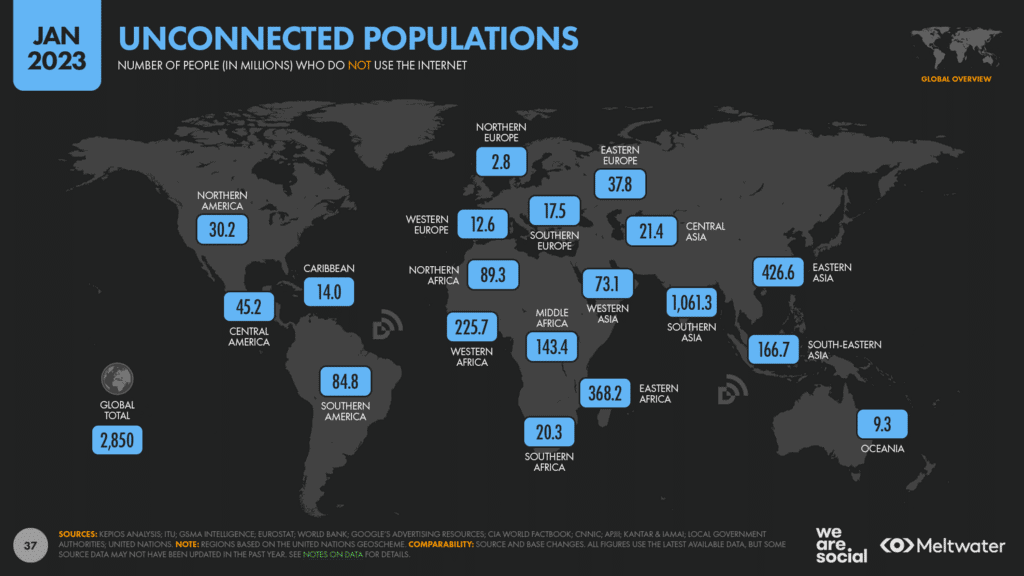
Several developing countries, including some with large unreached people groups, still have large populations of non-internet users. For this reason, internet-based digital strategies to share the gospel with these populations may be challenging right now. At the same time, the number of internet users continues to grow, including among these groups, which increases opportunities for fruitful digital engagement with the gospel.
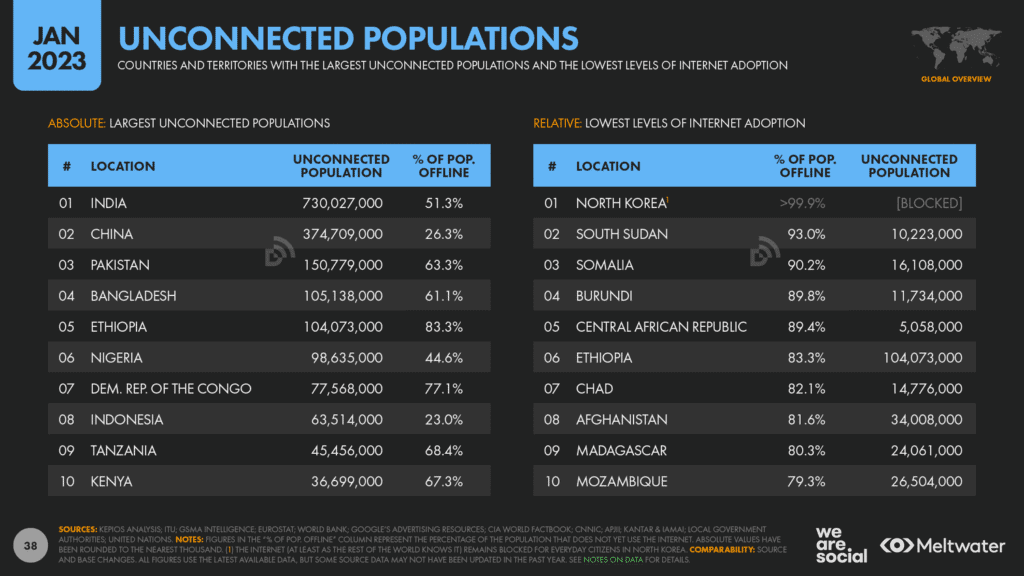
Other groups of people may be online, but the internet may have little to no information in their language. This can correspond with a community not having a Bible translated into their language. This also highlights the importance of people from all cultures and languages working collaboratively in digital technology to help advance the gospel.
Keeping these two significant technical challenges in mind, it is important to remember that single solutions do not work in all cases for all people. A contextualized and personalized approach is necessary to determine the best use case for every technology used for missions.
Digital Outreach and Evangelism
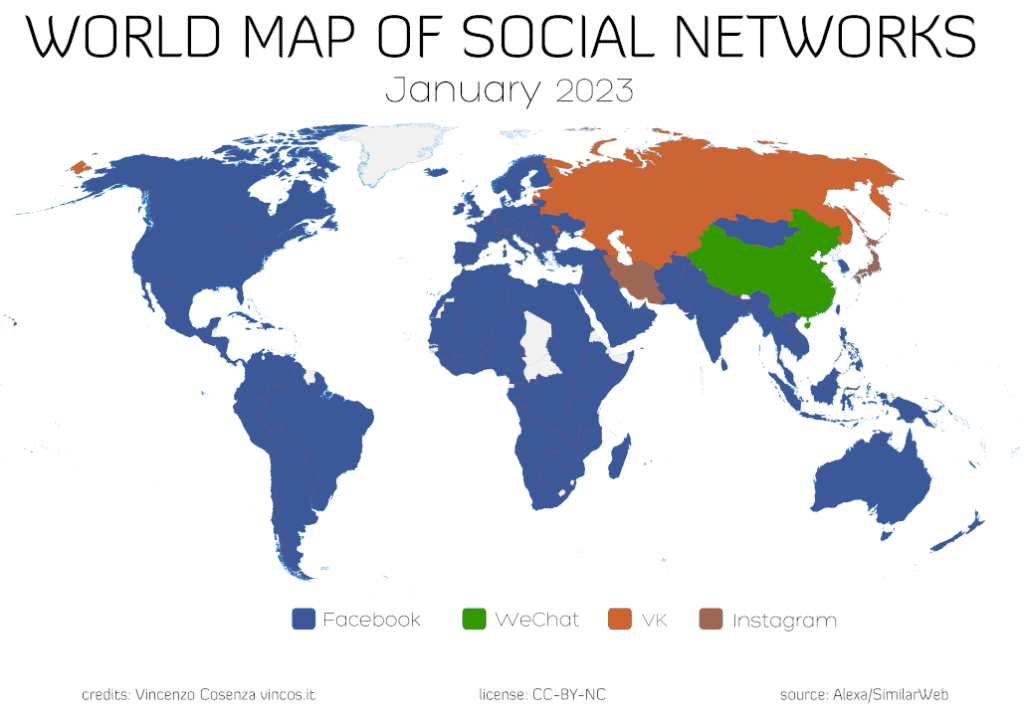
When the internet became mainstream in the mid-1990s, early outreach efforts happened through websites like Bible Gateway and Blue Letter Bible. Three decades later, digital outreach and online evangelism take several shapes and forms, primarily using digital communications tools like messaging apps and social media, to share the gospel either directly or indirectly. Figures 1.3 and 1.4 graphics show the largest social networks and messaging apps by regions of the world.
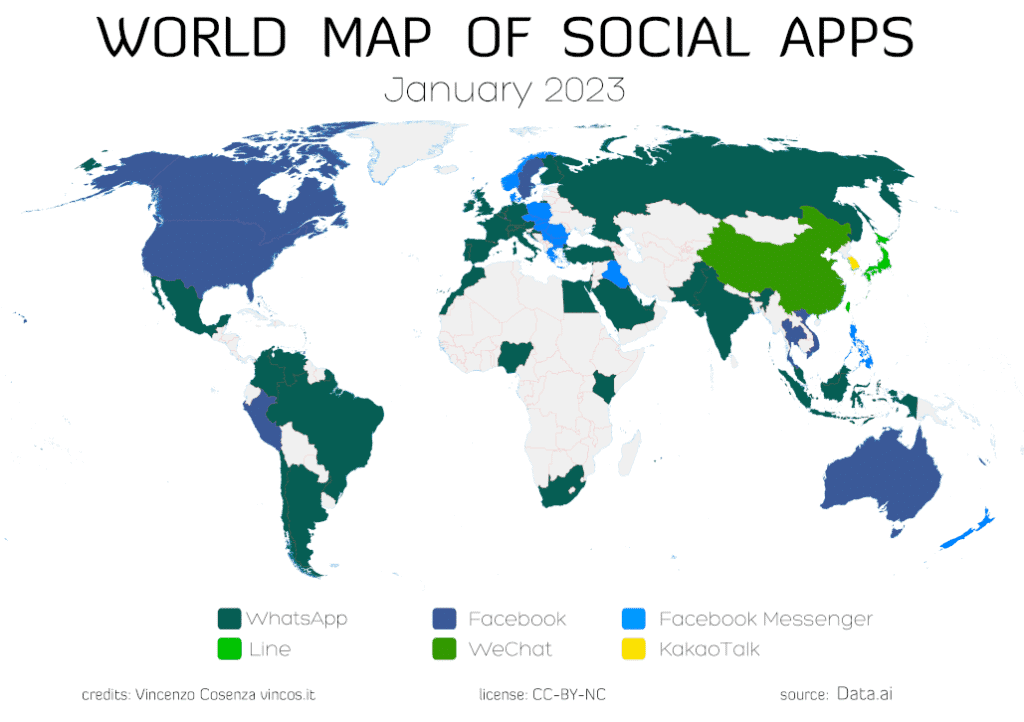
Figure 1.3 – World map of social apps as of January 2023. Source: “World Map of Social Networks,” vincos.it/world-map-of-social-networks/.
For start engagement with non-Christians, some ministries are using advertisements on social media platforms. Ads on Facebook can reach a large audience at various price points depending on the country or target audience.ii Several unreached people groups may prove to be a very cost-effective target for social media ads that eventually leads to gospel conversation, discipleship, access to a Bible, and placement into a local body of believers. Two organizations utilizing digital evangelism via social media ads includes:
- Media to Movements (mediatomovements.org)
- Ekballo University (ekballou.org)
- Dreams About Jesus (dreamsaboutjesus.com)
Digital evangelism also includes the use of smartphones to help facilitate in-person conversation. Such tools package evangelistic guides into an app, which can provide even for users with limited training and basic knowledge. This can help reduce any anxiety with spiritual conversations and bring confidence to the evangelist. Such tools include:
- GodTools: Gospel Conversations by Cru (godtoolsapp.com/en/)
- YesHEIs app by Christian Vision (cvglobal.co/what-is-yesheis)
- Gospel Tracts Worldwide (gospeltractsworldwide.org)
Digital evangelism can lead to digital discipleship which may involve audio and video calls for deeper relationships. In other cases, communication online can lead to offline events and gatherings like meet ups for a local church or Alpha course (alpha.org). Programs like Zume Training (zume.training) provide online training to equip people to do discipleship online and offline.
Prayer
Digital prayer platforms continuously grow in popularity as the global Church joins together to pray for the nations. From online video prayer meetings to prayer apps, people of all different cultures can create online communities and pray together. These communities can communicate the needs of believers, both on the field and to supporters, as well as praying for new believers to hear the gospel.
Key networks facilitating online prayer include:
- The Global Prayer Resource Network (globalprn.com)
- International Prayer Connect (IPC, ipcprayer.org)
- World Prayer Assembly (worldprayerassembly.org)
- International House of Prayer (IHOP, ihopkc.org)
- Pray4 Networks (pray4movement.org/pray4-network/)
- 24-7 Prayer (24-7prayer.com)
- Joshua Projects’ Unreached of the Day Prayer App (joshuaproject.net/pray/unreachedoftheday/app)
Digital resources and data are used to inform prayer points of all kinds, but especially about unreached peoples. Data and research, current events, and ministry updates given through online sources offer guidance for prayer. Updating information and resources for prayer is not to be done alone, but crucial for a community or network to share with each other.
Additionally, digital prayer rooms and virtual prayer walks bring new forms of prayer for locations where one is not physically present. However, these examples are not to replace in-person gatherings, but to encourage additional connections and collaboration to prayer.
Artificial Intelligence
Artificial intelligence (AI) is the use of data by computers to make recommendations and decisions. AI is growing in popularity. Common tools include ChatGPT and AI art generators that can turn several words into fully rendered art within seconds. Debate continues on the ethics of AI applications, but it can be an effective tool when used properly.
AI has become a powerful tool in missions especially in Bible translation. Even though the Bible is often the first text to be translated into a new language, many people groups still do not have the Bible in their own language. And as languages evolve, Bible translations need to be updated.
Ministries involved in Bible translation are now using AI to help with large data sets on multiple languages to help produce more accurate models of translation. They often use machine learning and natural language processing. As more translators and AI practitioners work together, the technology and its applications grows. Several organizations involved in doing this include:
- Avodah (avodah.com)
- Cherith Analytics (cherith.io)
- Clear.Bible (clear.bible)
- Christian Vision (cvglobal.co)
- SIL (sil.org)
- Organizations in the Wycliffe Global Alliance (wycliffe.net)
AI is also being used to produce Bible translations and content for the Deaf. One software program used by SIL, Deaf Bible Society, Deaf Mission, and Pioneer Bible Translators is called Chameleon, which uses AI and motion capture technology for sign language Bible translations.iii Videos and content for the Deaf can then be used to communicate the Bible in multiple sign languages and with greater efficiency and accuracy.
While AI offers invaluable help for Bible translation, it also offers a wide variety of other applications that can help anyone. Missions workers struggling with workloads can take advantage of time and resource saving AI tools that can help with text, presentations, graphics, and even art. AI’s place in missions will continue to grow with new opportunities in the near future.
Blockchain
Blockchain technology gained popularity with the widespread growth of cryptocurrencies. Cryptocurrency remains volatile, unstable, and investment continues to be unadvisable. But blockchain is a tool that leaders and practitioners need to explore for opportunities to expand gospel reach.
A blockchain, or a digital ledger with immutable data, is pieces of information that are often recorded on a decentralized network. Digital ledgers can bring transparency to how churches, missions, and charitable finances are managed.
Decentralized blockchain technology also offers an alternative for field workers with limited access to traditional income in the region where they serve. This is where a digital ledger can send donations discreetly and securely in a more reliable manner.
Blockchain can also be used for storage and distribution of information, including Scripture content, translations, and resources. This may help creative access nations to receive the Bible.
Specific Christian-lead blockchain efforts are still relatively new, including:
- Engiven (engiven.com)
- HeartChurch (heart-church.org)
- Mission DAO (themissiondao.com)
Networks
Networks focused on missions and technology are key to Great Commission collaboration. Leaders and practitioners join these networks to find like-minded people, establish trust, and accelerate each other’s ministries. More can be done together than alone. They may concentrate on a specific area of technology or encourage collaboration around technological strategies for global missions. These in-person and online networks include:
- Coalition of the Willing (COTW, cotw.global)
- EMDC (emdc.online)
- Ergatas (ergatas.org)
- FaithTech (faithtech.com)
- Finishing the Task (FTT, finishingthetask.com)
- Global Alliance for Church Multiplication (GACX, gacx.io)
- Indigitous (indigitous.org)
- Linking Global Voices (LGV, linkingglobalvoices.com)
- Zume (zume.vision)
Among these networks, practitioners can share data and activity as a community in real-time, either using social media or their own platforms. It is encouraging to know where people are and the resources available out there in an inter-connected network.
Conclusion
Technology, powered by innovation and collaboration, is crucial for the future of missions. Remaining informed about the digital landscape enables leaders to find the resources, strategies, and tools that best match their goals and strategies. When technological resources are stewarded well for God’s kingdom, we can see our efforts in evangelism, discipleship and ultimately, church planting, grow in quality and quantity.
To learn more, read the Indigitous report, The State of Digital Technologies for the Great Commission: https://ndgt.us/digitalreport.

Andrew Feng (andrew@indigitous.org) serves as the US director for Indigitous which engages young leaders to use their giftedness beyond the four church walls. Andrew and his wife served abroad for five years where they adopted their special needs son. Andrew has a heart for the younger generation and continues to mentor them under Indigitous. Andrew holds a ThM and is a Fellow at Dallas Theological Seminary. Prior to ministry, Andrew graduated from the University of Southern California, interned at Yahoo, and consulted for KPMG.

Nick Wu (nick@indigitous.org) serves with Indigitous US as the cohort lead and content producer. He helps lead young adults and students in digital missions projects. He also has a passion for telling stories for the missions world through videos. He is currently an MA student at Dallas Theological Seminary.
[1] Simon Kemp, “Digital 2023: Global Overview Report,” Datareportal, January 26, 2023, accessed April 2, 2023, https://datareportal.com/reports/digital-2023-global-overview-report.
[1] Michelle Martin, “How Much Do Facebook Ads Cost? (2023 Benchmarks),” Hootsuite Blog, May 16, 2022, https://blog.hootsuite.com/facebook-ads-cost/.
[1] Deb Fox, “Chameleon: Changing the Future of Deaf Bible Translation,” Wycliffe Today Spring Edition 2020, Wycliffe Bible Translators Australia, https://wycliffe.org.au/chameleon-changing-the-future-of-deaf-bible-translation/.
EMQ, Volume 59, Issue 3. Copyright © 2023 by Missio Nexus. All rights reserved. Not to be reproduced or copied in any form without written permission from Missio Nexus. Email: EMQ@MissioNexus.org.