EMQ » April–June 2023 » Volume 59 Issue 2
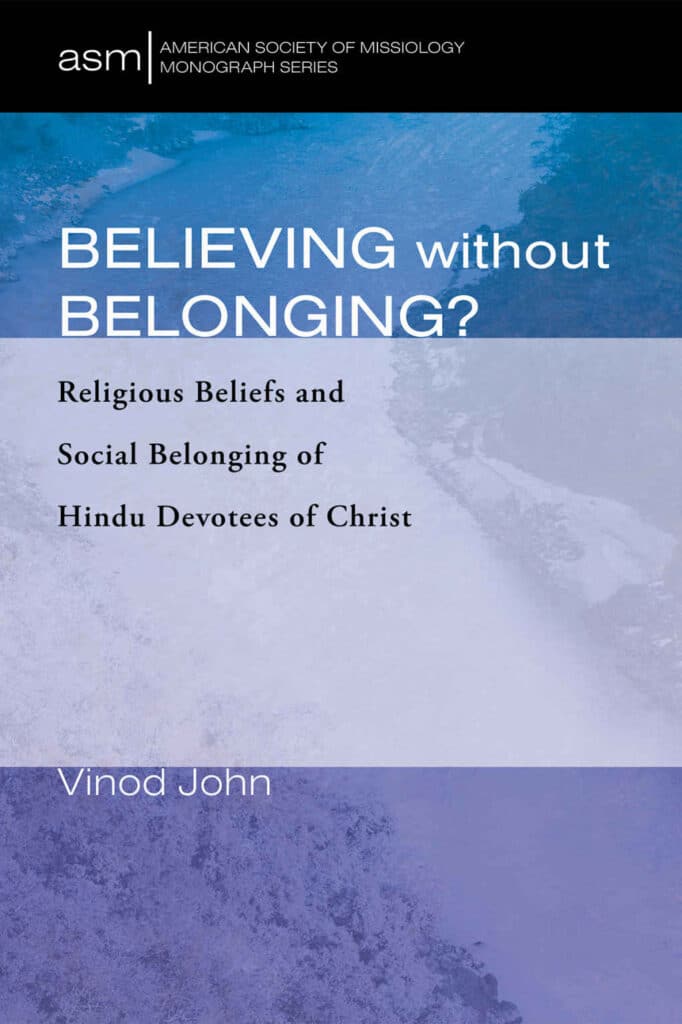
Believing Without Belonging? Religious Beliefs and Social Belonging of Hindu Devotees of Christ*
By Vinod John
American Society of Missiology Monograph Series
Pickwick Publications, 2020
250 pages
US$39.00
*As an Amazon Associate Missio Nexus earns from qualifying purchases.
Reviewed by Anish Puthusseril Joseph who has served as an assistant professor of biblical studies in India and is currently a PhD student in intercultural studies at Fuller Theological Seminary.
In Believing Without Belonging? Religious Beliefs and Social Belonging of Hindu Devotees of Christ, Vinod John, an Asian missiologist, examines what believing without belonging means “in the context of caste Hindu devotees of Jesus in North India” (2) who have no interest in connecting with the local or global ecclesial establishment intentionally. Key questions that the book addresses include “When such Hindus believe in Jesus, why don’t they identify as Christians or with the global Christian church?”, “Why do they not join an institutional church?” and “How does becoming a devotee of Jesus affect the self-identity of such a Hindu?”.
Examining the issue of belonging through baptism from a cultural anthropological perspective (chapter 5), John proposes a Guru-Diksha, a new believers’ initiation, as a contextual baptismal ceremony leading into discipleship. Looking at religious identity (chapter 6) from the perspective of world Christianity, John proposes that Hindus maintain their Hindu identity with Christ as their ishta (preferred deity) to affirm the devotee’s self-identity.
After the introduction in chapter 1, and an in-depth analysis of the responses to the gospel in the sociocultural context of North India in chapter 2, John concludes that “most caste Hindu followers of Christ are not content with the institutional church as they have experienced it and persist within their Hindu community” (68). Chapter 3, through descriptive contextual analysis, provides the necessary backdrop “of the beliefs of the Hindu devotees of Christ as an indigenous phenomenon conditioned by socioreligious realities rather than as a conversion movement toward Christian religion” in the city of Varanasi (95).
Through a qualitative ethnographic case study, chapter 4 describes, categorizes, and analyses the religious beliefs and belonging of Hindu devotees of Christ in Varanasi. The next three chapters discuss missiological issues that emerged out of these studies: baptism, socio-religious identity, and ecclesiology.
John pushes back against Tennent’s and others’ appeal for some normative ecclesiology in line with historical ecclesiology (194). Drawing from Roger Haight, he argues that even the historical church has not been immutable but instead adapted to its socio-cultural contexts (195) and appeals to be open “to the God-given creativity and dynamic move of the Holy Spirit” in a pluralistic context with pluriform imagination of ecclesiology (196).
John utilizes Lamin Sanneh’s concepts of translatability of the gospel and the distinction between global and world Christianity effectively to propose an appeal for pluriformity of ecclesiology in his work (37, 198). I appreciate his tracing Christian mission to before the British to Akbar’s time and works by a German Roman Catholic military adventurer Walter Reinhardt Sombre (or Samru) who managed to establish a tiny principality in 1773, Sardhana, a town near Meerut in Uttar Pradesh.
His effective engagement with Indian scholars (such as Devanandan, M. M. Thomas, Dayanand Bharati, John Sunderaj, and Jayraj Dasan) and prominent Western scholars of Indian Christian theology (such as Boyd, Newbigin, Hiebert, Webster, and Hoefer) is praiseworthy. Those interested in imagining a relevant pluriform ecclesiology and emerging churches in any context will find this seminal ethnographic study well-grounded in historical, theological, and missiological perspectives helpful.
For Further Reading
Churchless Christianity, by Herbert E. Hoefer (William Carey Library, 2001)
Christianity in South and Central Asia, Edinburgh Companions to Global Christianity, edited by Kenneth R Ross, Daniel Jeyaraj, and Todd M Johnson (Edinburgh University Press, 2019)
EMQ, Volume 59, Issue 2. Copyright © 2023 by Missio Nexus. All rights reserved. Not to be reproduced or copied in any form without written permission from Missio Nexus. Email: EMQ@MissioNexus.org.