EMQ » April–June 2023 » Volume 59 Issue 2
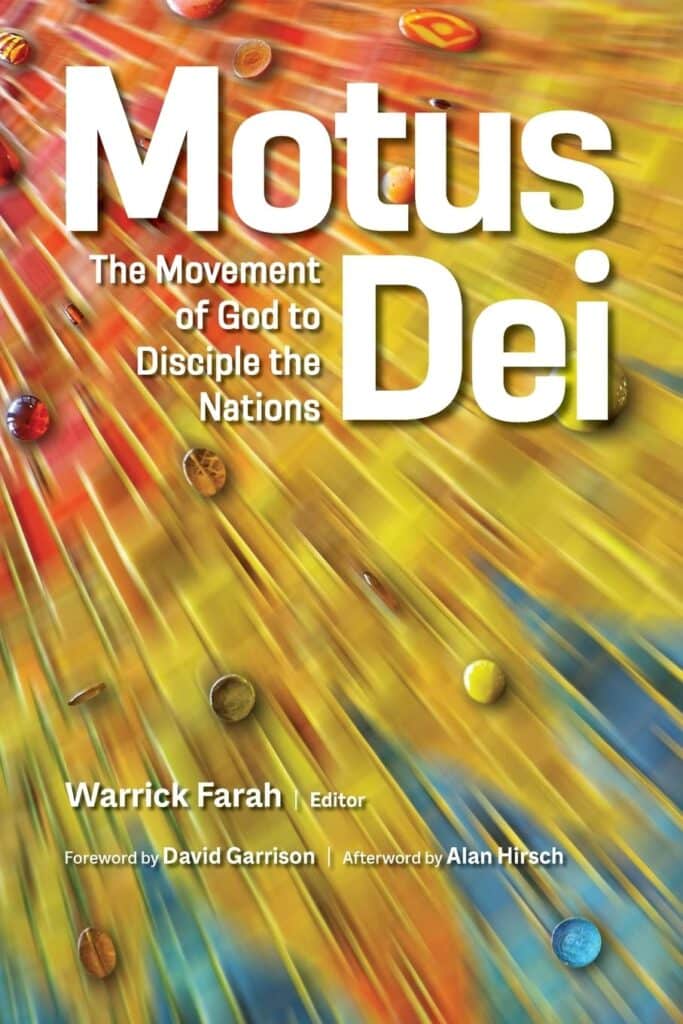
Motus Dei: The Movement of God to Disciple the Nations*
Edited by Warrick Farah
William Carey Publishing, 2021
352 pages
US$26.99
*As an Amazon Associate Missio Nexus earns from qualifying purchases.
Reviewed by Karry Kelley (PhD), a church planter with World Team who, together with his wife Charlyn, train church planting teams.
Motus Dei (movement of God in Latin) is a useful introduction to church planting movements (CPMs) and disciple-making movements (DMMs). Editor Warrick Farah and the other missiologists who contributed chapters aim to answer the question “What factors are contributing to the increase of discipleship movements in the world today?” (xv). The book explains the theological and theoretical underpinnings of CPMs, then goes on to describe their practical outworking. There also are abundant examples and recommended applications.
Early in the book, the authors address what they call “significant theological and missiological objections” (37) that have arisen against CPMs. Chapter three, “Addressing Theological and Missiological Objections to CPM/DMM,” is a refreshingly candid response to these objections. Dave Coles answers each of the eight objections with well-reasoned reflections on Scripture. This chapter alone is worth the price of the book.
The succeeding parts of the book (each consisting of multiple chapters) explain and define movements, outline a biblical theology of movements, explore the dynamics of movements, present examples of movements, and finally, describe movement leadership and possible next steps for research and practice.
One valuable highlight is chapter seven by Craig Ott’s on CPMs and the book of Acts. After warning against proof-texting when studying Acts, he describes how the CPMs we see happening in the world today are “consistent with the trajectory and theology of what we find in Acts” (94). He analyzes the accounts in Acts of the founding of churches in Jerusalem, Judea, and the surrounding region, Pisidian Antioch, and Ephesus. Ott then carefully highlights seven biblical dynamics of CPMs evidenced in Acts. While there is no example in Acts of a CPM by today’s definition, the principles in Acts are consistent with what we see in today’s CPMs.
Ott points out that Acts ends without a conclusion. The action just seems to stop in mid-stride. Luke’s “‘rhetoric of silence’ prompts the reader to enter the story and continue the ongoing mission of bringing the gospel to the ends of the earth” (110).
Ott skillfully preserves for the reader the incomplete narrative: The missional story of the book of Acts must be continued. For that reason, Motus Dei the book is presented as a first step in motus Dei the movement. The ultimate aim of the book is to mobilize Christians in a global learning community of reflective practitioners: “We envision a participatory, multiyear conversation – in which you are invited to take part” (10). Motusdei.network is a place to get connected.
For Further Reading
Ephesiology: A Study of the Ephesian Movement, by Michael T. Cooper (William Carey Publishing, 2020)
The Church on Mission: A Biblical Vision for Transformation Among All People, by Craig Ott (Baker, 2019)
EMQ, Volume 59, Issue 2. Copyright © 2023 by Missio Nexus. All rights reserved. Not to be reproduced or copied in any form without written permission from Missio Nexus. Email: EMQ@MissioNexus.org.