EMQ » April–June 2023 » Volume 59 Issue 2
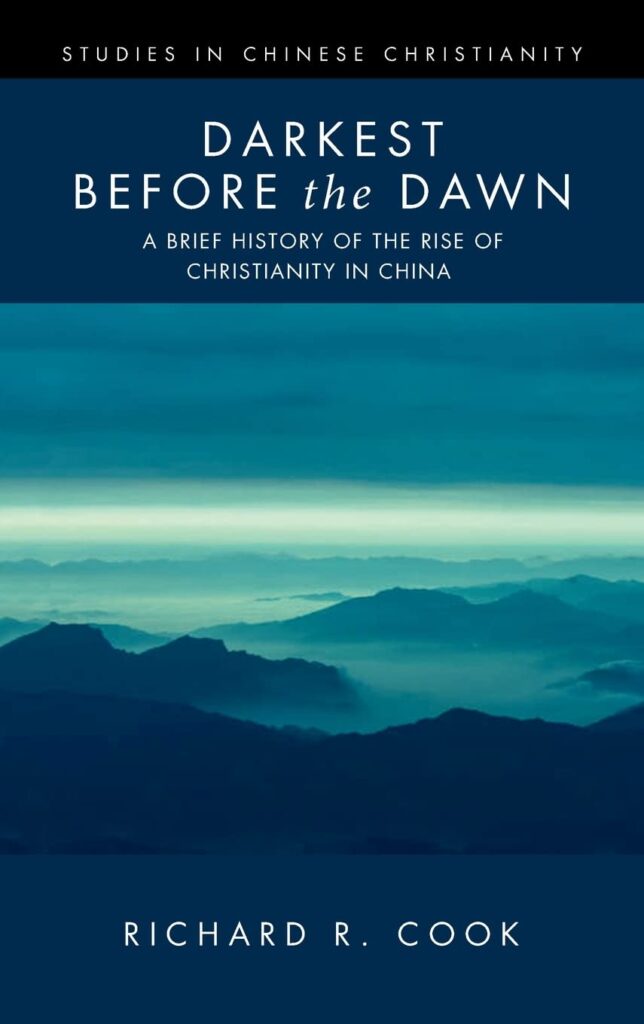
Darkest Before the Dawn: A Brief History of the Rise of Christianity in China*
By Richard R. Cook
Studies in Chinese Christianity Series
Pickwick, 2021
230 pages
US$28.00
*As an Amazon Associate Missio Nexus earns from qualifying purchases.
Reviewed by Gene Wilson, church planting catalyst with ReachGlobal who has traveled and taught in many parts of China over the last decade. He is the co-author of Global Church Planting—Biblical Principles and Best Practices for Multiplication (Baker Academic 2011) and author of Emerging Gospel Movements —The Role of Catalysts (Wipf and Stock 2021).
Richard Cook brings us a thorough, balanced, and inviting history of the Church in China based on four decades of firsthand experience and research. He traces the history of the Church there, going back to the first known believer reached by Nestorians. The book has four sections:
- Nestorians to Robert Morrison (635–1807)
- Morrison and Colonial Missions (1807–1900)
- The Rise of an Independent Chinese Church (1900–1949)
- Indigenous Church Growth (1949–Present).
He concludes with the question, “What next for the Chinese churches?”
Cook tells the amazing story of the church’s birth, move inland with Hudson Taylor, survival during the Boxer Rebellion and Cultural Revolution, and surprising growth in the shadow of the State. He wrestles with missiological issues like syncretism (Jesuit period), the use of missionary compounds and social institutions (Protestant missions), and the patriarchal attitudes which contributed to the Boxer Rebellion.
The unique value of the book is in its objectivity, comprehensiveness, and its relevance. It describes today’s church in light of its history and socio-political setting and brings us right into the twenty-first century. Given that the church was born in struggle and suffering, its spiritual vitality and explosive growth are all the more amazing.
It is written as a textbook with inserted field notes and reflection questions. There is a treasure trove of recommended reading at the end of each chapter. The field notes are a mixed blessing – they add didactic value but interrupt the flow of the narrative. Although Cook is a foreigner, he personalizes the narrative by highlighting the experience of Chinese church leaders like Wang Mingdao, which helps us see events through indigenous eyes.
Cook predicts that “global missions might be the future of the Chinese churches” (203). Indeed, Chinese missionaries, sent out primarily by the underground church, are having an impact, even though such activities are poorly supported, illegal, and risky. The Back to Jerusalem Movement – rooted in the notion that Chinese missionaries would complete the Great Commission – is part of this emerging missionary movement. More could be said about the impact of Chinese grassroots church planting movements and the progress of missionary sending by the Chinese Church. The suggested reading below addresses those gaps.
Since publication, government surveillance has increased, and visiting Bible teachers have been expelled. Many western missionaries with student or social work visas have left. CCTV cameras are being installed outside urban churches and some that refuse to comply are closed. Religious content on WeChat and other platforms is being monitored. Through all of this, the Church remains faithful to the gospel and vocal in its witness. Christ continues to build his Church.
For Further Reading
Training for Trainers: The Movement that Changed the World, by Grace Kai and Ying Kai, (WIGTake, 2018)
China’s Ambassadors of Christ to the Nations: A Groundbreaking Survey, byTabor Laughlin (Pickwick, 2020)
EMQ, Volume 59, Issue 2. Copyright © 2023 by Missio Nexus. All rights reserved. Not to be reproduced or copied in any form without written permission from Missio Nexus. Email: EMQ@MissioNexus.org.