EMQ » April–June 2023 » Volume 59 Issue 2

Summary: Being fully human comes with a mission to care for creation as God originally intended. Asian Journeys Ltd is a social enterprise that engages young people in Asia in environmental mission and creation care projects. Young people learn the compassion of the good Samaritan and the strategies from the parable of the sower. They become caring empathic volunteers equipped to help communities directly impacted by environmental degradation.
By Lawrence Ko
In 1998, I attended a Southeast Asia regional environmental seminar in Yangon, Myanmar. I encountered the urban poor in the new village of Laing Thyar, and learnt how my regional counterparts addressed challenging environmental issues with simple yet bold solutions.
A Cambodian delegate shared about a campaign initiated by Buddhist monks to give people in rural areas saplings to plant. The communities happily obliged. The actions of these Buddhist monks spoke louder than words, and their example enlarged my view of what Christian missions could look like.
Asians emphasize harmonious relationships in the universe, but true harmony is only found when we seek transcendence. Chinese culture recognizes that people must be reconciled with God (Heaven), then with themselves, and then with other selves (including nature). We affirm this in our biblical tradition which includes the Buberian I-Thou relations.[1] This means we relate with others respectfully as subjects rather than as objects.
NT Wright reminds us that being fully and gloriously human comes with a mission to care for creation as God originally intended.[2] When people participate in caring for God’s earth, a nurturing community develops that enables them to relate with other human beings, other created living things, and the non-living parts of our world with respect and care.
These reflections led me to study experiential learning pedagogy and begin mobilising university students for overseas community projects in China. In 2002, I founded Asian Journeys Ltd (AJ, asianjourneys.org) as a social enterprise to engage young people in Asia in environmental mission and creation care projects. In that first project in 2002, students engaged in a river conservation and water treatment project in Shanghai, China.
Sowing Seeds
AJ organizes student volunteers into teams of about 25 who work together for six months. Each team studies the challenges of Asian environmentalism, the global climate crisis, and mitigation strategies. The eight sessions of interactive team training include team building skills, conflict management skills, cross-cultural competencies, and research on Asian urbanization and regional development. Young people learn the compassion of the good Samaritan and the strategies from the parable of the sower to become caring empathic volunteers.
Crafted as an experiential learning journey, student volunteers learn about culture and nature. When they visit communities, they see with their own eyes how the loss of natural habitat directly impacts a community’s way of life, and hence their traditional culture. They also witness the main beneficiaries of environmental mission – the poor and environmental refugees. They see how homes and livelihoods are destroyed by environmental degradation and disasters.
Through this journey, we sow seeds in our volunteers’ character and moral formation. Students come from different ethnicities and faiths, but in the journey of sharing lives in community, they learn to self-discover, self-disclose, and self-develop. They develop the courage to be human, vulnerable, and to reach out. They dare to dream, set goals, and pursue them. Indeed, they dare to expect and attempt great things … with hope. Several have gone on to win the National Youth Achievement Awards (Gold),[3] a great accomplishment for young people in Singapore.
Can the Desert be Green?
The success of the first student environmental mission trip I led in Shanghai in 2002, resulted in local leaders inviting me to explore the central government’s initiative to green the desert of Inner Mongolia. In the fall of 2002, two local county mayors in Inner Mongolia invited me to visit. AJ agreed to participate with them in a reforestation project to combat desertification, and launched the Green Desert Project in 2003 to do it.
The Green Desert Project is AJ’s flagship programme. It helps young people in Asia discover and recover Asian resources and develop partnerships in addressing environmental challenges. This project was conceived as a vision of putting faith into action. It mobilises young people in Asia for greening urban settings and the desert wastelands in Inner Mongolia.
Thus through the Green Desert Project, Christians in Asia raise a prophetic voice and the eschatological vision of redeeming wastelands and restoring community. It is a signal of transcendence which points to a way emerging in the wilderness where streams can flow once again in the dry arid lands, and the desert can become green (Isaiah 35, 43).
The Green Desert Project’s first team comprised students from Singapore Polytechnic who focused on urban environmentalism in Beijing in 2007. We partnered with Beijing Jiaotong University’s Eco-Family student club in a 2-week campaign in the city. The students from Singapore and Beijing collaborated to plant 50 trees in one district in the city.
For decades, every spring Beijing residents regularly contended with yellow dragons – severe sandstorms caused by sands from the Gobi desert. They rained down sandy deposits in the city, filling hair and nostrils with irritable sand particles.
These sandstorms don’t only affect Beijing. Communities in northern China, Korean and Japan also experience the impact. Hence the project’s goal was to plant a green wall of forest across Inner Mongolian desert to help stem the tide of desertification and reduce these sandstorms and the air pollution they cause. The project tagline was, “Plant an acre of desert in Inner Mongolia, and restore an azure sky in Beijing City!”
Two years later, we organized a team of 17 environmental science graduate students along with the dean and two lecturers from the Singapore University of Social Studies. The team used their knowledge and skill to help the Green Desert Project acquire the know-how to plant trees in dry arid environments. To adequately address this desertification challenge, we learnt how to integrate the social, economic, and civic needs of the community and concerns of the government.
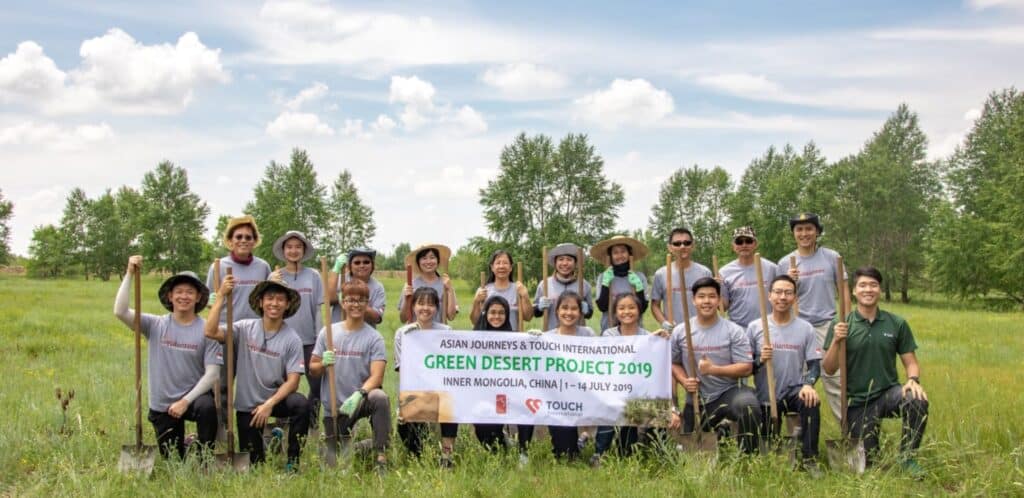
The Green Desert Project has since sent more than 30 teams of young Singaporean volunteers from universities, polytechnics, and the institutes of technical education (ITE). By the end of 2019, over a thousand young people had helped plant 30,000 trees in Inner Mongolia at the AJ tree-planting base.
Can the desert be green? Yes! We witnessed desertification stop and land being redeemed and restored. The project affirms the importance of forests and vegetation as carbon sinks and natural air filters. Our student volunteers learned to appreciate trees as perpetually life-giving, just like our parents, teachers, mentors, and, of course, our Creator God.
At the 2019 Green Desert Forum organised by the Duolun government in appreciation of the 10 years of partnership with AJ, we presented to the local government a Chinese calligraphy scroll inscribed with 2 lines: “A decade of planting trees; a century of sculpting souls.”
A sense of transcendence is signified as we affirm the deeper sense of hope beyond the activity of tree-planting. We pray that those we worked alongside will be like young saplings planted with love and nourished with care. Rooted firmly in hope, we hope they will be ready to sprout forth with branches and blossoms in time. We look forward to the day when they will be fruitful and multiply, scattering lasting legacies of a new anthropology, as new beings in Christ.[4]
From the Desert to the City
The Green Desert Project does not stop at reforesting desertified grasslands. Asia has been experiencing rapid urbanization with rural-urban migration at its height along with transnational migration. In many cities, we easily find hundreds of ethnicities if not nationalities. In a global city such as Singapore, we can experience diversity of culture in the cosmopolitan urbanism, with cultural expressions and ethnic rhythms rooted in diaspora communities.[5]
Through AJ environmental projects, young people learn about the human causes of the climate crisis, and how to live sustainably in urban settings. Though restorative action and conservation in the wilderness are important, living a green lifestyle in the cities is imperative as cities are merely 2% of the earth’s surface area but consume 70% of the energy and contribute significantly to pollution and waste generation.
Hence from 2010, AJ also started developing urban environmental projects with the Iban people who live in the Malaysian state of Sarawak on the northwestern coast of the island of Borneo. We also worked among the Karen people who live in the mountains of Chiang Mai, in northern Thailand. In Jakarta, the capital city of Indonesia, we also explored a community health project to reach Kampong Melayu – an informal settlement in Jakarta that comprises of thousands of urban poor living in informal dwellings by the main river in the city.
In 2014, AJ launched a Global Awareness Project for young people that brought young creative directors and videographers to study and document urban environment issues in the cities of Asia. From Shanghai to Dujiangyan city in China and Metro Manila in the Philippines (MMP), we created video clips studying the problems faced by urban poor, living in the ubiquitous slums within the city.
In 2017, we partnered the Nanyang Academy of Fine Arts (NAFA) in Singapore to bring arts students to Manila to study urban community and culture. The teams visited the official home of president of the Philippines (Malacanang Palace). They met with presidential attorneys to learn about strategies to address urban environmental issues in the city. They also met transformational urban leaders from MMP working in informal settlements to break the poverty cycle, create livelihood opportunities for the unemployed, and provide early childhood education for the children.
Immersed in the community with urban poor families, the AJ volunteers organised programmes for the children who would otherwise join their parents scavenging in dump sites near the slums. Young people experienced sweat equity first hand as they participated with a local NGO – Gawad Kalinga – in their programme of building inexpensive homes for the urban poor.[6] They joined local slum residents in transporting bricks and mixing cement in the building process.
Creation Care in Urban Settings
In 2007, the Green Desert Club was launched in Singapore to engage young people in schools in environmental mission. From 2011, the club organised the Youth Environmental Stewardship (YES) forum. It became an annual event for youth organised by youth volunteers to sound the cry for climate action.
In one workshop, participants learnt to creatively convert discarded T-shirts into tote-bags at workshops. “Plant a terrarium, today; plant a tree, tomorrow,” was a tagline of another popular workshop which sought to mobilise participation in the Green Desert Project and challenge the wasteful urban consumptive lifestyle.
We organized Green Urban Youth (GUY) forums starting in 2016 for our youth volunteers to share their reflections on the urban issues. Arts students, especially from NAFA, also creatively advocated for a green urban lifestyle by using visual arts, music, dance, and drama.
A short play, written by a Chinese playwright Kuo Paokun, featured a performer dressed as a tree that looked very similar to a crucifix. It became a powerful image for the connecting points between Earth Day and Easter (which happened to be in the same week that year).
Stewardship and Priesthood in Creation Care
In 2015, I was invited to participate in the Bible and Environment forum in Shanghai organised under the auspices of Shanghai academy of social sciences and United Bible Society. I shared the vision and programme of the Green Desert Project based on my newly published book in 2014 entitled Can the Desert Be Green? Planting Hope in the Wilderness.[7]This practitioner’s reflection on creation care and cultural anthropology in Asia comes from my perspective as an Asian Christian.
In 2018, I was invited by Ethos Institute, a Christian think-tank in Singapore, to write a book as a resource for churches for Christian engagement in climate action in Singapore. It was published in January 2020. In the book, From the Desert to the City: Christians in Creation Care,[8] I outlined the theology (especially the eschatology) needed for a hopeful and adequate Christian response to the climate crisis. A recovery of a theocentric worldview is imperative (as opposed to an anthropocentric one) for God’s kingdom vision and values to come to the surface.
Our sense of identity as environmental stewards and priests of creation is needed to creatively and meaningfully respond to our creation mandate. The book also emphasises a Christian spirituality as part of our faith formation to live sustainably and adequately care for God’s creation. It is a call to Christian discipleship that seeks the kingdom of God and his righteousness in all aspects of life. It points to the shalom vision of God’s kingdom in which we will see his creation flourish for his glory.
Planting Hope
Jurgen Moltmann, the theologian of hope,[9] calls us to see eschatology as key to a proper appreciation of theology and thus creation missiology. The exciting eschatological vision of hope empowers us to live in the presence of God and to have the courage to be as Paul Tillich asserts. Only then will we dare expect and attempt great things for God, as William Carey did. Driven by the vision of hope and the transformed future in Christ, we can make the leap of faith to pursue the passion for the possible.
AJ’s teams of student volunteers have served many communities through environmental mission. Community leaders often enquired with AJ’s leaders about our motivation for environmental activism. We told them, “We serve because this is our Father’s world. We care because God cares for his creation.”
A Chinese adage says that learning to be more human precedes learning to be more effective at work. Through serving the local host communities in our projects, our AJ student volunteers have learnt more about themselves, learnt how to appreciate nature and diverse cultures, and learnt to be more human.
Together we learnt to discover and recover our humanity as we seek to live simply and in community. We cared for creation and worked the land with our hands appreciatively. In this way, we became more familiar with our creatureliness as part of God’s creation.
Christians are needed in every sphere of life as active and reflective practitioners, as influencers and drivers in environmental care including climate action. This is simply an expression of our vocation and hence, obedience to God in worship. When we live sustainably and steward responsibly, we plant hope in the wilderness both on land and in our hearts as faithful servants of the new creation.
Action is urgently needed to combat not only desertification but all evil practices resulting in environmental degradation. Christian engagement speaks loudly and serves as a witness of God’s grace and hope. It is a signpost to God – our Creator and Redeemer and humanity’s only hope in history.

Lawrence Ko (lawrence@asianjourneys.org) is founder-director of Asian Journeys Ltd, a social enterprise in Singapore. He has served as a pastor, corporate trainer, and lecturer. Lawrence has an active ministry in writing, speaking, and teaching. He served as executive director of Singapore Centre for Global Missions (2012–22) and was active with Asian networks including the Asia Evangelical Alliance (AEA), Asia Lausanne, and the International Council for Higher Education (ICHE).
[1] Martin Buber, I and Thou (New York: Charles Scriber’s Sons, 1958).
[2] N.T. Wright, Surprised by Hope: Rethinking Heaven, The Resurrection and the Mission of the Church (New York: Harper Collins, 2008).
[3] National Youth Achievement Awards, http://www.nyaa.org/.
[4] Paul Tillich, The New Being (New York: Charles Scriber’s Sons, 1958).
[5] See Lawrence Ko, ed. Ethnic Rhythms: Life in the Global City (Singapore: Singapore Centre for Global Missions, 2015).
[6] Gawad Kalinga, GK Villages, https://www.gk1world.com/gkvillages.
[7] Lawrence Ko, Can the Desert Be Green? Planting Hope in the Wilderness (Singapore: Singapore Centre for Global Missions & Asian Journeys Ltd, 2014).
[8] Lawrence Ko, From the Desert to the City: Christians in Creation Care (Singapore: Ethos Institute for Public Christianity, 2020).
[9] Jurgen Moltmann, Theology of Hope: On the Ground and Implications of a Christian Eschatology (Minneapolis: Fortress Press, 1993).
EMQ, Volume 59, Issue 2. Copyright © 2023 by Missio Nexus. All rights reserved. Not to be reproduced or copied in any form without written permission from Missio Nexus. Email: EMQ@MissioNexus.org.