
EMQ » January–March 2023 » Volume 59 Issue 1
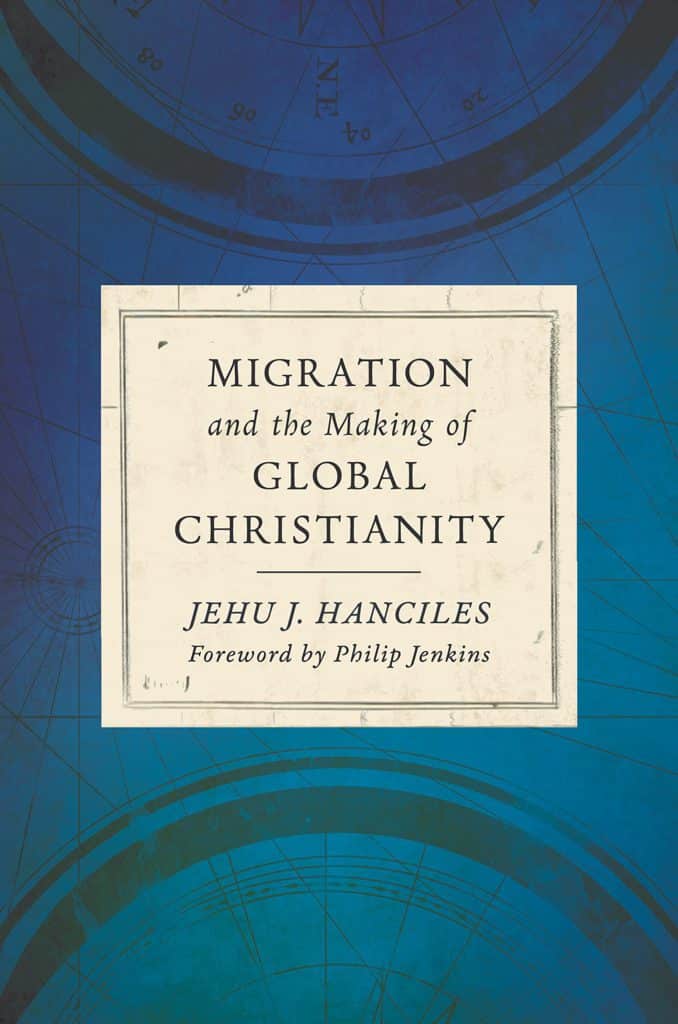
Migration and the Making of Global Christianity
By Jehu J. Hanciles
Wm. B. Eerdmans Publishing Co., 2021
461 pages
US$45.00
*As an Amazon Associate Missio Nexus earns from qualifying purchases.
Reviewed by Anthony Casey, associate professor of intercultural studies, William Carey University.
Author Jehu Hanciles states that much of church history is written from a Western, empire-driven “top-down” approach that “centers on political authority, structures of power, dominant (or elite) segments of society, and institutional forms” (4). He posits that on the contrary, “from the earliest beginnings, the cross-cultural spread of the Christian faith … [was] sustained by the largely unstructured, boundary-crossing movements of Christians in countless migrant flows” (419). In essence, Hanciles surveys the sweep of the global expansion of the church through the lens of migration. Such an approach is not only historically accurate but adds a new dimension to the work of God today to advance the kingdom through migrants such as international students and refugees.
The book begins with a conceptual overview of ancient migration from the earliest biblical and historical accounts, an examination of what conversion is and how it is influenced by political power, cultural interaction, and imperial expansion, and a brief survey of Scripture to not only demonstrate the centrality of migration in the flow of biblical history but to closely tie migration to the redemptive purposes of God to make his name known among the nations.
The bulk of the book traverses the globe revealing the significance of Christian migrants carrying with them the gospel throughout the Roman empire, the Persian empire, across the Norse lands, and on to the East. Rather than tracing the “big names” in the history of these empires, Hanciles follows the stories of merchants, sailors, slaves, pilgrims, scholars, refugees, and exiles that “galvanized cross-cultural exchange and decisively shaped religious propagation” (358).
He writes that an understanding of Christian expansion prior to 1500 into Asia, not through empire, but through migrants, is vital to avoid a distorted view of Christian history (402). Finally, Hanciles discusses the later relationship between migration and empire, acknowledging the undeniable force of imperialistic expansion, while also demonstrating that actual conversions often came through the witness of everyday migrants that were pushed, pulled, and dragged along by political expansion.
I benefitted from the largely untold story of the expansion of the Church through the lens of migration. While reading, I often thought of the so-called everyday Christians globally that work in business, study in universities, or endure tragic upheaval and resettlement as perhaps the main driving force in modern missions. Attention is typically given to church and agency-based missions sending that, while important, can fail to acknowledge and celebrate what may in fact be the bulk of the global missionary force – migrants.
The book is thoroughly researched and well-written, but as such, presents a heavy academic read. I do not envision many non-academics taking up this work, which would be unfortunate given its insightful and encouraging reframing of the global expansion of the church. The book is most at home in graduate courses in church history or diaspora studies, but I encourage professors to perhaps develop a series of lectures for undergraduates based on the book in order to make these insights accessible to a variety of students.
For Further Reading
Scattered and Gathered: A Global Compendium of Diaspora Missiology, edited by Sadiri Joy Tira and Tetsunao Yamamori (Langham Global Library, 2020)
EMQ, Volume 59, Issue 1. Copyright © 2023 by Missio Nexus. All rights reserved. Not to be reproduced or copied in any form without written permission from Missio Nexus. Email: EMQ@MissioNexus.org.




