EMQ » January–March 2023 » Volume 59 Issue 1
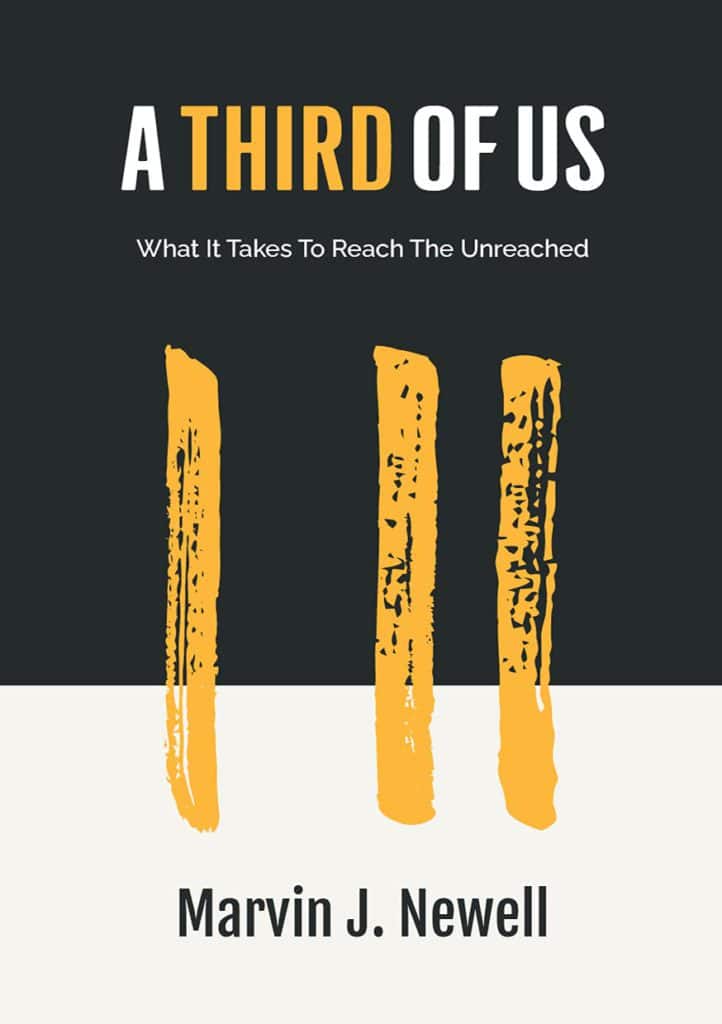
A Third of Us: What It Takes to Reach the Unreached
By Marvin J. Newell
William Carey Publishing, 2021
119 Pages
US$10.99
*As an Amazon Associate Missio Nexus earns from qualifying purchases.
Reviewed by Randy L. Jackson, PhD, associate pastor of discipleship and missions at First Baptist Church in Milton, Florida. He served 18 years as a missionary.
Marvin J. Newell introduces his book by noting people’s concern about pursuing values of justice, equality, and fairness. He says the church must address the great injustice that three billion people, a third of the world’s population, have no access to the gospel. Newell examines the commissioning passages in the Gospels and Acts to encourage the church to act. In so doing, he provides a resource for mission mobilizers and disciple-makers seeking to form missionaries.
Newell defines “a third of us” as those with little or no access to the gospel. If these people are to hear the gospel, God’s people must obey Jesus’s commissions between his resurrection and ascension. Newell orders these chronologically as John 20:21–23, Mark 16:15, Matthew 28:18–20, Luke 24:44–49, and Acts 1:7–8. Newell interprets and missiologically applies each commissioning passage in separate chapters.
John 20:21–23 emphasizes that Jesus sent the disciples and that his ministry was the model for theirs. Mark 16:15 presents the scope of their mission as the entire world and all people. Matthew 28:18–20 describes the disciple-making method among all nations as going, baptizing, and teaching them to obey, or as Newell summarizes, penetration, consolidation, and transformation. Luke 24:44–49 explains the disciples’ message: Jesus died, was buried and raised, and forgiveness of sins is available through him. Acts 1:7–8 elaborates on the means of the mission: Spirit-empowered disciples are to work in their own cultural setting, near-cultural settings, and settings with significant cultural differences from their own.
After explaining the commissioning passages, Newell tells why the church should reach the unreached by asking probing questions of John 3:16. The answers to those questions reveal that Jesus is the only way by which sinners are saved and brought into a relationship with God. Therefore, all must hear the saving message about him. In the next chapter, Newell deals with opposition to reaching the unreached, namely persecution. The final chapter challenges the reader to become involved. Newell shows the disparity between resources, both funding and missionary workforce, directed toward the reached and unreached. According to Newell, only 3% of these resources are directed toward the unreached and unsaved. Newell asks the readers what part they are willing to play.
In evaluating the book, Newell’s insistence on a chronological order for the commissioning passages adds little to the book’s message. However, his explanations and missional applications of the commissioning passages are well-grounded in both exegesis and missiology. Newell not only successfully applies the Scripture to the problem of the unreached but also introduces missiological terminology. The book could serve as a resource and discipleship study for a missions pastor to teach small groups in a local church and, hopefully, identify those called to go to a third of us.
For Further Reading
Apostolic Imagination: Recovering a Biblical Vision for the Church’s Mission Today, by J. D. Payne (Baker Academic, 2022)
Something Needs to Change: An Urgent Call to Make Your Life Count, by David Platt (Multnomah, 2019)
EMQ, Volume 59, Issue 1. Copyright © 2023 by Missio Nexus. All rights reserved. Not to be reproduced or copied in any form without written permission from Missio Nexus. Email: EMQ@MissioNexus.org.