EMQ » January–March 2023 » Volume 59 Issue 1
By David Lewis
A Church Planting Movement (CPM) in Russia has been praying regularly and systematically for unreached ethnic groups in their country for several years. They have a prayer calendar featuring 49 people groups, mainly those living in Siberia and other parts of far eastern Asia – such as the Udegei, Mansi, and Ainu (who live not only in Japan but also on Sakhalin – an island in Russia).
Every day the Christians pray for one of these ethnic groups, repeating the cycle every seven weeks. In January 2022, their movement included representatives of 30 of these ethnic groups, including one which now has an indigenous pastor. In 2006, this group with an indigenous pastor had no known Christians!
How much is this a result of prayer? Because members of this movement have also been active in trying to reach these peoples, one cannot disentangle the relative contributions of prayer and church planting. Intuitively, however, we sense a connection between prayer and the responsiveness of these communities.
This is a partnership between God and human beings: the Holy Spirit is working in the hearts of the unreached, but he also wants us to play our part in sharing the good news in a culturally sensitive manner. A similar partnership can be seen in the way that God sometimes prepares people through supernatural interventions, but then a human agent is the one who follows up and disciples the prepared person. We see this in the biblical examples of Ananias with Saul of Tarsus, and Peter with Cornelius (Acts 9 and 10).
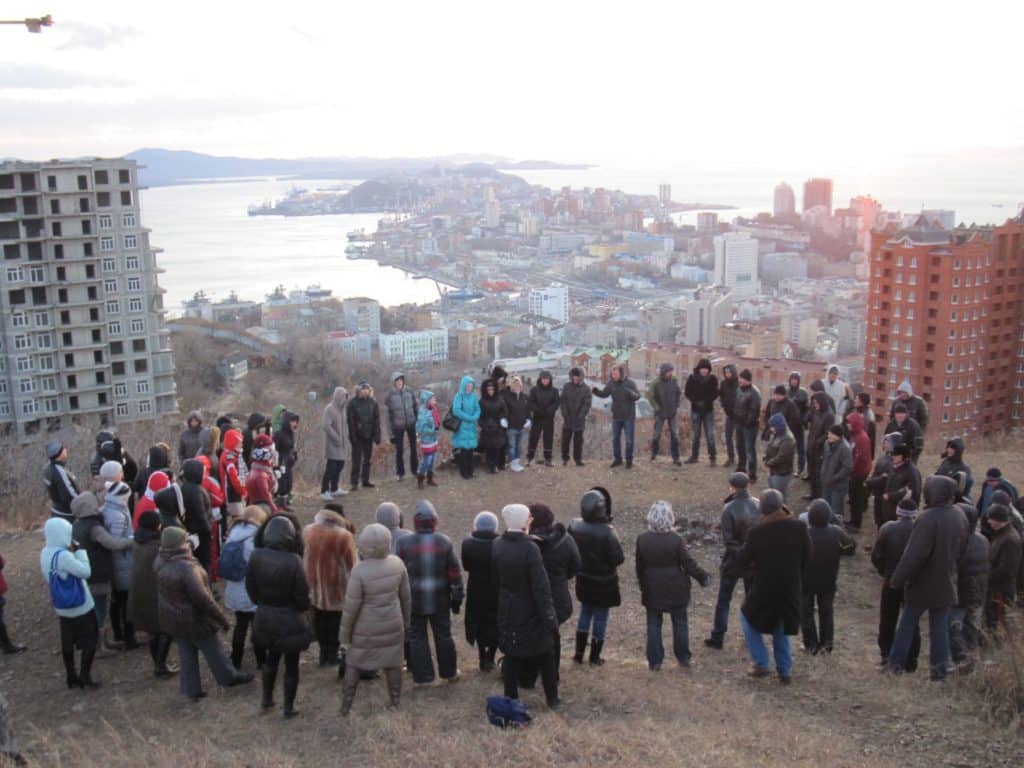
This movement in Russia has a high commitment to intercession in other ways besides the 7-week prayer calendar. For example, some take turns in a prayer room for around-the-clock prayer. Others go for prayer walks each week in a central square of their city. And still others in one specific place gather on a mountain overlooking the city to intercede from that vantage point.
Over the last three decades, this movement has planted more than 100 churches, some of which have planted daughter churches, and then other daughter churches up to a fourth generation. Churches within this movement are located not only throughout the length and breadth of the Russian Federation but also in Central Asia, the Middle East and elsewhere – from Spain to Cambodia. Intercessory prayer was likely a significant factor in their multiplication.
A Personal Example
Before this movement began their prayer journey, I shared about my own experience with them. In 1975, I began to pray for Mongolia. At that time no known Christians existed in the country. At first, I prayed in very simple terms such as: “establish and build your church in Mongolia.” A few weeks after I began to pray daily for Mongolia, I found a map on which the main settlements in the country were marked. I began to pray for each of these by name, besides praying in general for fellowships to be established in each province (aimak) of the country. While I usually prayed for Mongolia during the day, I found that if I forgot, I would not be able settle to sleep at night without praying for the country.
This went on for 15 years. In 1990, the Khalkha Mongolian translation of New Testament was nearly complete, and a tiny church began to grow. And at the same time, I felt released from the burden to pray daily. I have no idea how many other people God prompted to intercede for Mongolia during that same period, but I suspect that our intercession laid the spiritual foundations for the subsequent growth of the church there.
Now the Mongolia Republic has more than 42,000 Christians among a population of more than 3 million Mongolians. I also prayed for Mongolian missionaries to go to other parts of the former Mongolian empire. This is now happening. Mongolia has sent out more missionaries relative to its population than any other nation![i]
Local Illustrations – Miraculous Healings
Measuring prayer’s impact (as compared with other factors) in large-scale movements can be difficult; however, seeing its results on a local level is easier. Many Christians around the world testify to prayer’s effect on healing, on deliverance from evil spirits, and on the people who receive this ministry. Its influence often extends even further. For instance, a Kyrgyz family whom I have known for over 20 years say that the principal factor in their decision to follow Jesus was the miraculous healing of one of their family members after prayer in the name of Jesus.
Although those involved in such situations perceive the power of God at work, sceptics can often suggest alternative explanations, even if simply coincidence. Trying to document divine healing from a medical perspective is a minefield. Rarely does hard medical evidence show both the presence of a condition before the healing and its absence afterwards.
Even when such evidence is available, it can be questioned or interpreted in other ways, for example by calling into question the original diagnosis or by claiming that the healing was due to psychological factors (especially the placebo effect) or perhaps the effect of conventional medical treatments if these had also been administered.
Nevertheless, the explanations of sceptics can also become rather far-fetched. For example, when I tried to follow up a case of a child whose cancerous tumour had disappeared after regular prayer, the consultant could only attribute it to spontaneous remission. What that really means is the cancer has disappeared by itself, and we do not know why! In the absence of any other explanation, that case is now counted as an instance of spontaneous remission. However, for that type of cancer, the available medical literature up to that time did not record any other cases like this. And in this instance, the normal procedure would have been cutting out the tumour or even amputation of the limb.[ii]
Rex Gardner, who was a consultant at Sunderland General Hospital in England, assembled several well-documented cases of divine healing which are difficult or (I believe) impossible to explain away in conventional medical terms.[iii] Notably, some of the most dramatic cases of divine healing around the world, such as raising the dead or the filling of dental cavities[iv] occur in poorer countries or among indigenous peoples with limited or no access to conventional medicine.
This fits with my follow-up study of healings reported at a Christian conference in England. Among the 1,890 Christians who filled in a questionnaire for me about their experiences, those from higher social classes were less likely to report a high degree of physical healing than those from lower social classes.[v]
Such a pattern fits with the ministry of Jesus, many of whose miracles were among beggars or outcasts. Jesus said he had come to bring good news to the poor (Luke 4:18). Extrapolated to a worldwide scale, a bias for the poor in divine healing might be one of the reasons why various Christian movements with an emphasis on praying for healing or deliverance have grown rapidly in developing countries in Africa and Asia.[vi]
Miracles are signs that may help to precipitate faith (e.g., John 2:11; 4:53) but are not in themselves a magic formula for bringing people to faith. Pharisees who witnessed the same kind of miracles made decisions against Jesus rather than for him (John 11:46–50; Acts 4:5–21; 5:12–18). Nevertheless, if proclamation of the gospel is accompanied by signs and wonders, these can be divine confirmations of the truth of what is proclaimed (Mark 16:20; Acts 14:3; Hebrews 2:4). The source of the miraculous healing also needs to be explained so that people recognise that it is not by human power but has been accomplished through the authority and power of Jesus (Acts 3:12–16).
When I interviewed 100 Christians selected at random from the 1,890 who filled in questionnaires for me, I asked how they had put into practice the training they had received at the conference. Most of them spoke about praying for others in their own churches, with mixed results. Relatively few had prayed with non-Christians for healing, but those who had done so had seen evidence of God’s power at work in answering their prayers.[vii] Signs are intended to help non-Christians come to faith, so the significance of signs and wonders is that they are an evangelistic confirmation of the verbal message.
What does God require?
This poses a dilemma for many of us, who at times feel that God does not answer our prayers. We may question if we are doing it right. Questions come to mind such as: “Am I praying frequently enough? For long enough? Deeply enough? Should I be fasting?” Perhaps God requires more of us than doing justly, loving mercy, and walking humbly with him (see Micah 6:8).
Micah’s summary of what God does require relates to every aspect of our beings – body, soul, and spirit. It connects to our physical conduct, attitudes of the heart, and our closeness with God. Our prayer lives reflect all these aspects as well – we can seek justice, request loving mercy, and reveal our humble dependence on God in our prayers.
Humility is a key element of Micah’s requirements because any reliance on our own talents, competencies, or personal characteristics can lead to pride and glorification of self, becoming a barrier to dependency on God and hearing from him. In New Testament terms, walking humbly with God is called walking in the Spirit (Galatians 5:16). Living in the Holy Spirit involves being sensitive to the voice of God and obeying his promptings.
By listening to God we begin to discern what the Father is doing (John 5:19). Jesus enunciated this principle after he had chosen just one lame man out of many to heal at the pool of Bethesda. This principle applies not only to prayer for healing but also to evangelism and other aspects of church life in which resources are limited. We need to discern God’s agenda, so we spend our time and energies wisely.
By listening to God we may be directed to the person that God wants us to speak with or minister to, as exemplified by Jesus in his ministry to the crippled man at the pool of Bethesda (John 5:1–14). The same principle applies to prayer, so we can know in specific situations how to pray and what to pray for.
For example, when ministering to a boy with seizures, Jesus cast out a deaf and mute spirit (Mark 9:25). In Matthew 4:24 those having seizures are listed separately from the demon-possessed, indicating that not every case of apparent epilepsy is demonic. Yet in the case of the boy in Mark 9, Jesus and the boy’s father recognized the cause as a demon. Furthermore, in such cases fasting may also need to accompany prayer (Mark 9:29 in some manuscripts). This teaches us that fasting and persistence in prayer are products of our relationship to God; they are not ends in themselves or tools by which we can manipulate God to do our will.
Conclusion
Breakthroughs among certain ethnic groups may only come after a prolonged period of intercession. If we are open to God and listening to him, he may put certain nations on our hearts, encouraging us to intercede for them. We do not know how many intercessors are around the world, and their impact is unquantifiable in this world. Nevertheless, each of us can do our part.
Are we willing to pray seriously for a territory (e.g., North Korea, Tibet, Afghanistan) or an ethnic group (e.g., Taureg, Fulani, Pumi)? If so, we might not see the results with our own eyes; others may reap where we have sown spiritually. Nevertheless, our reward is in heaven if we hear the words, “Well done, good and faithful servant.”
David Lewis (lewisanthropologist@gmail.com) is an affiliated researcher at the Mongolia and Inner Asia Studies Unit at the University of Cambridge, England (https://www.miasu.socanth.cam.ac.uk/staff/professor-david-lewis). His books include After Atheism: Religion and Ethnicity in Russia and Central Asia, The Unseen Face of Japan, and Healing: Fiction, Fantasy or Fact? Among other things, David conducts training seminars (in person or online) on understanding other cultures and contextualization.
NOTES
[i] K. Sutter, “Once A Mission Field Now the #1 Missionary-Sending Country in the World,” YWAM Frontier Missions, March 9, 2021, https://www.ywamfm.org/mission-field-mongolian-missionaries/.
[ii] David Lewis, Healing: Fiction, Fantasy or Fact? (London, Sydney, Auckland, Toronto: Hodder and Stoughton, 1989), 221–228.
[iii] Rex Gardner, “Miracles of healing in Anglo-Celtic Northumbria as recorded by the Venerable Bede and his contemporaries: a reappraisal in the light of twentieth century experience,” British Medical Journal (Clinical Research Edition) 287, no. 6409 (December 1983): 1927–33. Rex Gardner, Healing Miracles: A Doctor Investigates (London: Darton, Longman and Todd, 1986).
[iv] David Pytches, Come, Holy Spirit: Learning to Minister in Power (London: Hodder and Stoughton, 1985), 232–9. Gardner, Healing Miracles, 175–186.
[v] Lewis, Healing, 66–67. David C. Lewis, “A Social Anthropologist’s Analysis of Contemporary Healing” in The Kingdom and the Power, ed. Gary S. Greig and Kevin N. Springer (Ventura, California: Regal Books, 1993), 336–337.
[vi] David Lewis, “Healing Miracles, Church Planting Movements, and Population Dynamics” in Global Missiology 19, no. 1 (January 2022): 22–23.
[vii] Lewis, Healing, 215–234.
EMQ, Volume 59, Issue 1. Copyright © 2023 by Missio Nexus. All rights reserved. Not to be reproduced or copied in any form without written permission from Missio Nexus. Email: EMQ@MissioNexus.org.