
EMQ » Jan – March 2025 » Volume 61 Issue 1
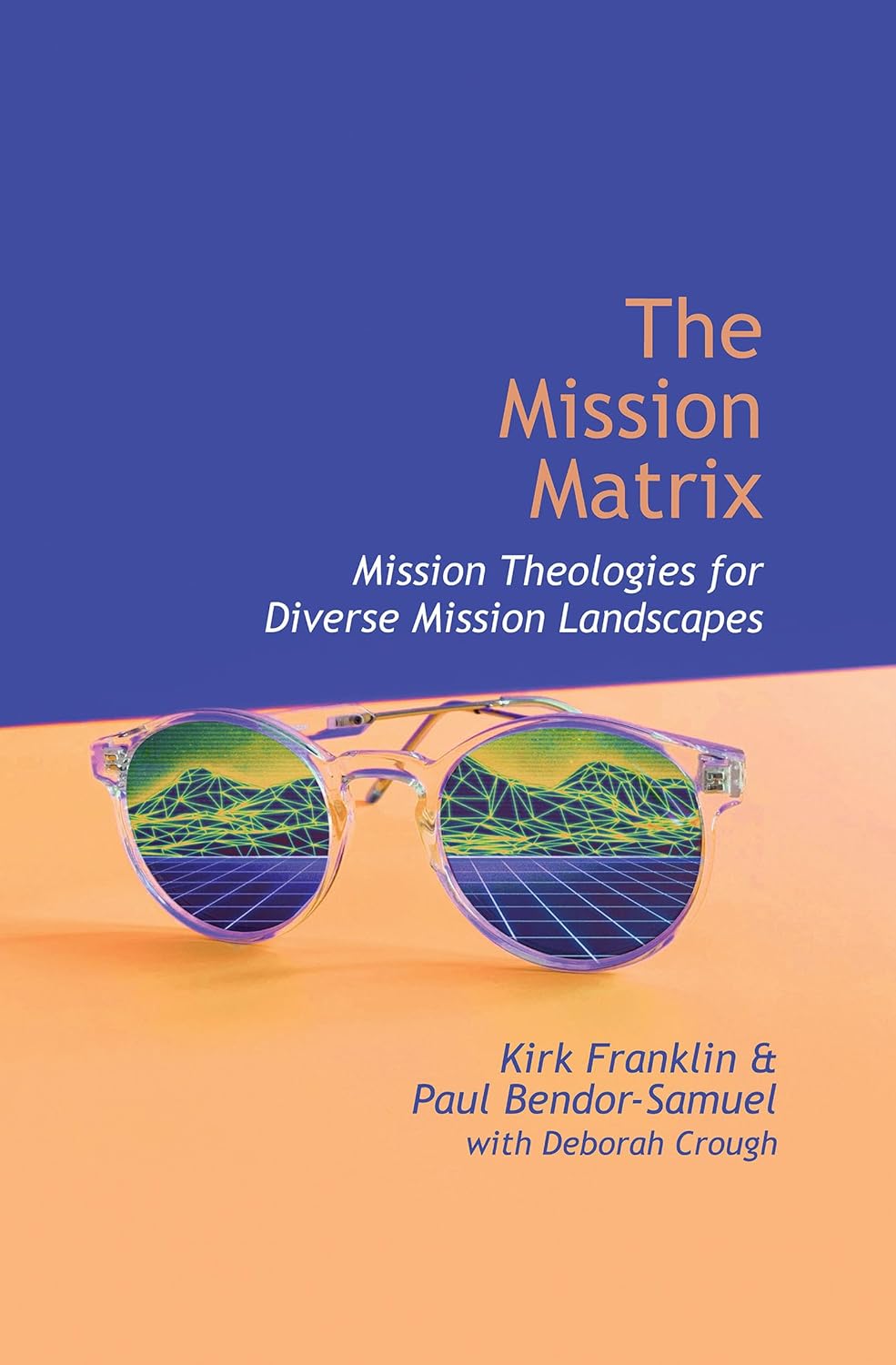
The Mission Matrix: Mission Theologies for Diverse Mission Landscapes
By Kirk Franklin and Paul Bendor-Samuel, with Deborah Crough
Regnum Books International, 2024
279 pages (Kindle edition)
US$7.99
*As an Amazon Associate Missio Nexus earns from qualifying purchases.
Reviewed by Karry Kelley (PhD, intercultural studies), who served 15 years in Spain as a church planter with World Team. He and his wife, Charlyn, now coach and train church planting teams.
The Mission Matrix is not a theology of mission. Instead, it offers a framework for thinking theologically about mission. How are we to understand our God-assigned mission in our specific context and time? This book aims to help both students and practitioners answer that question.
Part 1, “Mission Landscapes,” explores the dynamic between changing contexts on the one hand and interpretive approaches to theologizing about mission on the other hand. Chapter 1 traces the theology of missio Dei from Augustine to the present day.
Chapter 2 follows David Bosch’s six paradigms of mission theology (126) to trace the development of mission theology through the centuries. Against this historic landscape, the authors highlight three current trends: internationalization of leadership, nationalism, and globalization. Chapters 3 and 4 trace the development from a Christendom mindset to a post-Christendom missiology centered in the missio Dei. In contrast, the authors then offer recommendations for a mission theology of the global church.
Part 2, “Mission Theology,” consists of three chapters that elaborate on Franklin and Bendor-Samuel’s “Integrative Missiological Matrix” for theologizing about mission. This matrix summarizes the categories to address in a mission theology. The authors argue that “God’s mission belongs to him” (152). He invites his people to participate with him. To understand our participation, we must study the theology and praxis of mission in four areas of practical learning: the Bible as our authoritative source, the Church as God’s primary agent, our individual agency as disciples, and our specific human and cultural contexts.
The book concludes with a discussion of a missional hermeneutic for the global church in which every page of the Bible is interpreted missiologically. The final chapter addresses terminology and suggests corrections and updates in the use of terms in mission theology.
The authors’ emphasis on the complete process from mission theory, to praxis, and then to practice left this reader hoping for examples. The book’s stated aim is “to equip you with the tools necessary to apply Mission Theology’s frameworks to intricate issues and diverse situations… within your specific field of ministry” (11). A few stories exemplifying application would have helped us see our way along that journey.
Having said that, their adaptation of Van Engen’s integrative theory and elaboration of the matrix were among the high points and helpful contributions. Perhaps reflective practitioners can complement the theory with their own applications in the practice of mission.
For Further Reading
Encountering Theology of Mission: Biblical Foundations, Historical Developments, and Contemporary Issues by Craig Ott and Stephen J. Strauss, with Timothy C. Tennent (Baker Academic, 2010)
Theology of Mission: A Concise Biblical Theology by J. D. Payne (Lexham Press, 2021)
Transforming Mission Theology by Charles Van Engen (William Carey Library, 2017)
EMQ, Volume 61, Issue 1. Copyright © 2025 by Missio Nexus. All rights reserved. Not to be reproduced or copied in any form without written permission from Missio Nexus. Email: EMQ@MissioNexus.org.




