EMQ » Jan – March 2025 » Volume 61 Issue 1
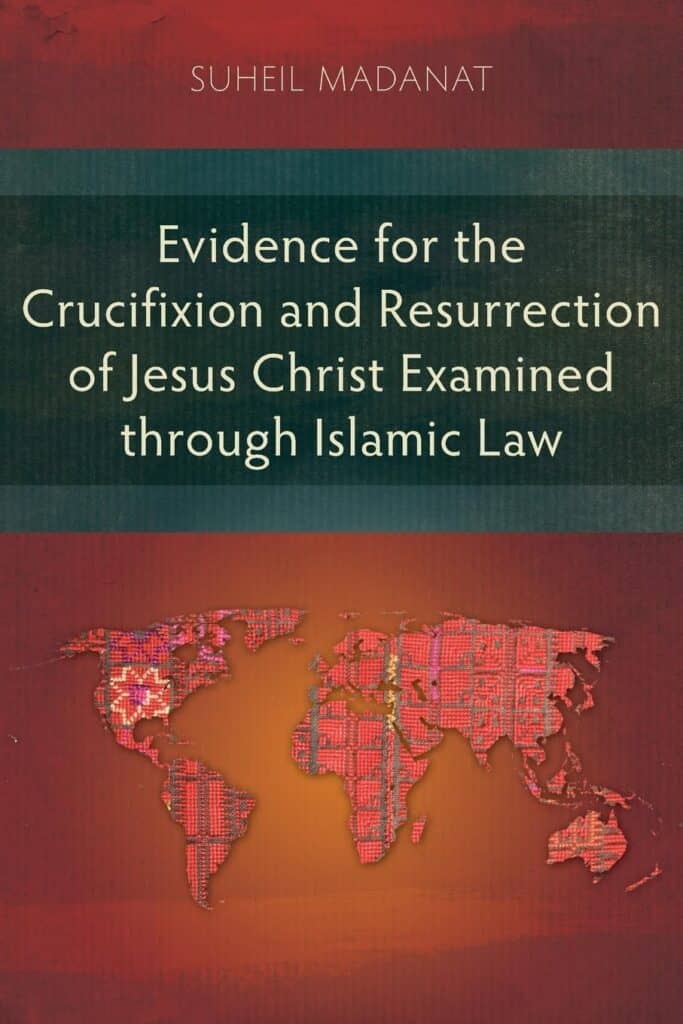
Evidence for the Crucifixion and Resurrection of Jesus Christ Examined through Islamic Law
By Suheil Madanat
Langham Monographs, 2023
276 pages
US$32.99
*As an Amazon Associate Missio Nexus earns from qualifying purchases.
Reviewed by Eun Yul (Joel) Kim, PhD student (intercultural studies), Fuller Theological Seminary, pastor of the English-speaking congregation at New York IN2 Onnuri Church.
Suheil Madanat’s “evidential apologetics” (17) provides an original and objective approach to persuade Muslims on the authenticity of the New Testament and its testimony of a crucified and resurrected Jesus. Madanat’s approach is unique in that it is not a conventional apologetics based on Western common law but one that applies Islamic law and its standard of verifiability.
After his opening chapter introducing his thesis, Madanat presents an overview of Islamic law in chapter 2, providing a good summary of how Muslim scripture was canonized. While all Muslims accept the Qur’an and Sunna as primary revealed sources, not all non-revealed sources are accepted, depending on the interpretative school of Islam.
Only the Ijma and Qiyas are accepted by all schools as primary non-revealed sources, and together with the primary revealed sources, these make up the “traditional Islamic law” (76) to which Christian evidence will be attested. As a start to show that this is possible, he ends the chapter by going over the Islamic court system to make the point that Christianity, specifically the death and resurrection of Jesus, has a case with relevant and admissible evidence.
Before making a case for the cross event, the author defends appropriately, in chapter three, the authenticity of the New Testament by applying “the very principles that recognize their [Islamic law] authenticity” (94). The New Testament is valid according to these same principles of authenticity in Islamic law. This is persuasive apologetics because it prohibits one from applying a double standard. What is more interesting is that when you apply the same standards to the New Testament, the results show that the Bible is more authentic than Muslim scripture.
It is worth interjecting here some praise of the book. First, Madanat is a good apologetic. Not only does he make an original contribution, the book itself flows logically, strengthening his case. Second, he is consistent in arguing for Christian evidence from the perspective of Muslims. The evidence has to be acceptable by their standards. This is why synthesizing discrepancies within the gospels to reconcile them, though there is plenty of evidence, “is unrecognizable by Islamic law” (187). However, though reconciliation by synthesis is dismissed, there is sufficient evidence, the “common denominator” (194) between accounts, to satisfy the requirements of the Islamic law” as well as to reconcile the crucifixion and resurrection event under Islamic law.
Chapter four is the central part of the book as it provides evidence to Muslims of the cross event through their own standard of evidence. One may wonder why this chapter is so far into the book, but the reader must be patient, as a good apology must be developed through a logical presentation of the arguments. Chapter five covers secondary evidence of Jesus’ death and resurrection that may be admissible in Islamic law. It is not primary, but in corroboration, it adds to the persuasiveness of the argument.
Finally, who is this book written for? Madanat states in his conclusion that the study is meant for Muslims to read directly and be persuaded. However, it is also a helpful read for Christian apologists, missionaries, and evangelical churches and their leaders who are involved with comparative study as well as dialogue and witness with Muslims. The book is academically written, but the pastor, church leader, and layperson with biblical and theological literacy can definitely benefit from the book.
For Further Reading
John of Damascus, First Apologist to the Muslims: The Trinity and Christian Apologetics in the Early Islamic Period by Daniel J. Janosik and Peter G. Riddell (Wipf and Stock Publishers, 2016)
Law and the Rule of God: A Christian Engagement with Shari’a by Joshua Ralston (Cambridge University Press, 2020)
Answering Islam: The Crescent in Light of the Cross by Norman L. Geisler and Abdul Saleeb (Baker Books, 2002)
EMQ, Volume 61, Issue 1. Copyright © 2025 by Missio Nexus. All rights reserved. Not to be reproduced or copied in any form without written permission from Missio Nexus. Email: EMQ@MissioNexus.org.