EMQ » Oct – Dec 2024 » Volume 60 Issue 4
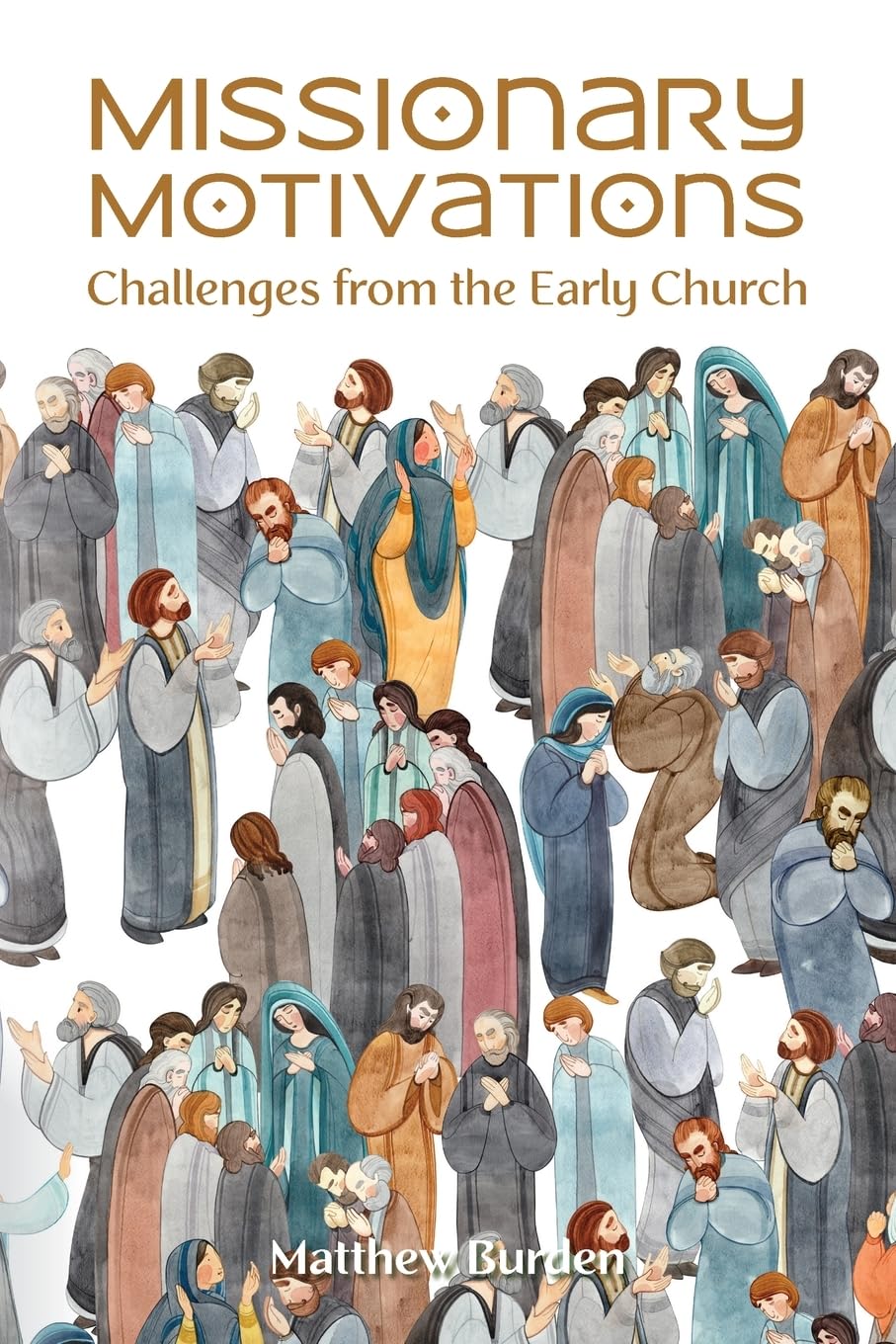
Missionary Motivations: Challenges from the Early Church
By Matt Burden
William Carey Publishing
140 pages
US$10.99
*As an Amazon Associate Missio Nexus earns from qualifying purchases.
Reviewed by Marcus Dean, professor of intercultural studies and missions, Houghton University; former missionary for 14 years in Colombia and Puerto Rico.
This book by Matt Burden may be a shock to those who perceive that the Great Commission has been the church’s driving force for missions since Jesus uttered those words before his ascension! Missionary Motivations is an intriguing study of missionary motivations during the approximately first 700 years of the church. Matt Burden does a solid job of summarizing the perspectives of the time, when as he recognizes, the early church writers did not explicitly record their motivations for missions.
Burden opens the book with various theological missionary motivations of the period: the reign of Christ, the messianic priest-king, Christus Victor, and a kingdom of priests (chapter 1). This is followed by an overview of the church’s expansion within the Roman Empire, to the empires to the East, to North Africa and Arabia, to Central Europe, and finally to Northern Europe (chapters 2–6). Each chapter examines key people, missions expansion, and the motivations involved.
The final three chapters focus on lessons learned. Chapter 7, which looks at the communal or church aspects of missionary motivation, calls to mind current discussions focusing on church planting movements and worship as the reason for missions; yet Burden gives us a sense of the uniqueness of missions in the early church period. Chapter 8 has a more individualized focus on motivation but does not feel very familiar to the reader today because it describes how the theological themes of chapter 1 motivated individuals to want to see God’s kingdom expand and Jesus Christ lifted up.
In chapter 9, “Mission in the Spirit of Early Christianity,” Burden offers various lessons to process regarding the church’s missionary motivation today. He shows that the early church often established communities that lifted up Christ in hostile contexts and lived a life that reflected Christ through personal holiness.
The context of the early church looks a lot like our current world in that growth did not occur within a Christendom setting. While we may not start a monastic movement, it does call for thinking and praying about what the world needs to see in us as the church and individuals. Can we be as attractive in our context as the early church was in its own?
Missionary Motivations came to me as I was preparing to teach a missions/church history class. While not in time to consider adopting it as a text, it will definitely be used. I think an important lesson from this book is that what motivates us to missions is relevant to our context.
We are not amiss to have held up the Great Commission as motivation. But the book challenges us to see that we should not get stuck on a single motivation and that we need to learn from the past. This is a thought-provoking and useful book for all who desire to see God’s reign expanded and Jesus Christ lifted up in our contemporary setting.
For Further Reading
Turning Points in the Expansion of Christianity: From Pentecost to the Present by Alice T. Ott (Baker Academic, 2021).
Mission in the Early Church: Themes and Reflections by Edward L. Smither (Cascade Books, 2014).
A Multitude of all Peoples: Engaging Ancient Christianity’s Global Identity by Vince L. Bantu (IVP Academic, 2020).
EMQ, Volume 60, Issue 4. Copyright © 2024 by Missio Nexus. All rights reserved. Not to be reproduced or copied in any form without written permission from Missio Nexus. Email: EMQ@MissioNexus.org.