EMQ » Oct – Dec 2024 » Volume 60 Issue 4
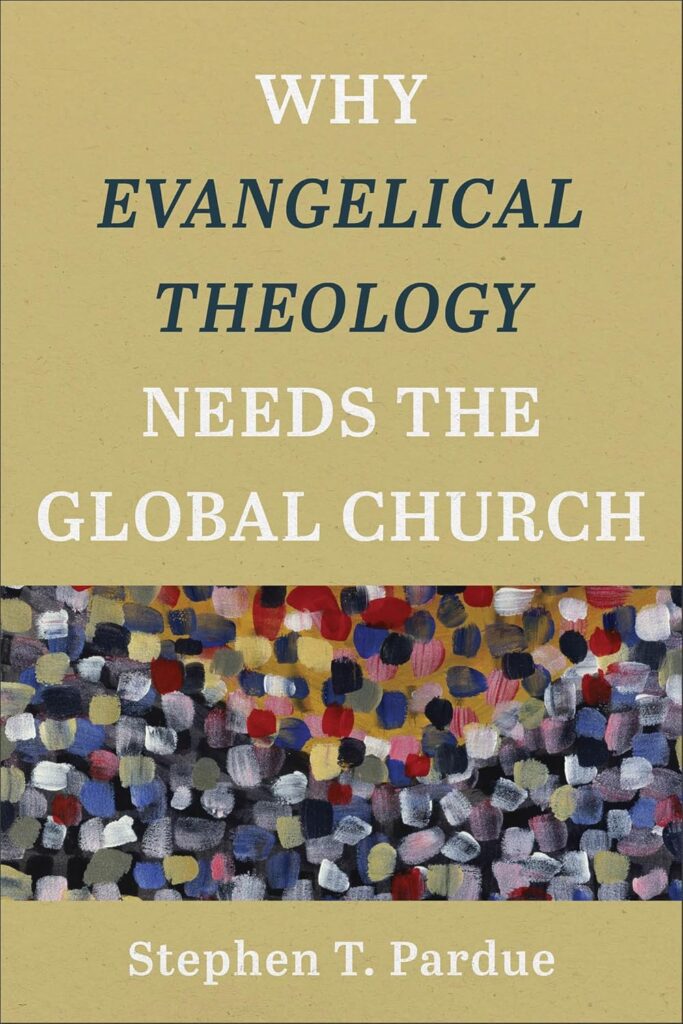
Why Evangelical Theology Needs the Global Church
By Stephen T. Pardue
Baker Academic, 2023
197 pages
US$24.99
*As an Amazon Associate Missio Nexus earns from qualifying purchases.
Reviewed by Mark D. Wood, PhD, director of Kingdom Leadership Training Center, Darhan, Mongolia.
Recently at a conference, I heard a speaker remark that when the Western world writes it is called theology but when the majority world writes it is often referred to as contextual theology. This hegemony is addressed by Stephen Pardue in his book, Why Evangelical Theology Needs the Global Church, where he cogently and persuasively argues for contextual theology to have a place at the table. Currently the director of ThM/PhD in theological studies and church history at Asia Graduate School of Theology in Manila, Pardue (PhD, Wheaton College) is well positioned to help the voice of the global church to be heard.
The book is divided into six chapters with chapters 2 through 6 featuring helpful and insightful case studies. Each chapter defends a specific thesis. In chapter 1, “On God and Gravity,” the author starts with the cogent question, “What difference does it make for the practice of evangelical theology that the church is no longer primarily rooted in North America and Europe but increasingly comprises people from an astonishing variety of cultures and nations?” (1). Pardue uses the term “contextual theology” to refer to local theologies and “Evangelical” to refer to the broader theological context.
In chapter 2, “A Word Very Near,” he wrestles with the dynamic of theology being an expression of local context but also universal or catholic. Pardue lays out a survey of contextual theology drawing from catholic theologians, such as Schreiter and Bevens, to other notable writers Tillich and Barth, to the Ecuadoran theologian Rene Padilla and many others. A strength of this book is Pardue’s ability to draw on many different voices and bring clarity and synthesis to the various perspectives.
The next chapter, “The Wealth of the Nations Shall Come to You,” examines that, while Scripture is authoritative, “Evangelical contextual theologies must acknowledge culture as a material theological good, a gift from God designed for the benefit of the church” (64). Pardue delves into Niebuhr’s work on Christ and culture while also interacting with the works of Carson, Kuyper and Bavinck, and Chinese theologian Yu.
Chapter 4, “A Great Multitude from Every Tribe and Tongue” delves into the impact of doctrine in shaping culture. The thesis is “that evangelical contextual theologies should look to the Christian doctrine of the church in order to coordinate the once-for-all of the gospel and the remarkably diverse expressions of the faith that emerge in the real world” (92–93).
“The Children of God Scattered Abroad” (chapter 5) assesses the relationship of contextual theology to the church universal, both its global breadth and the historical depth of tradition. The final chapter, “A Great Cloud of Witnesses,” continues with a call for all theology to be engaged simultaneously with the culture and tradition of the church.
This book is outstanding and recommended for anyone working cross-culturally. The book is equally at home being discussed by a mission leadership team or a small group or seminary classroom. It serves as an excellent introduction but also as a plea for reform in how global theology is engaged. Pardue has produced a solid work on the theology of the global church. This book should be on your reading list.
For Further Reading
Neighboring Faiths: A Christian Introduction to World Religions, revised 3rd edition, by Winfried Corduan Majority World Theology: Christian Doctrine in Global Context edited by Gene L. Green, Stephen T. Pardue, and Khiok-Khng Yeo (InterVarsity Press, 2020)
Asian Christian Theology: Evangelical Perspectives edited by Timoteo D. Gener and Stephen T. Pardue (Langham Publishing, 2019)
EMQ, Volume 60, Issue 4. Copyright © 2024 by Missio Nexus. All rights reserved. Not to be reproduced or copied in any form without written permission from Missio Nexus. Email: EMQ@MissioNexus.org.