EMQ » July – Oct 2024 » Volume 60 Issue 3
[mepr-show rules=”100329″ unauth=”message”] This content is shown only to authorized members. It is hidden from everyone else.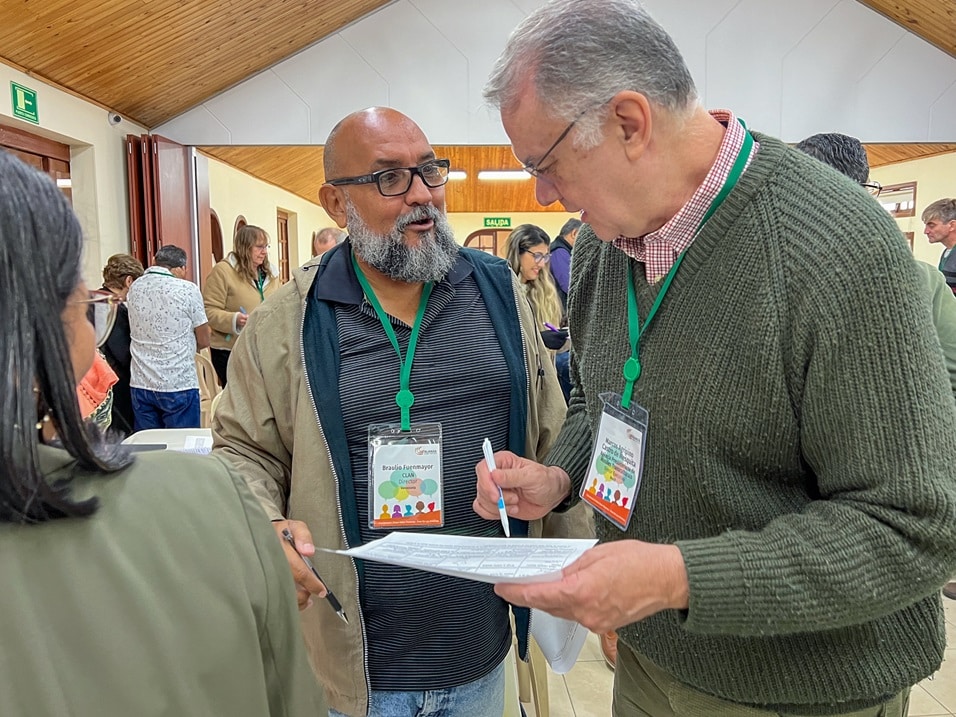
Mutuality Discussions
Summary: Global mission teams are becoming more and more multicultural. This presents challenges particularly to the work and relationships between people from the Global North and Global South. Facilitated discussions about cultural frameworks can help global workers gain a better understanding of different cultural perspectives.
By Sheryl Takagi Silzer
As the number of missionaries from the Global South increases, mission teams are becoming more cross-cultural. Workers from the Global North typically receive some pre-field cross-cultural training but have difficulty working through cross-cultural challenges.[i] At the same time, many missionaries from the Global South also struggle working with workers from other cultures but have not had access to similar training.
Learning together on-site in the mission context where they face cultural misunderstandings daily can help teams solve their team issues. Cultural misunderstandings need to be addressed together in real life situations so that the emotional distress they cause will not hinder the impact of their ministry or, even worse, lead to attrition.
What causes the cultural misunderstandings for mission workers? Cultural misunderstandings arise from unconscious cultural practices or habits everyone has. When we do things the same way day after day, information about our methods for doing things is stored in our long-term memory. These habits become unconscious, much like riding a bike or driving a car after regular practice.
Because cultural practices are unconscious, we assume that other people should react the same way. The problem is that our assumptions are frequently wrong. Therefore, we need a way to talk with each other so that we can better understand our cultural misunderstandings.
Global North and Global South Cultures
Let’s consider the idea of mutuality as an example. Cultures define mutuality within their own context. People from the Global North tend to have their own definition of mutuality which typically differs from that of people from the Global South. Therefore, a multicultural team must work together to define mutuality and describe their common goals.
The next step is to discuss how to move forward towards mutuality. People from the Global North tend to see implementation in terms of developing new initiatives or new programs – what institutional action must be done to create mutuality? Colleagues from the Global South tend to focus on relationships and will see implementation from that perspective – who needs to be involved and how will it deepen relationships? Without open discussions about the goals of mutuality both groups will be disappointed that what they thought was mutuality is interpreted differently by other members.
A crucial difference between the Global North and the Global South is the definition of the person. People from the Global North are typically individualists; they define the person as a unique individual. People from the Global South are typically collectivists; they define the person in relationship to the collective society whose lives are intertwined in such a way that their identity is in their group.
These fundamental differences cause many misunderstandings. People that have one or the other of these definitions of the person stored in their brain will automatically address mutuality from their cultural perspective. These different perspectives shape how people do things in everyday life and how they expect that other people think the same way that they do when in fact the two perspectives are almost opposite.
We are made in the image of God and our culture encapsulates the image that we reflect as a group. But our cultures are also affected by sin. Our cultural biases lead us to justify our negative responses towards people who do things differently. These are based on an underlying cultural ideal – the individual or the collective. If unrecognized, this bias can prevent the development of mutuality in multicultural teams. These reactions do not reflect the image of God.
Unpacking Cultural Knowledge
Remembering childhood experiences can be helpful for teams to gain more understanding of their cultural framework. Discussions can begin with team members thinking about where they first learned culture – their family and childhood home. This can help them understand why they do things the way they do.
Spaces in their home and their family structure played a part in shaping their cultural ideals. Team members can create a family tree and a rough drawing of their family home area. Sharing photos of their families and homes can also serve as visual tools to help participants remember and share their childhood experiences. These tools help trigger childhood memories.
Family
By looking at their family structure participants can come to understand the interaction with their parents and siblings. After discussing the topic of sibling interaction, one woman realized that she had problems working with a teammate because she reminded her of her older sister who always told her what to do when they were growing up.
Another exercise that can be incorporated is assigning everyone to one of three small groups by birth order (firstborn or only child, middle child, lastborn). Each group can receive a half sheet of paper to write down what they have in common.
In one group that participated in this exercise, the firstborns filled up their paper and asked for more paper. The middle children wrote a few things they had in common, but the lastborn group ended up with an empty sheet of paper because no one bothered to write anything down. The different groups were amazed to realize how their birth order played out.
Interestingly, our response to present day cultural differences is often also shaped by our childhood discipline experiences. Unconsciously, we often discipline others in the same way as our parents did to us when we encounter differences. Similarly, relational difficulties experienced in the childhood home or one’s present-day home can affect how mutuality is carried out in everyday life and ministry.
A man who participated in a discussion on this topic shared that he was the oldest of eight children and the only male. The women he worked with realized that was why he was so kind to them – he grew up taking care of his sisters. Another man had four sisters who used to take care of him, so he expected his female co-workers to take care of his needs.
An older woman realized that the reason she was easily angered by injustices was because she thought her mother had unfairly punished her when she was young. Her husband, who was also in the discussion group, thought she was overly concerned about justice. Through the dialogue he better understood her reaction.
As we explore how our family was structured and functioned in our childhood and share stories from our childhood, we can better understand how and why we relate the way we do to people today. Sharing helps build understanding and explains how misunderstandings occur.
Childhood Home
The floor plan of each person’s childhood home reveals how space in the house shaped cultural practices. Some houses are divided into enclosed spaces which emphasize individual activities. Some houses have fewer individual areas and facilitate collective activities. The interactive sessions go from room to room or space to space to talk about the activities that occurred there.
For example, certain parts of a house may be used for visiting and socializing; the kitchen and dining room relate to food preparation and eating; certain areas may be set aside for working; the bedroom for sleeping and resting; and the laundry and bathroom for cleaning. Hearing other people describe how they did things in each of these spaces in childhood helps people understand their own underlying cultural ideals – individual or collective. Sharing stories triggers memories for other team members. Asking further questions from each other enhances the team’s understanding of each other and builds relationships leading to more mutuality.
Unpacking Cultural Activities
The next step is to revisit activities – both the norms participants experienced in childhood, and things that have puzzled them as adults as they’ve engaged with other cultures.
Visiting
I’ve put socialization, communication, and hospitality all together in the category of visiting. People are socialized to behave differently in conversations and group discussions. Some speak up quickly or interrupt, and others may wait for a gap in conversation or wait until they are asked to participate. Social status also plays a part with older, male, higher status, firstborn, or individualists often taking a more dominant role in discussions.
As team members recognize these differences, they can help each other adjust their way of speaking to facilitate mutuality. Those quicker to speak may need to be guided to allow and encourage others to speak. Using small group table discussions can minimize the reluctance of some to speak up. Pointing out this cultural difference at the beginning of the discussion and giving guidelines for the discussion also helps everyone to participate.
Expectations for hospitality also vary. One difference is perspectives on planning for visits. One young female participant grew exasperated by unannounced visits from her friends from a different culture. Through discussion, she realized that these informal visits were a cultural norm for her friends.
Learning about norms for giving and receiving is another part of understanding hospitality. A woman from the West shared that she didn’t know how to respond when people came to her house asking for money. When she talked to her neighbor, she found out that the people thought foreigners normally gave handouts. Her neighbor explained that if the request was for a need in the community, she could give a small donation. However, if the request was not for the local community, she could ask them to clarify their request. After following her neighbor’s advice, she didn’t have as many requests.
Eating
Eating is another important daily activity with a host of cultural standards. When we think about eating, what, when, how, with whom are all critical aspects. One multicultural team had food for breaks and lunch provided for everyone. However, one teammate often brought his own food and sometimes didn’t even eat with the team. This behavior angered a man from a collective culture. He expected everyone would eat together because they were teammates and fellow believers.
One woman from an individualistic culture helped cook a group meal for the team and was upset because the men were served first. The men took the best portions, so there wasn’t that much left for the women and children. She was surprised that the other women weren’t offended. In her culture, men let women and children eat first.
Working
When it comes to work, individualistic cultures are more task-focused while collectivist cultures are more people-oriented. In one collective country, local workers tended to arrive late whenever it rained. The individualist supervisor wanted to correct their behavior. He later understood that local transportation didn’t run as early when it rained.
In another collective location, the local workers would go around and greet everyone when they came to work. Sometimes they got into long discussions and didn’t get to their work assignments right away. Their individualist supervisor felt they should prioritize getting their work done rather than spending time on non-work activities.
Resting
How we sleep also depends on our context. In some collective cultures, beds tend to be shared by more than one person. One individualist man was doing field work with a local colleague. Local hosts only prepared one small bed for them to sleep on. He was very uncomfortable sharing a small bed with another adult male.
In another collective country, there were only two bedrooms – one for the parents and one for the children and guests. When a married couple were guests, the wife was shocked that she had to share a bedroom with the male guests.
Cleaning
When is something clean or unclean, and who does the cleaning? In one context, local street food stalls used only a single bucket of cold water to rinse plates off before they were used again. From some teammates, this wasn’t a problem. Others expressed concern about the health issues.
In another location, nonlocal office workers noticed that the youngest male always cleaned up after the breaks – washing the dishes and putting the leftover food away. During the discussion, they learned that this was common practice in the local homes, so it was natural to also do the in the office context.
There are many other topics that can be added to these kinds of discussion such as childbirth, child-rearing, marriage, initiations, death and burials, holiday celebrations, local art, education, local economics, exchange practices, etc. Our reactions to cultural differences are often visceral which shows how strongly our childhood practices imprinted on us. Responses in any of these categories reflect childhood experiences. They show our cultural bias and fuel adult cross-cultural conflicts.
Moving Toward Mutuality
Because our own way of doing things are habits that we learned from childhood and are reinforced daily by our cultural context, team members need to be intentional in raising their awareness of their cultural biases. Just as it took a long time to form our habits, it also takes a long time to change or adjust our patterns to help one another develop mutuality.
Mission organizations that are serious about fostering mutuality in missions need to consider how to help multicultural teams work through and respond to cultural differences. To move toward mutuality, it is necessary for multicultural teams to uncover these unconscious biases in how we go about our daily life and ministry to remove the hindrances they cause in ministry and to further the Kingdom of God.
* Article content adapted from Sheryl Silzer’s Biblical Multicultural Teams: Applying Biblical Truth to Cultural Differences (William Carey International University Press, 2011). Also available in Spanish, Equipos bíblicos multiculturales (Ediciones Las Américas, 2021).[ii]

Sheryl Takagi Silzer (sheryl_silzer@sil.org) is a third generation Japanese American who served 50 years with Wycliffe Bible Translators as a Bible translator, anthropologist, and multicultural consultant in Colombia, South America, Papua New Guinea, and Indonesia. She taught Asian culture at Talbot School of Theology and conducts Cultural Self Discovery workshops for multicultural teams. She is the author of Biblical Multicultural Teams: Applying Biblical Truth to Cultural Differences, and co-author of Tapestry of Grace: Untangling the Cultural Complexities of Asian Life and Ministry.
[i] Thorsten Prill, “Equipping Twenty-First Century Missionaries for Cross-Cultural Ministry: African and Western Realities and Perspectives,” Foundations – An Exegetical Journal of Evangelical Theology 83 (Winter 2023), accessed March 3, 2024, https://www.affinity.org.uk/foundations/issue-83-winter-2023/equipping-twenty-first-century-missionaries-for-cross-cultural-ministry/.
EMQ, Volume 60, Issue 3. Copyright © 2024 by Missio Nexus. All rights reserved. Not to be reproduced or copied in any form without written permission from Missio Nexus. Email: EMQ@MissioNexus.org.