EMQ » April–July 2024 » Volume 60 Issue 2

Summary: For the gospel to be most effectively received, it must be oriented to the receiver. This contextualized approach safeguards the fidelity of the meaning of the gospel while at the same time ensuring it reaches the heart of the receiver. Only a heart-felt comprehension of the gospel leads people toward God’s true transformation.
By Irma Espinoza
In today’s globalized world, more people cross more geographic barriers more easily than ever before. Goods, services, people, news, entertainment, and ideas flow freely. However, while this ease of access increases exposure to different cultures and peoples, it doesn’t create deep understanding. Really grasping the humanity of our neighbors requires time and commitment to participate in relationships of mutual trust and respect.
Yet when the church seeks to do mission in other places, it is not unusual to see touristic approaches take precedence. This happens when going is overemphasized. It can lead to gospel-spreading efforts that are paternalistic, conversionist, ethnocentric, messianic, or only focused on denominational growth.
When we engage in cross-cultural mission, we enter societies and cultures composed of people who are not only mission fields, or fields “ripe for harvest.” They are people with many of the same characteristics and needs of those who enter. Each has their own problems, limitations, difficulties, dreams, desires to improve their situation, joys, sadness, etc.
Adequate preparation must precede and happen in tandem with going. We are not only crossing geographical borders, but also other socio-cultural, ideological, techno-economic, and linguistic borders. This should lead us to an attitude of humility and an openness to continuous learning. To minister and serve effectively we must first take the time to live among the community, get to know them, listen to them, and learn – in other words, participate in cultural immersion.
I have served as a cross-cultural missionary for over 40 years with a focus on the Amazon. As I have watched other outsiders join this important work, I have realized how important it is to take time to prepare outside and inside the field where you are going to serve. This can make the difference between successfully connecting with people or creating barriers.
Contextualization
For the gospel to be most effectively received, it must be oriented to the receiver. This contextualized approach safeguards the fidelity of the meaning of the gospel while at the same time ensuring it reaches the heart of the receiver. Only a heart-felt comprehension of the gospel leads people toward God’s true transformation.
The gospel that reached most of the indigenous peoples of the Amazon was reduced to norms and forms adopted from a mission or denomination. In most cases, no time was taken to contextualize the gospel to their cultural realities. As a result, many indigenous people saw the gospel only as rules to follow, just like their own rituals. Yet their core beliefs remained unchanged.
This deficiency in contextualization happens for many reasons, but one cause is inadequate cultural immersion during missionary preparation. Most cross-cultural workers are encouraged to participate in local cultures and learn the language. But contextualizing the gospel requires another level of engagement. To go deeper, missionaries need to also immerse themselves in a culture’s worldview including core beliefs and how those impact daily life. Cultivating close relationships provides a path to connect with a receiving-culture below surface level pleasantries.
Understanding the Amazonian Worldview
For people in an Amazonian culture to become followers of Jesus, they need to see Jesus within their own context. As part of my ministry alongside indigenous people in the Amazon region, I spent 13 of those years living with the Kandozi-Chapra (otherwise known as the Shapra Candoshi) people. The Kandozi live in northern Peru and number less than 10,000.[i] A small and growing church exists among them, but most still adhere to their traditional animist beliefs and practices.[ii] Let me share several characteristics of their culture that are common amongst indigenous people throughout the Amazon region.
Animism
At the heart of the indigenous Amazonian worldview is animism. People live in the continuous presence of spirits that can affect their daily lives for good or ill if not properly engaged and appeased. To make sure that they live in right relationship with these spirits, they will seek “power” through rituals and magic.
In the Kandoshi culture, for example, a young man will follow a strict diet for a week, and then go deep into the rainforest alone carrying a container of ayahuasca (a traditional brewed drink with hallucinogenic properties). When he drinks the ayahuasca, he will fall into a trance.
During his trance, he will see an otorongo (tiger), and it will put a black stone in the young man’s mouth. When the young man swallows that stone, he will have “the power” to be a good Kandoshi from that moment on. This will make him a good community member, a good speaker, a good worker, etc. and everyone in the community will recognize him.
Death
Death is terrifying. People in this region believe that after dying they will wake up in a dark world left to wander alone, never to see any of their friends or family again. When the Kandoshi bury their loved ones, they leave food, drink, clothes, and a machete in hopes of equipping them to survive that dark world. Mourning for the dead lasts several days and is full of sad lamentations.
Revenge
Avenging a death gives value and meaning to the person who died. So the person who pursues vengeance is seen as virtuous and admirable.
Harmony with the Earth
In the Amazonian indigenous worldview, maintaining harmony with the earth is essential. They believe the earth cannot live without them, and they cannot live without the earth. The jungle is their market, hardware store, and pharmacy. They protect their environments in gratitude.
For example, when they hunt, they do not kill animals that can continue to procreate. If they cut down a tree, they plant many seedlings of the same variety so that it does not disappear. They do not have pets. Instead, they take care of all the animals knowing they will be part of their food.
Marriage
Marriage is part of growing up and beginning to fully participate in the social life of the community. The Kandoshi marry young. Boys can marry by the age of 14 or so. Girls are ready to marry after their first period. The marriage ceremony involves two boys agreeing to exchange their sisters. Immediately after this ceremony, the young groom goes to live in the house of his in-laws and serves them for two years. When his time of service is complete, the whole family helps the young couple build their own house as they fully enter adulthood in the community.
Orality
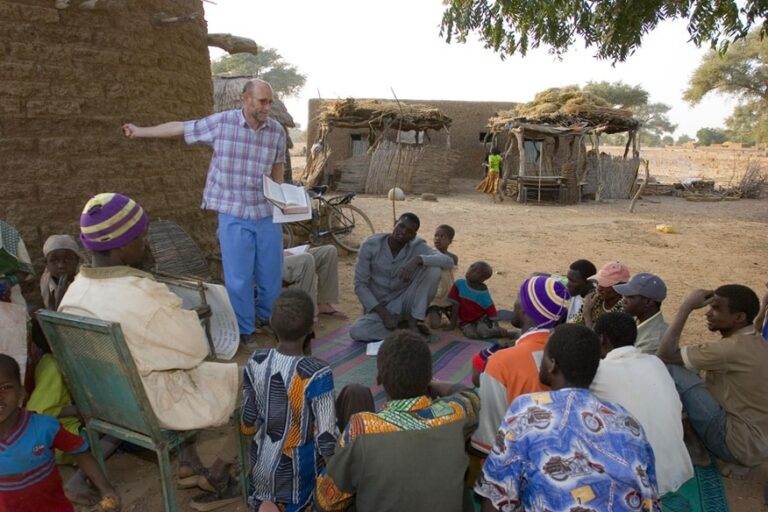
Competence is not a value, but learning is because everyone can learn. People with knowledge, teach others because it is not good to stand out for either good or bad. Knowledge is not gained or shared through reading and writing. It is gained through telling stories to each other that have been passed down through generations. People also learn by observing and experimenting.
Echoes of Christianity
While Indigenous peoples in this region experience many individual spirits, they are typically unfamiliar with the presence of an all-powerful God. However, some groups have simple legends without many details which seem to echo what we know in Christianity about God and Jesus.
For instance, the Kandoshi people have a legend that one time, long ago an all-powerful God sent his son to help them. During the child’s brief visit, he taught the adults many skills to live better. But the children of the community were jealous. They took the boy to the riverbank and threw sand in his eyes. The child went away crying and never came back. Because of that bad deed, God moved away and was never interested in them again.
Key Terms
Some of the main concepts in Christianity take effort to discover in other cultures. In some indigenous cultures in the Amazon, words like “forgiveness” are difficult to translate because most people run away from problems and never confront them. Other concepts like sin, salvation, and reconciliation can also be difficult to explain. Instead, these challenging words are often discovered within the context of a story or ritual which embodies the meaning of these key Christian terms. Full immersion offers the chance to discover these truths alongside a community. Without this understanding, it is impossible to talk to them about the value of receiving and living in Christ.
Bible Translation
In addition to discoverying key terms, translating the Bible into the local language in a contextualized way ensures that a community can continously learn about the one true God and be transformed by God’s truths within it. They need the whole Bible, and not only the New Testament. Without the Old Testiment, Jesus is presented as a man without a history. Indigenous people want to see his ties to his ancestors and community. The Old Testament fills in these essential details.
Contextualization is Rooted in Jesus
God demonstrates what contextualization looks like in Jesus himself. He is Immanuel – God with us. God fully immersed himself in our context by becoming a human, starting as an embryo that developed in the womb of a woman for nine months. He experienced parents, siblings, and extended family. He knew what it was like to be a part of a people group – the Jewish people. He learned and complied with human traditions, rules, and laws whether they were social, religious, or cultural.
Yet he never let his human life override his mission of redemption. After around thirty years of complete immersion as a human in the Jewish culture, he began his public ministry. He taught people from within their context in the style of teachers of that time. He listened and attended to the poor and most needy. He took his teachings to places where people were discriminated against and even to those beyond the boundaries of the Jewish culture.
God’s loved motivated him to contextualize himself as a man who dwelt among us. His love took him to the cross where he gave his life to rescue the humanity he came to know so well. Cross-cultural missionaries who fully immerse themselves in a culture discover how to contextualize the gospel. By doing so, they follow Jesus’s example. He shared his transformational message in a way that was understood and known deep in the heart. We need to do the same so that everyone understands Jesus’s invitation to be part of his Kingdom.

Irma Espinoza (irma.espinoza1@gmail.com) has worked alongside the indigenous peoples of the Amazon since 1977. She pursued studies in theology and missiology, and began her work with indigenous peoples thanks to a program presented by SIL in Peru. For 13 years, she lived among the Kandozi-Chapra people of Peru. She was involved in the founding of the Three Waves Movement (movimientotresolas.org, MTO), and continues to collaborate with them.
[i] Paul Lewis, Gary F. Simons, and Charles D. Fennig, eds., “Kandozi-Chapra,” in Ethnologue: Languages of the World, 23rd ed. (Dallas: SIL International, 2020), accessed February 06, 2024, https://www.ethnologue.com/language/cbu/.
[ii] “Candoshi, Shapra in Peru,” Joshua Project, accessed February 06, 2024, https://joshuaproject.net/people_groups/11090/PE.
EMQ, Volume 60, Issue 2. Copyright © 2024 by Missio Nexus. All rights reserved. Not to be reproduced or copied in any form without written permission from Missio Nexus. Email: EMQ@MissioNexus.org.