EMQ » January – April 2024 » Volume 60 Issue 1
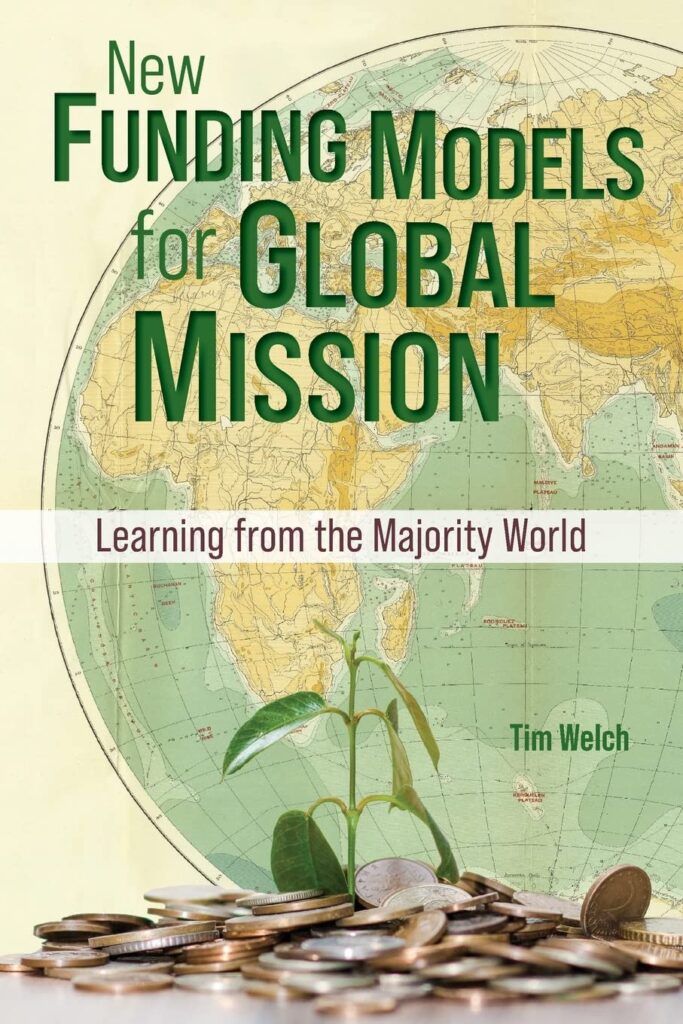
New Funding Models for Global Mission: Learning from the Majority World
By Tim Welch
William Carey Publishing, 2023
130 pages US$10.99
*As an Amazon Associate Missio Nexus earns from qualifying purchases.
Reviewed by Louisa Evans, a Malaysian PhD student at Fuller Theological Seminary and former lecturer at All Nations Christian College, UK.
Today, Christians in the Majority World outnumber those in the West two to one. This is projected to be three to one by 2050. Thus, what Tim Welch calls the “traditional” model of funding missionaries employed by Western evangelicals, where missionaries are responsible for raising support, is increasingly criticized. Why? It inhibits the recruitment of Majority World missionaries because it requires knowing people who can give and what many cultures view as “begging.”
This is culturally unacceptable in many non-Western contexts, and even among the younger generations in the West (4). The stakes are high: Without an answer to the question of how to fund missions, the two-thirds of the world that still does not know Jesus may not hear the message of salvation (14). This is the problem the book seeks to address.
The book chronicles ways of missionary funding from the Book of Acts to show that other models were used throughout history. However, the “traditional model,” proposed by William Carey in 1793, dominates current mission funding practice. Despite its weaknesses, Welch asserts that this model can be tweaked to be more effective.
Nevertheless, other models must be considered by Majority World Christians – not only because they “cannot afford this model” (21) but because “what works for one culture cannot be exported to another” (23). Welch then presents 18 alternative models that provide less difficult ways to find financial resources, thus allowing more Majority World missionaries to be sent.
In the last four chapters, Welch lays out the biblical principles of mission funding, challenges the church to invest in the Majority World like the business world is doing, argues that churches that are generous toward mission experience improved finances, and concludes with 15 recommendations for Majority World churches.
For evangelical missions and church leaders wrestling with the question of funding missions, this book offers ways to “break out” of the traditional model. It generates awareness of creative, alternative ways to finance missions, particularly those from “the margins” from which Welch hopes the West can learn. However, while promoting alternative funding models for the Majority World, Welch seems unwilling to abandon the traditional model despite its growing ineffectiveness, perhaps due to his focus on the “missionaries” as the primary agents of mission.
In contrast, for most of history, witnessing was part of Christian life not as missionaries but as ordinary believers, often scattered by persecution. This is not recognized despite his pointing out that Africans participated in cross-cultural missions in Acts 11. Today, there is a growing understanding that the whole church, rather than the missionary alone, is called to participate in God’s mission.
This shift in the understanding of mission requires a more radical rethinking of how global mission is funded than what Welch proposes. Nevertheless, the book contributes to a much-needed conversation on “money and missions” that Christians often shy away from and the urgent need to enable Majority World Christians like myself to participate in God’s mission.
For Further Reading:
A Multitude of All Peoples: Engaging Ancient Christianity’s Global Identity by Vince L. Bantu (IVP Academic, 2020).
The Realities of Money and Missions: Global Challenges and Case Studies edited by Jonathan J. Bonk, Michel G. DiStefano, and J. Nelson Jennings. (William Carey Publishing, 2022).
Beyond Christendom: Globalization, African Migration, and the Transformation of the West by Jehu Hanciles (Orbis Books, 2008).
EMQ, Volume 60, Issue 1. Copyright © 2024 by Missio Nexus. All rights reserved. Not to be reproduced or copied in any form without written permission from Missio Nexus. Email: EMQ@MissioNexus.org.