EMQ » January – April 2024 » Volume 60 Issue 1
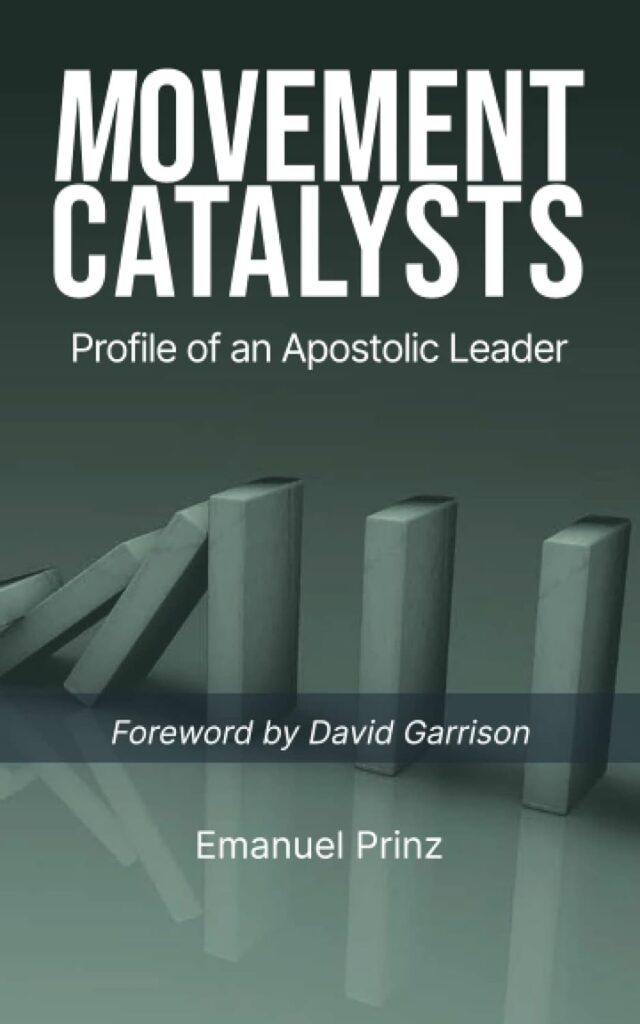
Movement Catalysts: Profile of an Apostolic Leader
By Emanual Prinz
Independently published, 2022.
206 pages US$12.99
*As an Amazon Associate Missio Nexus earns from qualifying purchases.
Reviewed by David Greenlee, PhD, missiologist for Operation Mobilization based in Tyrone, Georgia.
Describing, understanding, and at times critiquing rapidly growing Christ-centered movements has become a significant theme in mission strategy and missiology. While various authors have described how God is at work, Emanuel Prinz together with his team centered at the Bethany Research Institute carries out the most extensive research effort into the competencies of movement catalysts.
Prinz’s recent book Movement Catalysts is developed from his 2016 Columbia International University dissertation, an in-depth study of 31 apostolic leaders who have been effective in catalyzing a movement in a Muslim people group. These catalysts have contributed to the start of 35 movements among 28 people groups in 15 different countries.
Prinz’s key finding is that “the person of the apostolic leader is the key element that determines whether or not a movement is launched, not the method he or she employs” (100). Prinz explores and commends many of the widely known movement methodologies and approaches. However, his findings demonstrate that although a worker may be handed a good strategy and methodology, without the traits and competencies identified (including those related to prayer and dependence on God) the worker will most likely be ineffective.
One strength of Movement Catalysts is its solid grounding both in missiological literature and studies related to leadership and trait theory, offering us a compact summary of the insights of important publications on these themes. Coupled with a good research approach, the hard work Prinz went through in studying these sources is solid ground upon which he stands as he moves ahead with confidence and rigor in analyzing and presenting his findings.
A second strength I find is the detailed list of traits and competencies of movement catalysts, drawing attention to those typical of all the fruitful catalysts in his study as well as a further list of qualities ascribed to most of the sample. A chapter on best practices offers us illustrations of how each of these traits and competencies are lived and experienced by the study participants.
A further strength is in Prinz’s thoughtful recommendations. For example, rooted in his findings on the combined role of internationals and near-culture workers in the formation of movements, he suggests a partnering role focused on pioneering efforts among unengaged and frontier groups.
Finally, Prinz offers us a helpful model of an apostolic leader. The model is not static but is the subject of ongoing research and writing by Prinz and his team, based on a much larger and wider, global pool of movement practitioners.
Whether field missionary or agency leader, professor, or missions student, I commend Movement Catalysts as a good start to understanding Emanuel Prinz’s important research. Do not stop here, though; pursue his team’s ongoing publications including their occasional reports and Prinz’s frequent blog posts (see below), many of which are published as resources available to a global audience.
For Further Reading:
Motus Dei: The Movement of God to Disciple the Nations edited by Warrick Farah (William Carey Publishing, 2021).
Acts and the Movement of God from Jerusalem to the Ends of the Earth by Steve Addison (100 Movements Publishing, 2023).
Catalytic Leadership blog by Emanual Prinz (https://www.catalyticleadership.info/blog).
EMQ, Volume 60, Issue 1. Copyright © 2024 by Missio Nexus. All rights reserved. Not to be reproduced or copied in any form without written permission from Missio Nexus. Email: EMQ@MissioNexus.org.