EMQ » January – April 2024 » Volume 60 Issue 1
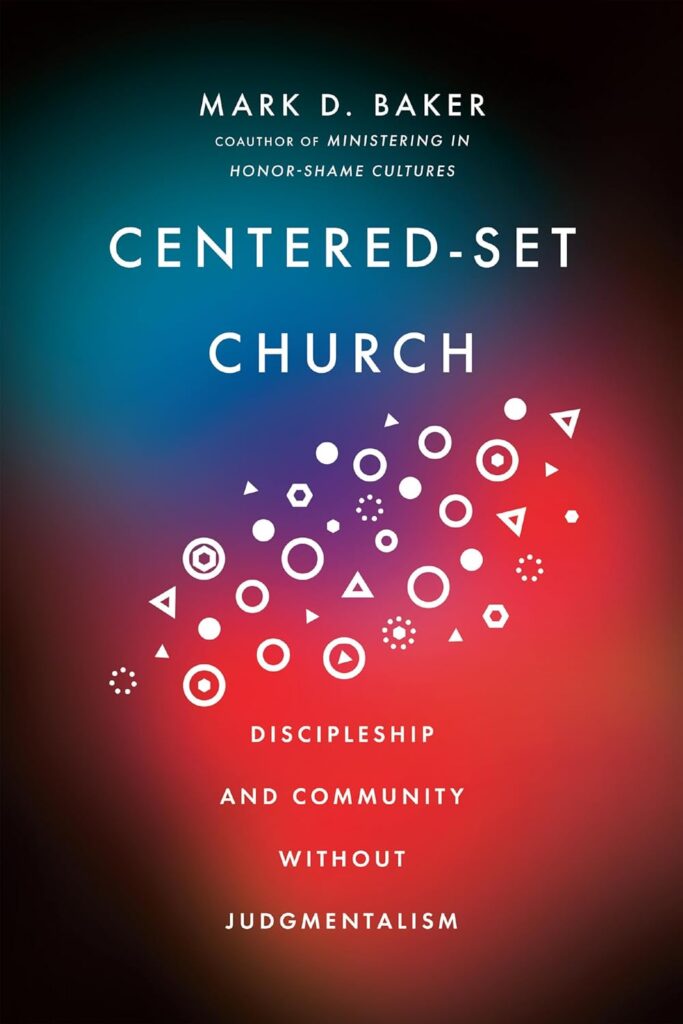
Centered-Set Church: Discipleship and Community Without Judgmentalism
By Mark D. Baker
IVP Academic, 2021
247 pages
US$16.50
*As an Amazon Associate Missio Nexus earns from qualifying purchases.
Reviewed by William R. Green, an affiliate professor at Kairos University and the associate editor of the journal Missiology: An International Review with a decade of pastoral and church-planting experience in East Asia and the Northeastern United States.
In the complex milieu of contemporary Christian congregations, some churches have elected to draw clear rule-based boundary markers that delineate “proper Christian behavior,” known as “bounded set” churches. On the flip side are churches disillusioned with this rigid approach and forgo most such markers in favor of a more ambiguous conciliatory “fuzzy set” approach to faith and congregational life.
Mark D. Baker (PhD, Duke University), professor of Mission and Theology at Fresno Pacific Biblical Seminary in Fresno, California, cautions against adopting either approach. Influenced by the work of missionary anthropologist Paul Hiebert, he champions an alternative “centered-set” church model, which he asserts not only fosters genuine freedom but also promotes robust spiritual growth and vibrant relationships.
The book unfolds through four logically structured parts. The first delves into the unique characteristics of bounded, fuzzy, and centered-set churches and concludes with Baker interfacing his articulation with frequent queries in the broader discussion. Underscoring the necessity of doctrine, ethics, freedom through Christ, and the fundamental necessity of love that permeates all aspects of centered-set churches, part two describes what it means to have God at the center of a church.
Building on this foundation, parts three and four turn to more practical and applied considerations. That is, part three focuses on discipleship in community, and explores themes related to centered approaches to exhortation, character development in light of the qualities of Jesus, methods and ideas to contextually practice loving intervention, and the necessity of discipleship that leads to transformation. In a related vein, part four focuses on a centered approach to ministry and culminates in a vivid tableau of the richness of centered-set churches: individuals journeying together in authentic relationships, repentance, forgiveness, reorientation, and love.
Within the ongoing debate surrounding the centered-set model, Baker makes several novel contributions. In this text, we find a refreshingly accurate representation of Hiebert’s anthropological work, which distinguishes it from the vast majority of books that get it wrong (see Yoder et al. below). Moreover, Baker brings theological acumen that is not always observed in discussions on the topic. Finally, and despite the intricate anthropological and theological themes, his work remains remarkably accessible, enriched by his own missionary experiences and the shared testimonies of numerous practitioners and congregants.
In sum, Baker adeptly navigates dual pitfalls: the stringent confines of bounded religiosity and the hazards of boundless relativism. As such, it is an indispensable resource for pastors and church leaders. Moreover, the optional supplementary 5-part video course, referenced below, enhances its utility, making it a valuable tool for small groups as well as lay members on a journey of healing from past wounds acquired in the church.
As someone who has followed the discussion for many years, I offer a hearty bravo!
For Further Reading:
Introducing Centered-Set Church by Mark D. Baker (https://jesuscollective.com/centered-set-church-series).
“The Category Christian in the Mission Task” in Anthropological Reflections on Missiological Issues by Paul G. Hiebert (Baker Books, 1994), pp. 107–136.
“Understanding Christian Identity in Terms of Bounded and Centered Set Theory in the Writings of Paul G. Hiebert” in Trinity Journal 30, no. 2 by Michael L. Yoder, Michael G. Lee, Jonathan Ro, and Robert J. Priest (2009): 177–88.
EMQ, Volume 60, Issue 1. Copyright © 2024 by Missio Nexus. All rights reserved. Not to be reproduced or copied in any form without written permission from Missio Nexus. Email: EMQ@MissioNexus.org.