EMQ » July–September 2023 » Volume 59 Issue 3
[mepr-show rules=”100329″]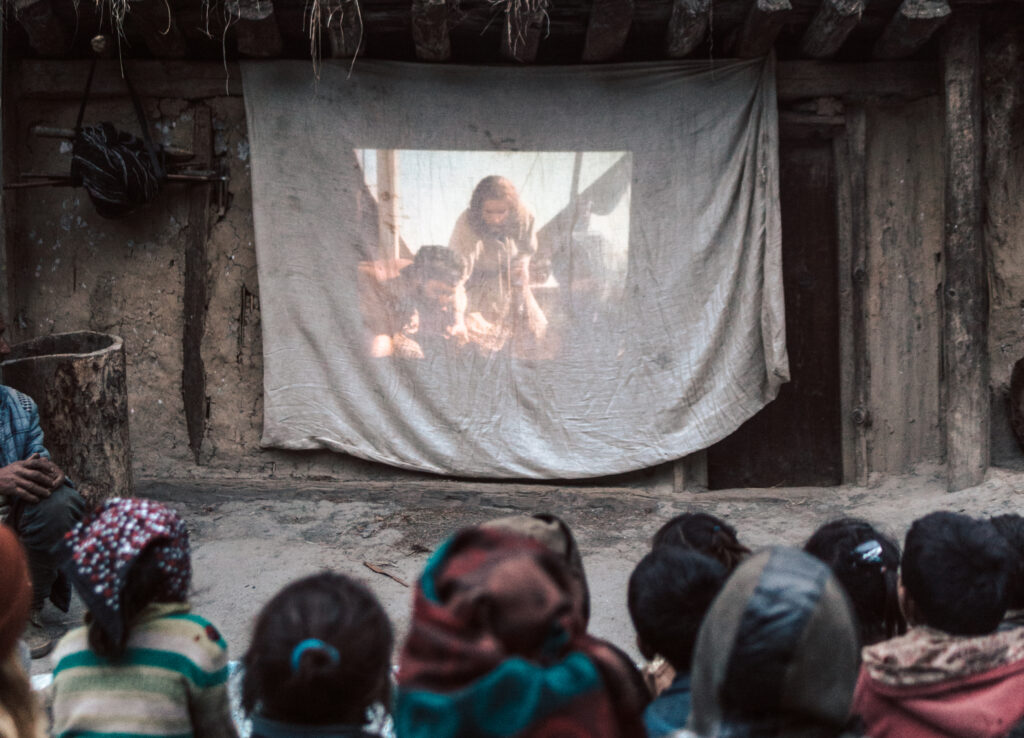
Summary: Innovative strategies are linking new and existing methods of evangelism and discipleship in ways not previously explored. In many cases, technology is playing a key role. The result is rapid expansion of the global church on both quantitative and qualitative levels.
By Josiah Palusky
The twenty-first century opened the floodgates. Urbanization, smartphones, social media, and the internet each brought new opportunities to rapidly spread the gospel message. Alongside the digital age, another revolution was gaining momentum: disciple making movements (DMM) and church planting movements CPM). This multiplication-focused missions community brought a powerful shift towards discipleship, but an ideological divide grew between movement practitioners and ministries that focus on mass gospel proclamation.
I grew up in a missionary family that stressed discipleship and the slow, relational task of community transformation. When I heard ministries talk about millions of people clicking an “I accepted Christ” button on their evangelistic website I would roll my eyes and say to myself, come on guys.
However, my outlook began to change when I started meeting people who were highly invested in discipleship and used mass evangelism strategies to catalyze discipleship and church planting movements. I started to ask questions.
What if these two worlds aren’t mutually exclusive?
What if mass communication strategies can accelerate movements?
The Funnel / Loop Framework
Bear with me for a little terminology (I promise it’ll be worth it). Let’s refer to mass evangelism strategies as funnels and discipleship structures as loops.

FUNNEL
Definition: an evangelism strategy that efficiently reveals people who are seeking Jesus.
In the marketing world, funnels are communication strategies that take a broad group of people down a path that reveals individuals of interest. In missions, we can use the same term to describe strategies that cast a wide net and find seekers. Examples include:
- Gospel crusades
- JESUS Film showings
- Evangelistic online ads
- Social media posts
- Door-to-door evangelism

LOOP
Definition: a discipleship strategy that develops, mobilizes, or multiplies followers of Jesus.
The loop terminology also comes from the marketing world. It refers to self-feeding funnels that mobilize people to reach others.i The following are some examples of missions-related loop strategies:
- Disciple Making Movements (DMM)
- Church Planting Movements (CPM)
- Discovery Bible Studies (DBS)
- Bible Listening Groups (BLG)
So, here’s the big question …

What Happens When a Funnel Pairs with a Loop?
In the book How Innovation Works, Matt Ridley argues that innovation isn’t the invention of entirely novel ideas, but rather involves the combination of existing things.ii Powerful ideas come from synthesizing existing tools or processes.
More and more people are combining funnels and loops to create powerful missions innovations. Gospel films, open-air preaching, and short-form social media videos are being connected to discipleship strategies are opening new opportunities for partnership and innovation in the kingdom of God.
2% to 200%: How the JESUS Film Launched a Reformation in the Amazon
Funnel: JESUS Film Showings
Loop: Audio Bible Listening Groups
Do you remember Frogger – that old arcade game where you hop around as a little frog and try not to get squashed? In the spring of 2005, I was playing Frogger so that I didn’t have to watch a man die (I promise this is on topic).
I was nine years old. We’d just shown the JESUS Film to a remote community in the Amazon. It was going great until the chief started vomiting water and shriveled into a living corpse right in front of us. If he didn’t get better, the community would think that we killed him. Not good.
I deserted my earnestly interceding parents and went back to the boat to play Frogger on my scratched-up 2002-era GameBoy Advance. Remember – I was nine. While I was gone, the chief leapt out of bed, completely healed. I totally missed it, all for a little green digital frog. To this day, I don’t like Frogger. Video games just can’t compete with the glory of God.
The fame and power of Jesus traveled far into the rainforest, and suddenly everyone in this people group wanted to watch the JESUS Film. We knew that we needed a follow-up discipleship strategy. We heard others say that after evangelistic showings without discipleship, very few new believers continued to identify as Christians as time passed.
Around this time, we heard about a study that would revolutionize the way we approached missions. Faith Comes by Hearing and the JESUS Film partnered to take more than 4,000 villagers who had responded to the JESUS Film (funnel) and put them into small groups listening to the Word of God using solar-powered audio Bibles (loop). By simply adding a loop strategy to their funnel, JESUS Film teams saw the number of believers in each region from the study grow by more than 200% over six months.iii 2% to 200%. We had to try it.
Step 1: Show the JESUS Film
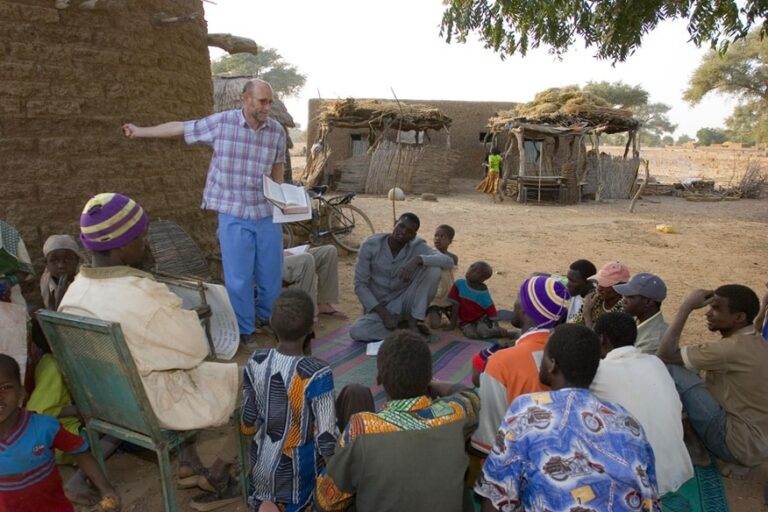
A local long-term missionary friend led a team to 20 villages from the same community as the healed chief. The team invited each community to send delegates to learn about Jesus and receive an audio Bible. They went to multiple villages each day, and if it was dark enough, they’d show the JESUS Film. Every village that saw the JESUS Film sent people to receive the Bible. Every village that didn’t see the film didn’t send anyone. We were floored. The funnel worked.
Step 2: Start Audio Bible Listening Groups
BLGs began in the villages that had shown interest. Over time, workers on the ground noticed participants who had integrity and leadership potential.
Step 3: Train and Mobilize Indigenous Disciplers
Devoted Christians from the listening groups were invited to join a discipleship school. Young Christians from other tribes got wind of the training, and as of 2023, indigenous believers from 12 unique people groups have been mobilized and sent out as indigenous missionaries. When the JESUS Film (funnel) was connected to audio BLGs and discipleship training (loop), a movement began from the indigenous to the indigenous.
We were hooked. Over the past decade, I’ve spent much of my time training missionaries to combine the JESUS Film with audio BLGs. A couple of years ago, I had a realization: movies aren’t the only way to share the gospel with a group of people; listening groups aren’t the only way to develop believers. There had to be other funnel and loop combinations we hadn’t discovered yet. One obvious funnel came to mind: evangelistic crusades.
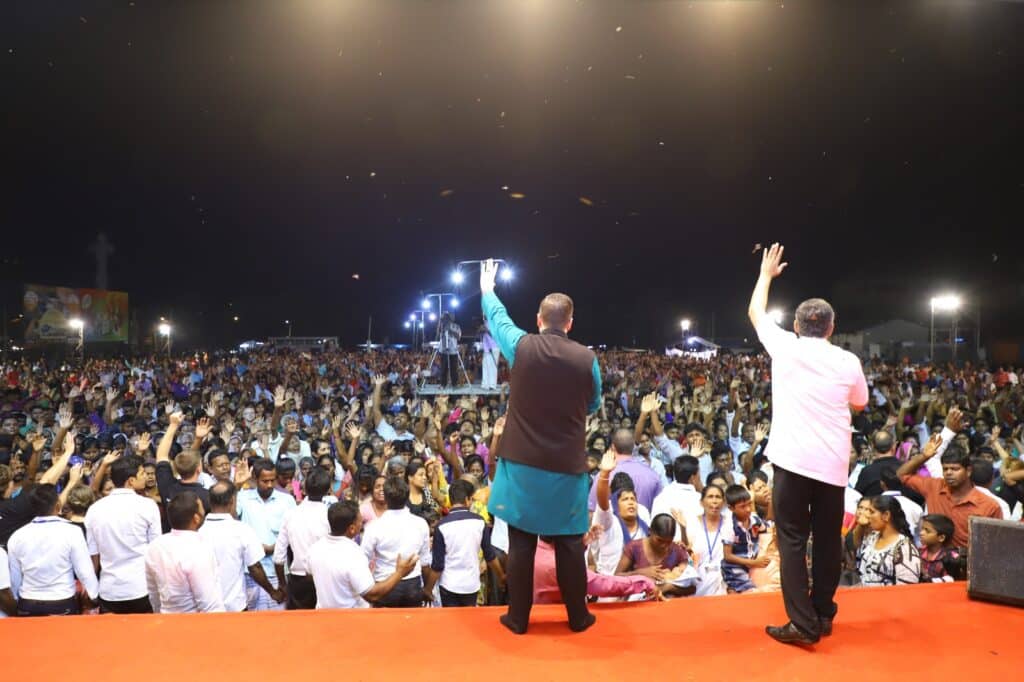
Billy Graham Crusade 2.0: Using Open-Air Gatherings to Launch Movements in South Asia
Funnel: Open-Air Preaching
Loop: Disciple-Making Movements
A few years ago we started snooping around to see if anyone had experimented with the intersection of open-air gatherings and movements. Someone on the Renew World Outreach (renewoutreach.org) team reached out to Curtis Sergeant (obeygc2.com), a pioneer in the DMM/CPM community, and he connected us to Josh Howard. Josh works with E3 Partners (e3partners.org), and in 2022 his team saw over 8,000 churches planted in a single South Asian country. That wasn’t why Curtis wanted us to talk, though. Josh has a controversial side-hustle: he’s a stadium evangelist.
“I have had conversations with many movement practitioners who think that I’m… a traitor for doing open-air events,” Josh said as he laughed. He was chatting with me via Google Meet from South Asia, 8,000 miles from my office in Atlanta, Georgia. Behind him were whiteboards with missions strategies scrawled all over them.
“Since I was like 13, I dreamt of doing big open-air events and reaching a lot of people for Jesus. Billy Graham and Reinhard Bonnke became big time heroes, and I was ready to go after it.”
He paused. “When I moved to South Asia though, that dream kind of died. [The assumption was that] as an American living in a closed nation, those types of events wouldn’t be wise.”
Laying down his plans, Josh trained as a DMM practitioner. He mobilized disciples to multiply across the country and began to see churches planted, but his dream for mass evangelism never found closure.
“In the New Testament, the open-air proclamation of the gospel was always tied to disciple making. Historically, they have become divorced from one another. Most crusade evangelists never do church multiplication stuff, and most movement multiplication guys think that crusades are like… the enemy’s work.” He burst out laughing. “But, we can’t base our strategies on failures of previous generations. We need to base our strategies on what Jesus and his disciples did.”
What would it look like to put public gospel proclamation events (funnel) and disciple-making (loop) back together again? Josh decided to try it. Initially it didn’t go as planned. In 2017 he hosted a condensed discipleship training for local believers and then held an open-air crusade in their region.
There were hundreds of indicated salvations, but no churches or movements came out of the effort. The discipleship crash-course given to the follow-up team didn’t stick. Instead of giving up on his vision, he went back to the drawing board. Through trial and error, his team came up with two main strategies:
Strategy 1: Use an Event to Launch Long-term Disciplers into an Unreached Region
Josh’s team started going into regions that had almost no churches or believers. Events helped launch disciplers into new regions with hundreds of people already begging to be discipled. They would recruit one or two externally trained church-planters who were committed to move to the location after the event. These people would then plant churches using the decision cards that they received.
“A guy can go house to house alone and reach people, but it will take him a lot longer than what we can do in a few days,” Josh explained. “We can speed up the process … so that he hits the ground running.”
Josh’s team began to see church-planting movements launch almost instantly in unreached regions following crusades.
Strategy 2: Use an Event to Accelerate a Movement That’s Already Happening
Strategy 1 was helpful in rural, unreached regions, but Josh’s team needed something else for places that had larger populations as well as local Christians. The team found that evangelistic gatherings could speed up a current movement by bringing a huge influx of seekers into it. While most legacy crusade follow-up strategies involved handing off decision cards to established churches, Josh found that feeding seekers into a current discipleship movement was more effective for continued and long-term growth.
“I used to have this dream to reach 100,000 people a year with the gospel in my country,” he said, “but I realized that if 100,000 people were added to traditional churches without multiplying, it would take us 13,000 years to reach this one country. We had to start asking different questions like, ‘what’s it actually going to take to see no place left unreached in this nation.’ The only way to do that is through multiplication.”
While we were on our call, Josh told me that he’d heard about someone who was using the internet as a funnel to drive people towards online Scripture-focused communities. He connected me with his friend, Cam Huxford. I didn’t know what I was about to walk into.
Using TikTok to Uncover Disciples in the United States
Funnel: Short-form video (TikTok + Instagram Reels)
Loop: Online Discovery Bible Studies (via Zoom)
Before I dig into how Cam is seeing social media drive discipleship, let me take you back to 2013. I was 17. My car still had a tape player. I’d just dumped my dumbphone. I sat in the corner of our barn sweating my brains out in the Georgia heat while I edited training videos on how to share the JESUS Film on cell phones. Spotify was just getting traction, and it was playing in the background. A song came on, and through my $7 earbuds I heard these words:
Where were you the day that I measured / Sunk the banks and stretched the line over / All the earth and carved out its cornerstone?
Where were you the day that I spoke and / Told the sun to split the night open / Calmed the morning dawn with its light to show?
As the song continued to describe the showdown between Job and God in Job 38, chills went up my spine. I started tearing up and stared blankly at the computer screen, totally captured. The song, “Where Were You” by Ghost Ship, instantly became one of my favorites.
Fast forward to 2023. I’m talking to some guy on the phone who’s using social media as a funnel to form Discovery Bible Studies. Turns out he leads a band too. I asked him what its name is. “It’s called Ghost Ship,” Cam mentions casually.
What on earth? Questions blew through my mind, rapid-fire. Cam Huxford is the lead singer from Ghost Ship! What led a successful worship leader with thousands of fans to step off the stage? What led him into online ministry and movements?
Cam’s band was launched out of Mars Hill Church in Seattle (the topic of “The Rise and Fall of Mars Hill,” a popular and controversial podcast in 2021). After the infamous implosion of the church, Cam began to wonder if there were better models for discipling the lost. He kept playing shows with Ghost Ship and found that young non-Christians at his concerts were eager to talk about spiritual things. He was launching a new church with friends and was excited to invite them.
“I would say ‘Hey, we also lead worship down the street, you should come on Sunday.’” On Sunday, no non-believers would show up. “God kept putting the passage of the Great Commission on my heart: go and make disciples. It seemed like, well, if the next generation is going to come to faith, someone is going to have to go to them.”
Cam’s team started toying with an idea: what if the internet was key to helping Christians connect with non-believers? Around this time, he met Josh Howard, who told him about the fruit of multiplying discipleship in South Asia. Cam’s life was flipped upside down. What if God could do this in America? He pulled together a team and launched something called Monochurch (mono.church).
“The mission statement of Monochurch is to go to the next generation online, and then disciple those who respond in our homes.” Through trial and error, the team began to build a model that ties together social media (funnel), and online Discovery Bible Studies (loop).
Step 1: Create Short-Form Videos Aimed at Non-Believers
“If you look in the online space, it’s really hard to find Christians or Churches with a non-Christian audience.” Cam said. “I was like, okay, clearly there is a vacuum for content online that is created for the non-Christian.”
Cam started posting sermons on TikTok. At first, they didn’t get any traction. One day, someone on his team uploaded a short, vulnerable story from one of Cam’s sermons to the account. The video went viral. Cam was shocked.
“It reached, like, over 500,000 people in a week.”
Step 2: As People Comment on Videos, Reach Out to Them Individually
The video following it generated thousands of back-and-forth conversations on TikTok.
“People online are looking for connection.” Cam stressed. The Monochurch team began facilitating meaningful conversations, meeting people with their felt needs.
Step 3: Invite People to Join an Online Discovery Bible Study
Cam emphasized that the goal of all of this was discipleship: “After we start conversations in the comments, we go ahead and invite people into Discovery Bible Studies on Zoom.” The Monochurch team started forming online Bible studies and inviting people who had interest.
Step 4: Build a Bridge to In-Person Discipleship Community
To prepare for the future, the Monochurch team is planting house churches around the country to eventually facilitate the discipleship of online seekers. Monochurch is building a bridge between the funnel of online short-form video content and the loop of in-person discipleship movements.
“No young people are on dating apps because they want to have digital dating,” Cam explained as he laughed. “They’re on there so they can get to the [in-person] date as quickly as possible. There is a pathway to go from an online conversation with a non-believer to an in-person relationship.”
Innovation in the Kingdom of God
In Matthew 7, Jesus said: “Ask and keep on asking and it will be given to you; seek and keep on seeking and you will find; knock and keep on knocking and the door will be opened to you” (AMP).
The people uniting funnels and loops have something in common: they aren’t afraid to fail. Josh’s dream to merge open-air preaching and movements didn’t work the first time. When Cam started posting videos online almost nobody watched them. Instead of giving up, they went back to the drawing board. Innovation in the Kingdom of God looks like dreaming with God and having the faith to keep asking, seeking, and knocking.
I have a friend who mobilizes missionaries to use Facebook for evangelism. He told me that his greatest challenge is that ministries don’t know how to innovate. When we’re trained on one system, we apply the same concepts year after year, long after they have become ineffective. We’re afraid to fail, so we camp around systems that have worked in the past. What if God is just waiting for us to humbly try something new? What if he has new wine for a new generation?
The night after I talked to Cam Huxford I sat in my bed, silent. My B-stock Telecaster electric guitar hung in the corner of my room. I’d been writing songs and posting them on TikTok hoping that one day people would watch them and open up to Jesus. I hadn’t posted in a while; I wanted everything to be perfect and polished. I wanted to be impressive. God had given me something that I could use as a funnel to find the lost, but one thing was stopping me: fear. I let out a deep breath.
Let’s do this.
I flipped on my camera, grabbed my Telecaster, and started to sing.

Josiah Palusky (josiah@renewoutreach.org) is the lead software developer at Renew World Outreach, a missions technology nonprofit in Atlanta, Georgia. Josiah helped create the LightStream, a WiFi box that distributes digital media in regions with limited internet connectivity. He is also pioneering Renew’s Missions Innovation Center, an initiative to champion technology and emerging opportunities in missions.
EMQ, Volume 59, Issue 3. Copyright © 2023 by Missio Nexus. All rights reserved. Not to be reproduced or copied in any form without written permission from Missio Nexus. Email: EMQ@MissioNexus.org.