EMQ » April–June 2023 » Volume 59 Issue 2

Summary: OMF began its journey into creation care in the 1950s when work expanded into Southeast Asia. Building on that history, we later wrestled with what the Bible has to say about creation care. We stood convicted to see the gospel lived out in all aspects of our lives and work. This led us to look at creation care as a posture that must be integrated in all we do rather than a program requiring experts.
By Jasmine Kwong
Although many Christians know the creation account in Genesis, how many of us read the whole Bible considering the entirety of creation, or ponder how creation and the gospel are connected? When we consider the need for personal salvation, we often focus on the relationship between a person and God, and redemption through Jesus Christ. Even though personal salvation has both vertical and horizontal dimensions, emphasizing only our vertical relationship may lead to underdevelopment in our horizontal relationships with other people and with the natural world.
As the global church grows in its concern for ecological issues (like biodiversity loss) alongside intensifying natural occurrences (like typhoons), dialogue about the relationship between Creator and creation is increasing. We also cannot avoid how the poor both bear the brunt of ecological challenges while also contributing to the damage that impacts their survival. Athena Gorospe, associate professor at Asian Theological seminary explains it this way:
“While the poor bear the brunt of the climate change and environmental degradation they also contribute to the damage impacting their daily survival, thus leading to a downward spiral, in which the further depletion of resources leads to increasing poverty. Hence, to address one without addressing the other fails in providing long-term solutions.”[1]
So we begin to ask: How is our relationship with God linked to our relationships with other people and the rest of creation? How should followers of Jesus respond to ecological crises and injustices? What does it mean to integrate creation care as we participate in God’s mission to redeem all creation?
OMF International (OMF) has wrestled with what the Bible says about creation care and the gospel, as well as how these questions can be answered for individuals, churches, and mission organizations. As we examined the biblical basis for our convictions, we concluded that some of our mission paradigms needed reframed. This led us to focus on living out the gospel in the whole of life as a posture (attitude) rather than only a ministry program. We’ve found that this holistic way of participating in God’s mission leads us into many areas of tension and opportunity. And these prompt us to continually reflect and grow as we engage faithfully in God’s Word and world.
OMF and Creation Care
God’s story of his creation in the Bible is not new to the global church. Yet, the Western evangelical missions’ emphasis on building the Church through the salvation of individual souls has historically led to a neglect of caring for needs in human society and concern for the rest of creation. At the 1974 Lausanne Congress, theologian René Padilla critiqued the exportation of Western Christianity to the world – resulting in evangelism without social action.[2] He coined the term misión integral or integral mission as an expression of the united practice of both evangelism and social action in mission.
OMF’s church planting efforts are widely known. While part of OMF’s vision is “to see an indigenous biblical church movement in each people group of East Asia,”[3] traditional church planting has not been OMF’s sole focus. Indeed, Hudson Taylor, the founder of China Inland Mission, which later became OMF, proclaimed the good news of Christ to the Chinese while also addressing their health concerns as a medical doctor.
In the 1950s when OMF’s work extended into the Philippines and Thailand, evangelism was integrated alongside sustainable agriculture and other practical services in work with a variety of communities.[4] This was the beginning of OMF’s journey into creation care. And we continue to see examples of creation care in OMF’s work among East Asia’s peoples.
OMF’s concern for creation has also closely reflected that of the Lausanne Movement. The Cape Town Commitment, which was crafted at the third Lausanne Congress in South Africa in 2010, declared “creation care as a gospel issue under the Lordship of Christ.”[5]
David Gould, OMF’s first international facilitator for creation care, was involved in the Lausanne Global Consultation on Creation Care and the Gospel in Jamaica in 2012, which produced a Call to Action. It reiterated the place of creation care in mission.[6] Since then, “OMF welcomes and has signed the Lausanne statement on creation care and the gospel.”[7]
In 2013, OMF’s international leaders identified the three following aspirations for creation care:
- As part of being disciples, we should practice creation care
- As part of our disciple-making we should teach creation care
- As part of mission strategy we should consider creation care.[8]
OMF also created its own statement on the theological basis for creation care. It was published in the May 2014 edition of the Mission Round Table Journal (MRT). The statement explores “God’s purposes and concern for his creation.”[9]
In the same MRT issue, David Gould includes an article entitled, “Creation Care in the Mission of CIM and OMF: People and Places.” He uses Five Marks of Mission, which is described by theologian, Chris Wright (who also contributed to OMF’s theological basis). In the Five Marks model, five areas comprehensively describe how we participate in the mission of God.
Wright says, “all five marks can be linked to the Great Commission…provided we put at the centre of all of them the opening affirmation of the Great Commission: the Lordship of Christ over all creation.”[10] These marks include: evangelism, teaching (discipleship), compassion (loving service), seeking justice, and caring for creation. Gould describes the last three as “practical demonstrations of godly living.”[11] Mission that excludes any of these is considered incomplete, or as Al Tizon terms it, a “half gospel.”[12]
OMF’s commitment to creation care as an integral part of God’s mission is reflected more recently by OMF’s General Director Patrick Fung who currently presents integral mission as one of OMF’s priorities.[13] This articulation of an integrated approach helps us understand some of the theological and missiological reflections in OMF in recent years and the consequent changes.
In all of this, OMF strives to live out creation care as a posture rather than seeing it as a program. While there are some in the organization with specific expertise in addressing ecological issues and others who understand the relationship between people and places, we are not trying to form a team of experts. Instead, the aim is for everyone to integrate creation care as part of our witness and discipleship as we work towards our vision of church and mission movements among East Asia’s peoples.
Taking a Posture Approach
So what does a posture approach to creation care look like? Regardless of our ministries and contexts, we can care for creation not only in what we do, but in who we are. This reflects OMF’s know-be-do approach. Our care of creation is fostered out of knowing Creator God, becoming more aware of how we are made to love and care, and then responding to creation in action.
Each of us looks for ways to be faithful in caring for creation. Some advocate to conserve rainforests, others cook farm-to-table meals. Some provide clean water for vulnerable communities, and still others teach the biblical basis for creation care at seminaries.
Because of our wide spectrum of interests, no precise ways to care for creation are prescribed, providing freedom for a variety of creation care expressions. Our lives and ministries are spread out in different places, and this gives unique opportunities for engagement that are specific to our locations. The following three examples illustrate what a posture approach to creation care looks like in different contexts.
Mongolia: Waste Becomes Opportunity[14]
The capitol city of Mongolia, Ulaanbaatar, has one of the highest levels of air pollution in the world.[15] It is located in a valley surrounded by mountains. With long winters and temperatures usually dropping well below freezing, burning coal is the most common heat source. Fumes released from burning coal pool in the air. The mountains trap it creating smog within the valley.
Kwai Lin is the former Executive Director of JCS International (JCS), which is a Christian non-governmental organization (NGO) in Mongolia. For many years, JCS has been concerned about air pollution and has worked to educate others about its impact.
Ben is a waste specialist from the UK with experience in running small businesses. He wanted to use his professional skills for God’s glory, so he contacted several organizations to find out how he could serve. OMF matched him with an opportunity in Mongolia to work collaboratively with JCS and other local NGOs.[16]
Together, Kwai Lin and Ben partnered with Betel, a local Christian group working among people in addiction recovery.[17] This community of about 80 to 100 is based in the impoverished Songinokhairkhan district in Ulaanbaatar.[18]
Littered cardboard and other paper waste is a common sight in Songinokhairkhan. Ben viewed this waste as “a resource rather than a liability.”[19] He explored a better disposal process that matched his values. He explained, “God’s kingdom ‘on earth as it is in heaven’ means looking after creation.”[20]
Like many other Mongolians, the Betel community burned coal to heat their buildings. Working together with Ben, JCS encouraged and helped the Betel community experiment with an alternative fuel using the paper trash in the area. Paper waste was collected, turned into pulp, and then formed into briquettes.
The briquettes were then burned in place of coal. Betel eventually set up a formal recycling service to collect more cardboard for their briquettes. Gradually, this waste collection effort became a small business operation.[21]
Not only did making briquettes help clean up the area; they also helped the community to earn an income. The Betel community began to sell the briquettes as a cheaper, cleaner alternative. Eventually, “they reduced coal burning by 40%!”[22] The waste went from a nuisance to an asset to the community.
SE Asia: Mangroves Connect a Community[23]
Qun-Ying[24] serves with OMF in Southeast Asia. On her first ride through a marine forest in that region, Qun-Ying was amazed by all the beauty and diversity. When she later returned to live in that same area, she noticed that many local people had not spent time exploring the mangroves. Some even tossed trash into the water.
Knowing that the more familiar people are with where they live, the more they care for it, she started bringing local friends with her when she took boat trips around the mangroves. Many were surprised by the beauty of a part of their homeland they’d never visited before. She even witnessed this leading to greater curiosity about the Creator God.
When a nearby dredging construction project began, Qun-Ying noticed the mangrove’s water quality degrade. She did not want her local friends to lose this beautiful landscape which portrayed God’s glory to them, nor risk their fishing livelihood. So she decided to pursue a PhD to research the situation.
Healthy coastal ecosystems need a combination of flourishing mangroves, seagrasses, and coral reefs. To better understand the whole mangrove area, Qun-Ying is using seagrass as her research index. With the help of local friends and fisherman, she is testing water quality in areas with varying amounts of seagrass. Including the local community in the process is part of her work to connect people more deeply with each other, their surrounding seascape, and the Creator God.
UK: Creation Care in an Office[25]
The OMF UK team has found their own ways to relevantly respond to creation care issues in their context. They identified four primary areas to focus their efforts: air travel, office, mobilization, and communication.
To respond to air travel, the UK team partnered with Climate Stewards to learn how to reduce their carbon footprint.[26] Whenever possible, the team tries to fly less, and when they do, they carbon offset their flights. At the office, the team installed solar panels and low energy lightbulbs to reduce electricity use.
In the area of mobilization, the UK team committed to explore creative ways for people to engage in God’s mission through creation care. Finally, in organizational communication, they are intentionally promoting creation care theology and practical actions through social media, international publications[27] and events.
Why do these actions matter in light of the gospel? The UK team cares for creation as part of their collective effort as part of the body of Christ. In addition, their care for creation is a vital part of their witness for Christ.

Creation Care as a Gospel Issue in OMF
The Cape Town Commitment confirms, “If Jesus is Lord of all the earth, we cannot separate our relationship to Christ from how we act in relation to the earth. For to proclaim the gospel that says ‘Jesus is Lord’ is to proclaim the gospel that includes the earth, since Christ’s Lordship is over all creation. Creation care is thus a gospel issue within the Lordship of Christ.”[28]
Each of these stories illustrates who we are becoming in Christ, and the value of relationships between human and non-human creation, as well as the human relationship with God the Creator. Our care for creation is as much about our own witness for Jesus as it is a part of our discipleship as his followers.
Kwai Lin’s conviction to tackle air pollution stems from when she first lived in Mongolia nearly 30 years ago and could still see the mountains. She laments that smog has made them invisible. And yet, she found ways to partner with others to care for this part of creation.
Qun-Ying’s conviction to conserve mangroves comes from experiencing the beauty of creation in the very place she and her friends live. Because she has a relationship with the Creator, she recognizes the beauty and intrinsic value of the mangroves and wants others to experience the same.
For the UK team, their conviction to care emerges from a desire to live out their theological reflections and actions as a team and as they mobilize others for God’s mission.
In each of these examples, their care for both people and the land have enabled them to testify to others about their motivation: a love for God whose biblical story includes all of creation from Genesis to Revelation. In the end, the final effort is not to reduce coal burning, improve water quality, or have the most energy efficient building. It is to worship and glorify God the Creator.
OMF is not creating a program to save the planet. Instead, it is focused on a posture of worship and obedience as part of whatever ministries we are serving in and wherever we are planted. This means that caring for creation in OMF is not only the concern of people like birders, marine biologists, and forest specialists. God is also inviting our administrators, Bible teachers, and church planters to consider all of creation in our worship, discipleship, and lifestyle.
We are still on a journey. OMF continues to pursue creation care within God’s kingdom purposes and to grapple with what that means for us as an organization. In agreement with the Jamaica Call to Action (2012) we can say, “our ministry of reconciliation is a matter of great joy and hope and we would care for creation even if it were not in crisis.”[29]
My personal longing is that we are growing in our understanding of God’s shalom. Al Tizon refers to God’s kingdom as being about his shalom: “the world whole, reconciled, and full of life.”[30] While we give our best to Christ now, we wait in hope for the full reconciliation that Christ will bring one day.
Conclusion
OMF’s journey into creation care includes how we came to articulate creation in the gospel and our practice of caring for it. It is also about our solidarity with the global church, as we are on the journey together. Creation care isn’t new to OMF, and we still pursue opportunities to grow and deepen our care as part of God’s mission.
Creation care as a posture is about our heart and our mindset. When we read the Bible with the entirety of creation in mind, and when we understand that Christ’s salvation includes all creation, then our actions follow suit. It is with renewed minds that we are able to respond with a wide range of actions for God’s glory. Then we are released to care creatively and faithfully in our lives and our ministries. Caring for creation is a part of our lifelong journey with Christ, and it can be for you, too.

Jasmine Kwong (jasmine.kwong@omfmail.com) is a creation care advocate with OMF International. With her background in conservation biology and community development, she strives to care well for God’s creation – people and the natural world – and encourage others to do the same. Jasmine is also a catalyst for creation care with the Lausanne Movement. She is based in the Philippines.
Bibliography
Al Tizon. “Whole and Reconciled: Gospel, Church, and Mission in a Fractured World” (Grand Rapids: Baker Academic, 2018).
Athena E. Gorospe. “God’s Story of Life: Themes for an Asian Creation Care Ethics”, in Asian Christian Ethics: Evangelical Perspectives, eds. Aldrin M. Peñamora and Bernard K. Wong (Manila: Langham Global Library, 2022), 191–211.
Breathe Mongolia, accessed Nov 30, 2022, https://breathemongolia.org/en/.
Chris Wright, “Integral Mission and the Great Commission: The Five Marks of Mission”, (im:press, 2015).
David Gould, “Creation Care in the Mission of CIM and OMF: People and Places,” in Mission Round Table: The Occasional Bulletin of OMF Mission Research 9, no. 1 (2014): 2–3.
Kwai Lin (former Executive Director of JCS International), Interview with author, November 2022.
Lausanne Movement, The Cape Town Commitment (2011), Part 1, Sec. 7, http://www.lausanne.org/en/documents/ctcommitment.html#pl-l.
Lausanne/ WEA Creation Care Network, “Creation Care and the Gospel,” Jamaica Call to Action (2012), https://lausanne.org/content/statement/creation-care-call-to-action.
OMF Mission Research. “OMF International’s Theological Basis for Creation Care,” in Mission Round Table 9, no. 1 (May 2014): 4–6.
Patrick Fung. “State of the Fellowship”, Lecture presented at OMF Leadership Training Course, October 2022.
Qun-Ying (PhD candidate on seagrass and water quality). Interview with author, November 2022.
Reuben Grace (Communications Coordinator, OMF UK). Interview with author, November 2022.
“Short-Term; Long-Haul”. OMF International, accessed Nov 30, 2022, https://billions.omf.org/short-term-long-haul/.
[1] Athena E. Gorospe, “God’s Story of Life: Themes for an Asian Creation Care Ethics,” in Asian Christian Ethics: Evangelical Perspectives, eds. Aldrin M. Peñamora and Bernard K. Wong (Manila: Langham Global Library, 2022), 206.
[2] “The Late René Padilla and the Speech that Shook the World,” The Lausanne Movement, https://lausanne.org/best-of-lausanne/the-late-rene-padilla-and-the-speech-that-shook-the-world.
[3] OMF International, “About Us”, https://omf.org/about-us.
[4] David Gould, “Creation Care in the Mission of CIM and OMF: People and Places,” in Mission Round Table: The Occasional Bulletin of OMF Mission Research 9, no. 1 (May 2014): 2.
[5] The Lausanne Movement, The Cape Town Commitment (2011), Part 1, Sec. 7, http://www.lausanne.org/en/documents/ctcommitment.html#pl-l.
[6] Lausanne/WEA Creation Care Network, “Creation Care and the Gospel,” Jamaica Call to Action (2012), https://lausanne.org/content/statement/creation-care-call-to-action.
[7] Gould, “Creation Care,” 2.
[8] Gould, “Creation Care,” 2.
[9] OMF Mission Research, “OMF International’s Theological Basis for Creation Care,” in Mission Round Table 9, no. 1 (May 2014): 4.
[10] Chris Wright, “Integral Mission and the Great Commission: The Five Marks of Mission” (im:press, 2015), 10.
[11] Gould, “Creation Care,” 3.
[12] Al Tizon, Whole and Reconciled: Gospel, Church, and Mission in a Fractured World (Grand Rapids: Baker Academic, 2018), 71–76.
[13] Patrick Fung, “State of the Fellowship,” lecture presented at OMF Leadership Training Course, October 2022.
[14] Kwai Lin (former Executive Director of JCS International), interview with author, November 2022.
[15] Breathe Mongolia, https://breathemongolia.org.
[16] OMF International, “Short-Term; Long-Haul,” accessed November 30, 2022, https://billions.omf.org/short-term-long-haul/.
[17] Betel Mongolia, https://betelmongolia.org.
[18] Kwai Lin, interview with author, November 2022.
[19] OMF International, “Short-Term; Long-Haul.”
[20] OMF International, “Short-Term; Long-Haul.”
[21] OMF International, “Short-Term; Long-Haul.”
[22] Kwai Lin, interview with author, November 2022.
[23] Qun-Ying (PhD candidate on seagrass and water quality), interview with author, November 2022.
[24] Qun-Ying is a pseudonym use for security purposes.
[25] Reuben Grace (Communications Coordinator, OMF UK), interview with author, November 2022.
[26] Climate Stewards, https://www.climatestewards.org.
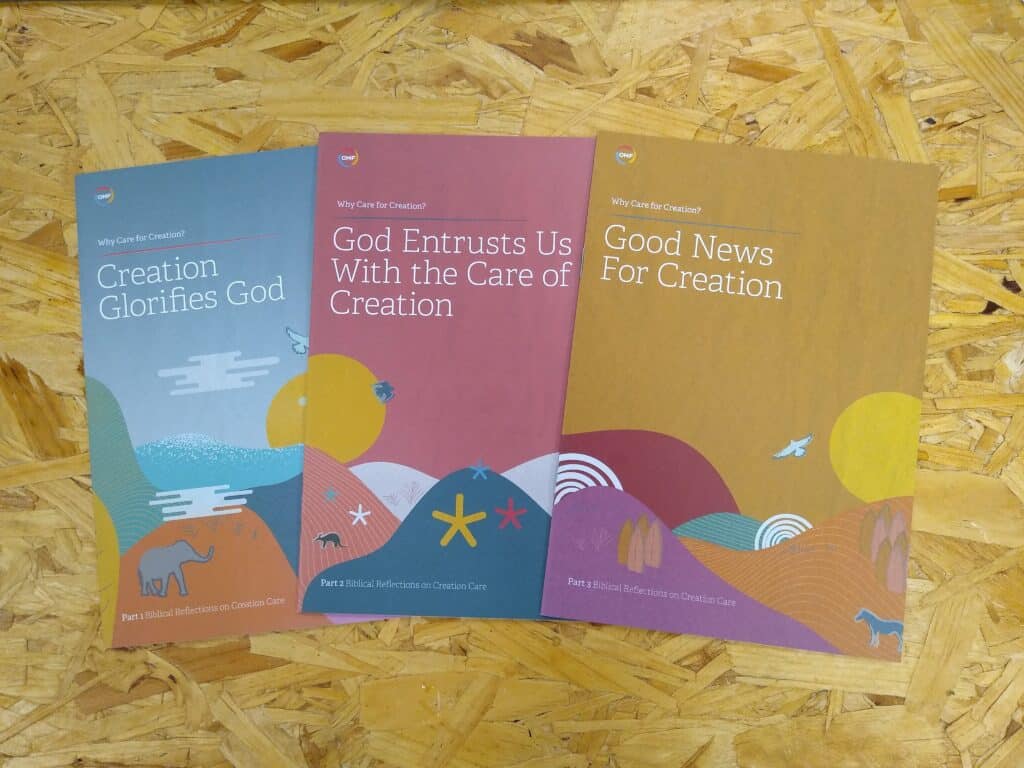
[27] For example, publication of three booklets: https://omf.org/uk/resources/why-care-for-creation/.
[28] Lausanne Movement, The Cape Town Commitment.
[29] Lausanne/WEA Creation Care Network, “Creation Care and the Gospel.”
[30] Al Tizon, Whole and Reconciled, 78.
EMQ, Volume 59, Issue 2. Copyright © 2023 by Missio Nexus. All rights reserved. Not to be reproduced or copied in any form without written permission from Missio Nexus. Email: EMQ@MissioNexus.org.