EMQ » April–June 2023 » Volume 59 Issue 2
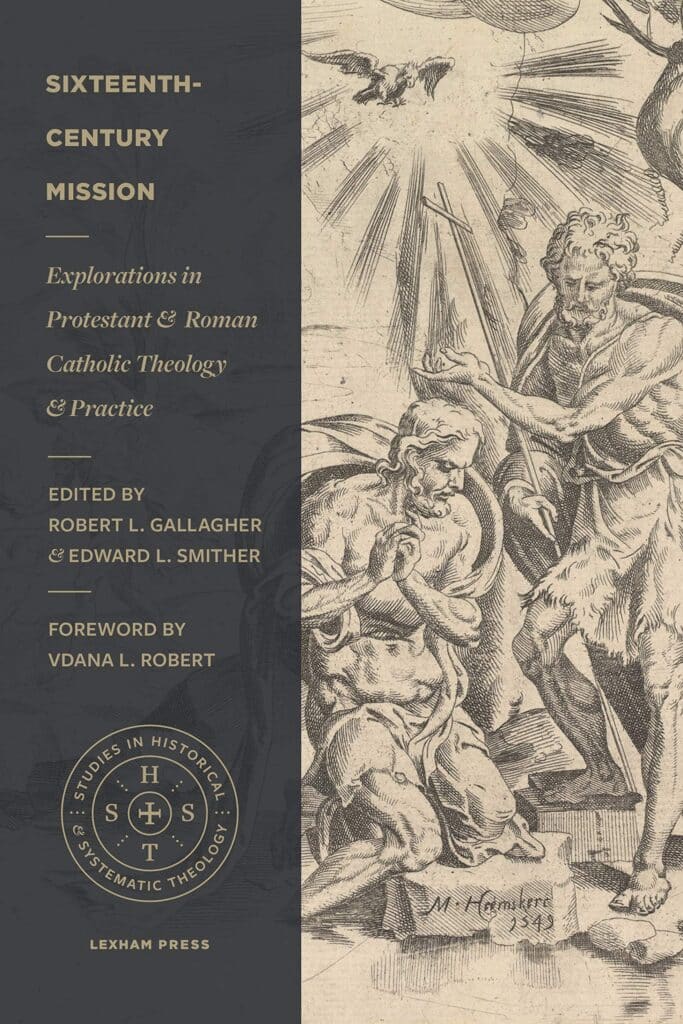
Sixteenth-Century Mission: Explorations in Protestant & Roman Catholic Theology and Practice*
By Robert Gallagher and Edward L. Smither, eds.
Studies in Historical and Systematic Theology
Lexham Press, 2021
504 pages
US$29.99
*As an Amazon Associate Missio Nexus earns from qualifying purchases.
Reviewed by Jonathan P. Case, professor of theology at Houghton University.
This collection of sixteen essays on sixteenth-century mission grew out of the 2018 annual conference of the Evangelical Missiological Society (EMS). Contributions from Protestant and Catholic scholars have been selected to make the case that a broad missional consciousness and spirituality spanned both Protestant and Roman Catholic renewal movements, a position contrary to the antiquated view that early Protestants were not especially interested in mission.
As an overview of the collection, Dana Robert, in her foreword, outlines three broad assumptions shared by the contributors: that the rise of world Christianity is the appropriate lens to re-evaluate the period under discussion; that mission should be revised to include the re-evangelization of people from supposedly Christian populations; and that interdisciplinary approaches will reveal a more fully-orbed understanding of this period.
The book is fairly evenly divided: nine essays deal with Lutheran, Reformed, and Anabaptist Mission, and seven with Roman Catholic mission. Three themes can be discerned throughout the various offerings: the meaning of mission, mission in forgotten places, and the strategy of mission.
As is the case with all collections of essays, it’s difficult to offer a fair review in a short space. However, overall, this is a fine selection. I especially appreciate the care taken by Ray Van Neste to put to rest the hackneyed notion that Luther and Calvin were somehow uninterested in mission, owing to their emphases on election and eschatology. (Given Luther’s stress on preaching and on baptism, this caricature has always struck me as bizarre.)
Allen L. Yeh’s essay on de las Casas emerges as one of the stand-out essays on account of its balanced and readable assessment of the famous Dominican’s work that includes not only his attitude towards the “Indians” but also his less-known (and less-laudable) assessment of Africans.
I do have minor quibbles with some of the contributors. Karin Spiecker Stetina provides a detailed analysis of Calvin’s Geneva as a center of missionary light to the world, but I suspect none of us would have wanted to live there. The jagged edges of the political-religious fusion in Geneva (what William Manchester once called “Calvin’s Orwellian theocracy”) are simply passed over.
I appreciate Alice T. Ott’s treatment of Matteo Ricci and his attempt to accommodate Christianity to Confucian culture. However, it is disappointing to arrive at her treatment of accommodation to Confucianism itself and find most of the primary Confucian virtues (e.g., ren, li, etc.) missing from the discussion.
In any collection of this sort, there will always remain a few essays too specialized to be of much use in the classroom. Overall, however, this is both a nuanced and accessible collection of essays and one that could be used profitably in a history of missions class.
For Further Reading
“Was Luther a Missionary?” by Eugene W. Bunkowske in Concordia Theological Quarterly 49, nos. 2 and 3 (April–July 1985)
A Companion to the Early Modern Catholic Global Missions, by Ronnie Po-Chia Hsia (Brill, 2018)
EMQ, Volume 59, Issue 2. Copyright © 2023 by Missio Nexus. All rights reserved. Not to be reproduced or copied in any form without written permission from Missio Nexus. Email: EMQ@MissioNexus.org.