EMQ » April–June 2023 » Volume 59 Issue 2
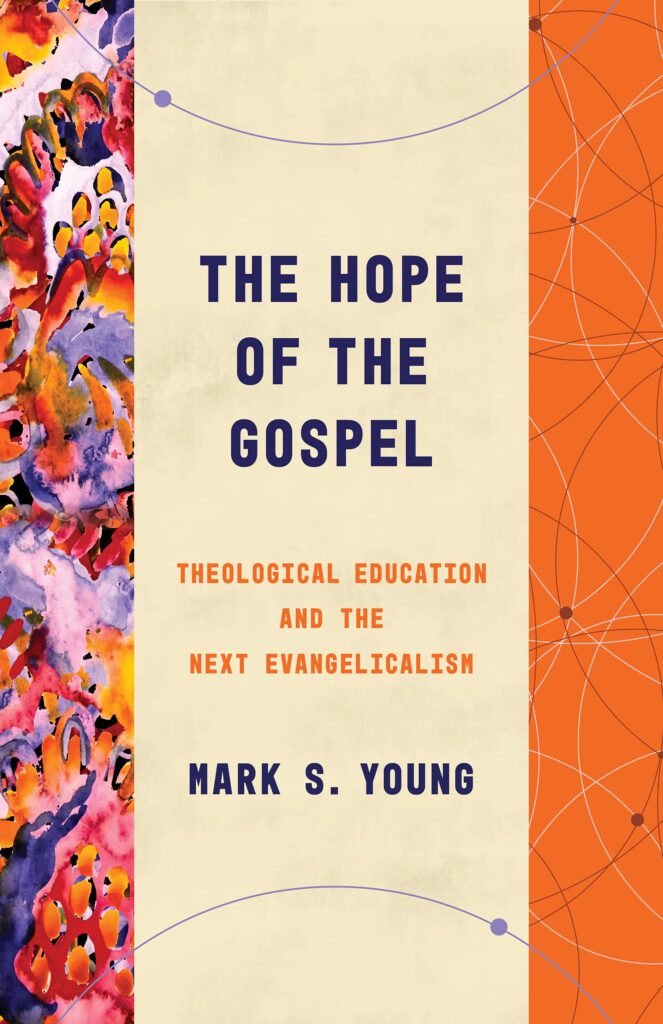
The Hope of the Gospel: Theological Education and the Next Evangelicalism*
By Mark S. Young
Eerdmans Publishing Company, 2022
137 pages
US$19.99
*As an Amazon Associate Missio Nexus earns from qualifying purchases.
Reviewed by Christopher Flanders, professor of missions, Graduate School of Theology, Abilene Christian University, Abilene, Texas.
Theological education is changing! Many today recognize the significant, even seismic shifts that have forced institutions of theological preparation in North America to face “realities that cry out for dramatic change” (4). In this brief treatment, Mark Young, president of Denver Seminary, leads his readers through many of the issues that have brought about the current challenging situation.
Before directly addressing issues of seminaries, Young takes us through a brief history of evangelicalism, defining it through the theological lenses provided by historian David Bebbington. He says the evangelical movement in North America is distinguished by its conversionism, biblicism, activism, and cruciformism, a quadrilateral of priorities constitutive of North American evangelicalism.
Young helpfully demonstrates critical awareness of how these four commitments have at times led to unfortunate, even disastrous results. Yet, instead of rejecting these, Young reaffirms each, albeit with nuance, historical awareness, and theological updating. He contends that though compromised in significant ways, the label “evangelical” is worth retaining, but only with redefinition and a significant makeover.
This helpful little volume provides what Young sees as the critical elements of this theological makeover, offering valuable critiques and substantive suggestions for theological education. These suggestions involve a more nuanced hermeneutical approach to Scripture that will move evangelicalism away from the “typically individualistic, white, male-dominated approach…in evangelical theological education” (84). Additionally, Young addresses issues of fundamentalism, pragmatism, and individualism.
Additionally, and perhaps most importantly for readers of EMQ, Young advocates a strongly missional approach to both reading scripture (“It is written to God’s people for the sake of the world”) (85) and a missional approach to theological education, which must “be formulated on the basis of shared theological convictions about the nature of God’s mission in the world, the role of God’s people in that mission, and the unique contribution theological education can make to that mission” (1). This is perhaps Young’s most valuable contribution. His strong call to formulate theological education in a missional mode has the potential to resist, as he notes, a “seminary experience … as Christians helping Christians learn how to help Christians be better Christians” (121).
My most serious critique is that though he acknowledges early on the work of Soong Chan-Rah who coined the term next evangelicalism, and writes with an awareness of the issues Rah raises, Young never directly engages that work or the significant issues of the changing demographic face of North American evangelicalism. This issue lurks on the margins of his generally helpful discussion, yet it would have benefited readers more if Young had intentionally engaged the issues that Rah and others have raised.
This book will benefit anyone who is struggling to understand how evangelical ministerial training must shift and change in order to retain a challenging relevance. It will also function nicely as a condensed and accessible set of proposals to help evangelicalism avoid its worst characteristics and embrace positive change for the future.
For Further Reading
Beyond Profession: The Next Future of Theological Education, by Daniel O. Aleshire (Eerdmans Publishing Company, 2021)
Attempt Great Things for God: Theological Education in Diaspora, by Chloe T. Sun (Eerdmans Publishing Company, 2020)
EMQ, Volume 59, Issue 2. Copyright © 2023 by Missio Nexus. All rights reserved. Not to be reproduced or copied in any form without written permission from Missio Nexus. Email: EMQ@MissioNexus.org.