EMQ » April–June 2023 » Volume 59 Issue 2
Summary: The Evangelical Fellowship of India Commission on Relief (EFICOR) started as an effort to respond to disasters, often in partnership with mission agencies and churches. However, as needs to provide relief increased, EFICOR developed a three-pronged approach (church, community, collaboration) to our response based on a broader understanding of mission, known as integral mission. Training in and advocacy for creation care has been part of this.
By Kuki Rokhum and Joylin Niruba
“Things have changed. It has become much hotter,” explained a participant in a recent creation care workshop in India. “We no longer know when it will rain. The streams have dried up. The forests have been replaced by roads and instead of trees there are concrete jungles.”
We often hear statements just like this when we visit communities or get feedback from people attending the creation care workshops that we conduct in different parts of India.As the Evangelical Fellowship of India Commission on Relief (EFICOR), we have experienced and are responding to the challenges caused by our ever-degrading environment and changing climate.
EFICOR’s Development
EFICOR was started in 1967 by the Evangelical Fellowship of India (EFI) as a response of the Church to drought in Bihar (a state in eastern India). The drought resulted in a famine that caused hundreds in the region to die. Our work grew from responding to different disasters by providing relief, to providing safe drinking water, and initiating integrated development projects amongst the poorest communities.
As the needs and work increased there was a felt need to equip and engage churches and Christians in India to respond with an integral understanding of the Bible. EFICOR’s Training Unit was started in 1979. This moved EFICOR toward being an organisation that not only responded to the needs in India, but one that also led thinking in the teaching and practice of integral mission.
EFICOR has also influenced and been influenced by other organisations and movements including the Micah Network (now known as Micah Global).[1] This is a movement and network of evangelical organisations that aims to teach and educate the Christian community about a broader understanding of mission and to help bridge the dichotomous understanding of mission.
EFICOR subscribes to the understanding of integral mission as defined in the Micah Declaration which was released in 2001:
Integral mission or holistic transformation is the proclamation and demonstration of the gospel. It is not simply that evangelism and social involvement are to be done alongside each other. Rather, in integral mission our proclamation has social consequences as we call people to love and repentance in all areas of life. And our social involvement has evangelistic consequences as we bear witness to the transforming grace of Jesus Christ.[2]
At the same time, we have helped the Church in India develop a more integral understanding of mission, we have also experienced increasing unpredictability in weather events and an increasing number of natural disasters. The poor have faced the most disruptive and harmful effects of climate change[3] even though they contribute little to the problem. EFICOR responds by advocating at the national and international level for environmental justice and practical actions to curb the warming climate.
In 2009 the Micah Network presented the Declaration on Creation Stewardship and Climate Change, which synthesized the findings of the Fourth Triennial Global Consultation[4] held in Kenya. The Micah Network claimed that “[The Declaration] . . . may perhaps in time be regarded as the most significant document coming out of the evangelical movement on a subject that has hardly received in the past the attention it deserves from people who confess the triune God as the God of Creation.”[5]
In 2010, the Lausanne Cape Town Commitment also addressed creation care as a core gospel issue:
The earth is the property of the God we claim to love and obey. We care for the earth, most simply, because it belongs to the one whom we call Lord . . . . If Jesus is Lord of all the earth, we cannot separate our relationship to Christ from how we act in relation to the earth. For to proclaim the gospel that says ‘Jesus is Lord’ is to proclaim the gospel that includes the earth, since Christ’s Lordship is over all creation. Creation care is thus a gospel issue within the Lordship of Christ.[6]
The Jamaica Call to Action,[7] drafted in 2012, built on this further and called for a response: “…we … call the whole church, in dependence on the Holy Spirit, to respond radically and faithfully to care for God’s creation, demonstrating our belief and hope in the transforming power of Christ.”
EFICOR Three-Pronged Response
Our response as EFICOR to creation care can be largely summed up as a three-pronged response driven by our understanding of integral mission. Those three-prongs are church, community, and collaboration. At the heart of our response is our faith that compels us to participate with God in his mission. As part of the Church, we foster transformation in the communities that we work with and collaborate with various stakeholders in order to achieve that.
Church
Churches in India are frequently located in areas of widespread poverty, injustice, discrimination, and marginalisation. The Church in India has played a key role in bringing transformation in local communities and continues to do so. Motivating and building the capacities of churches and enabling them to address issues of justice, poverty and the needs of the community has resulted in tremendous changes.
EFICOR has supported the Church’s transformational work by teaching integral mission. A key component of our integral mission training focuses on caring for creation – for God’s world. Instead of reacting out of fear of environmental disasters, our training teaches Christians in India to respond to the first call of God – the call to care. Our response must be informed by Scripture, and our action must come from God’s mandate.
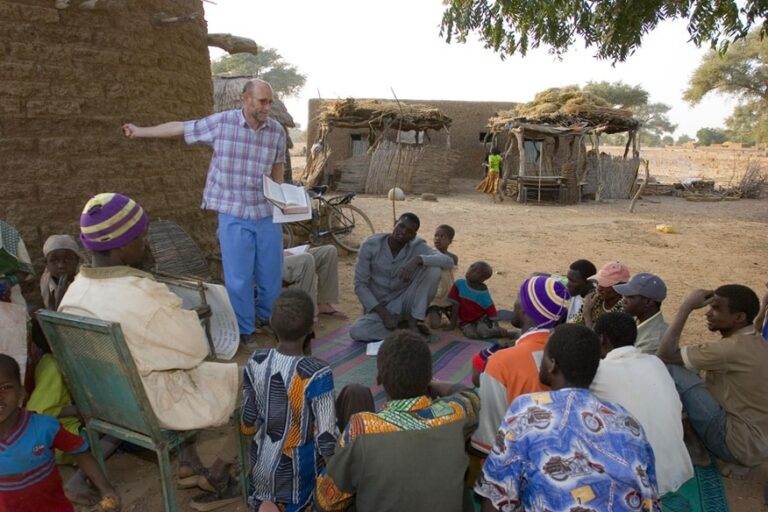
We have developed modules and curriculum that has been widely used. We conduct workshops and seminars, create awareness for creation care issues, and build the capacity of local leaders to act. Knowing our limitation of not being able to reach all parts of the country, our strategy has been to also train trainers. These trained trainers, equipped with strong Biblical foundations are then able to teach others in their own area of influence and local communities and congregations.
National level consultations on integral mission have enabled us to bring together influencers from Bible colleges, mission organisations, and local churches to learn from each other. This has reached local communities and helped people experiencing injustice and living in poverty to come out of it.
We have invited the Church in India to dedicate at least one Sunday in a year to preach and pray about the environment through what we call Eco-Sunday. Churches and Christian organisations that have been influenced have gone on to participate in creation care in a variety of ways. Some have sponsored tree plantation drives and reforestation efforts. Others have advocated for stopping the use of single use plastic at events, and cleaning plastic for recycling to reduce trash.
Another approach has been to encourage people to make small lifestyle changes especially in the use of energy, water, and other resources. Other organizations and churches have developed Sunday school curriculum on creation care. And still others are working to develop environmental policies.
Community
An important aspect of EFICOR’s integral work is our direct involvement in the community. As already mentioned, the genesis of EFICOR was from EFI as a response to the devastation caused by an environmental crisis. We work with our country’s most marginalised communities. While they contribute least to the problem, they are always the hardest hit. Where possible, we partner with local churches or mission agencies to ensure an integral response and long-term sustainable action.
Bikam Yadav, who comes from a village in the Bundelkhand region of Madhya Pradesh in Central India said, “The forests are disappearing; the plants and trees are suffering. The rains do not come on time. The crops are failing and there is no profit if we do not use fertilizers. Our lives are in danger.”
This region has seen the worst of climate change. It is infamous for frequent droughts, dry and barren lands, the consequent crop losses, unemployment, and perennial water stress. The farmers here prepare the land, sow the seeds, and wait in expectation towards the skies for rains.
If the rains fail (which has occurred frequently in recent years), they have to pack their bags, leave their families, and migrate to the cities in search of greener pastures. Despite having land, the declining land productivity has pushed many into huge debt. Their land documents are mortgaged, and social exploitation is rampant.
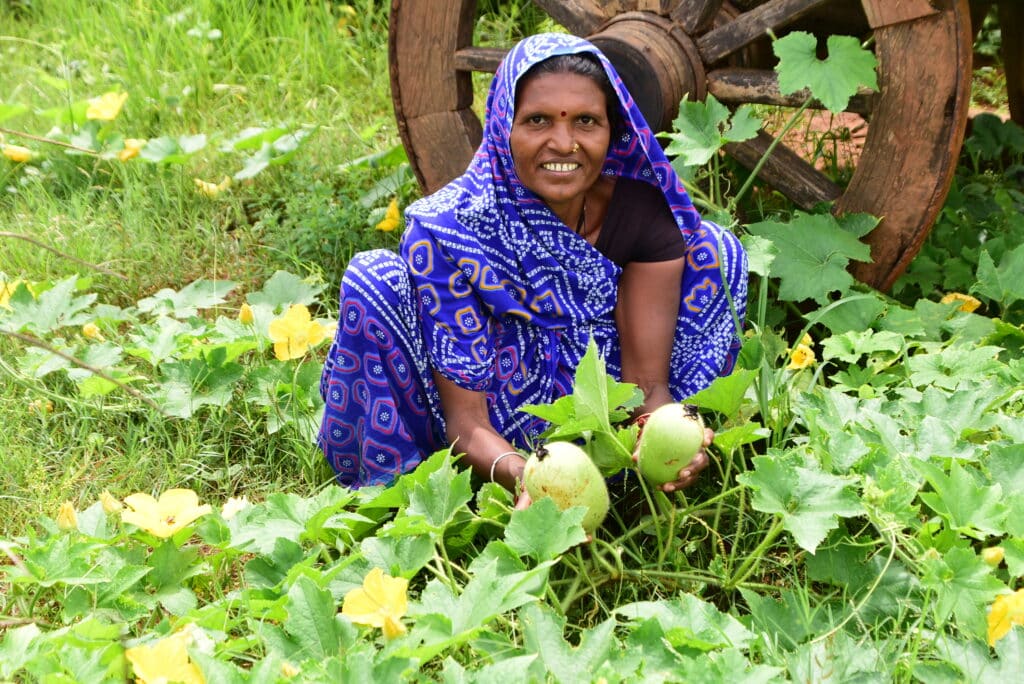
EFICOR works with drought-affected communities like this in North and West India. Starting with community mobilization and organization, strong local organizations called village watershed committees and self-help groups[8] are built from the bottom-up. They participate in brainstorming sessions to understand climate related problems and promote solutions.
Local knowledge and skills are built upon to manage and sustainably develop natural resources such as Jal (water), jamin (soil), jungle (forest), janwar (livestock), and jan (people). We address three pillars of sustainability – namely social, economic, and environmental development.
Our activities include land survey, linking the farmers with farm science centres and the government’s agriculture department, and training and support on sustainable agriculture techniques. Those techniques include multi-cropping, drip irrigation, sprinkle irrigation, a system of rice/wheat intensification, cultivation of minor millets and cash crops, watershed management, and land treatment for optimal use of water and money.
The materials are locally sourced, and ecological integrity of the micro-environment is maintained. The land and water works are done by employing people from the community to promote a green economy. Diversification of livelihoods is supported so there is minimal loss in case of failure of farm-based outputs. Model farms are set up so the farmers can see, experience, learn, and do.
Today, in Meghawakhurd, 150 acres of fallow land has become cultivable with increased water recharging. Some farmers are even able to cultivate two crops a year and have food security all year long through better water management. Families have reduced the number of months of migration, and some have completely stopped migrating. Children are now attending school. The members of the EFICOR-formed leadership committees are representatives in the local council of villages, and women are budding entrepreneurs!
EFICOR works with the indigenous people groups whose traditions, knowledge and skill are of huge value in building climate resilience. However, in the economic front, these people are struggling as a result of cyclic illiteracy, isolation, exploitation, and poverty. Their poverty level, remoteness, their reliance on agriculture and forest-based livelihood, their existing socio-economic conditions, and their lack of knowledge on the latest technology and information, has increased their vulnerability to climate change.
In the hilly terrains of Jharkhand, an eastern state in India with high tribal population, is one such group called the Malto community (also known as Pahariyas, translated as hill dwellers).
“There has been a major shift in the environmental surroundings. The weather has become uncertain leading to water shortage,” said one amongst a group of Malto farmers while interacting with the EFICOR team. “Forest products like Mahua flowers (Butter tree) and bamboo have been reducing over the past ten years. Agriculture has also become difficult. Unpredictable rain, climate change, water scarcity, rocky fields, and degradation of soil quality and labour constraints contributes to low-crop production.”
Working with the government and the community, EFICOR has tapped and fine-tuned the available local resources and skills to help manage and develop natural resources. We actively promote nature-based solutions like Farmer Managed Natural Regeneration[9], vermi-composting, conservation agriculture, growing kitchen/vegetable gardens in the fallow backyard using recycled water, and better livestock management.
At the centre of it all, we give intentional focus on people-building initiatives. This results in improved awareness and knowledge on conservational practices, and an increased stewardship towards natural resource management.
In disaster response, we engage communities in disaster preparedness and resilience building activities to break the cycle of dependency. We begin with Participatory Assessment of Disaster Risk (PADR), and then couple that with enhancing the traditional coping mechanisms and equipping them with new skills. The community is organized into a task force[10], and a disaster management committee[11] to ensure that the first responders have the skills to deal with disasters before any external help reaches them.
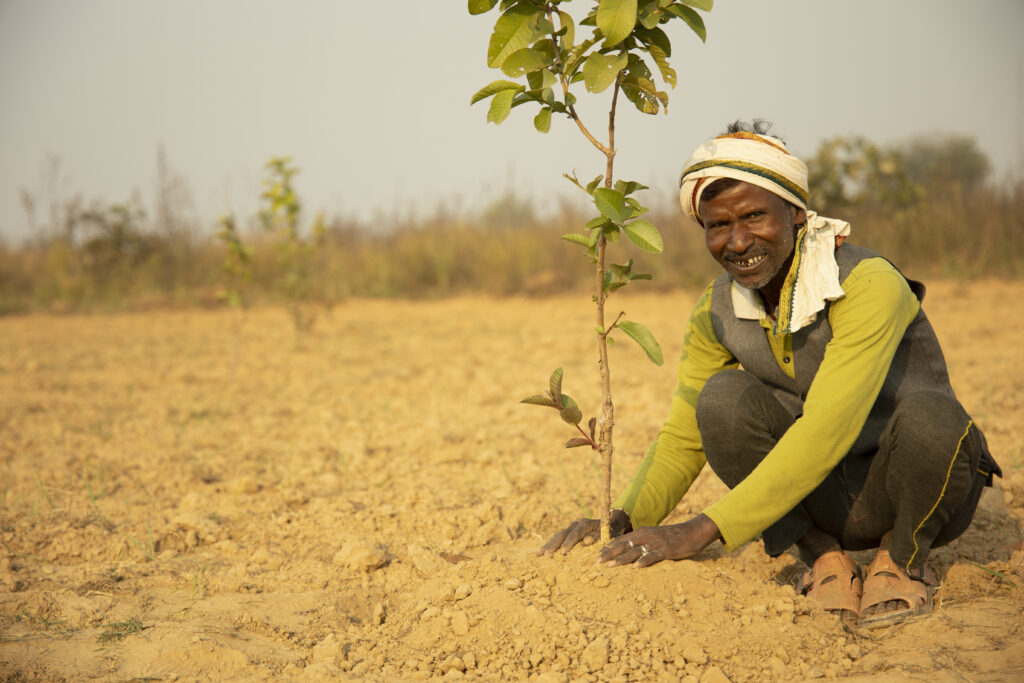
A contingency fund serves as emergency credit during disasters. We also promote alternative green livelihoods, and the maintenance of local seed banks to protect and provide good quality seeds even during disasters. Tree plantation drives, usually lead by enthusiastic children’s groups, are undertaken across our climate projects.
Collaboration
While we can facilitate changes at the local level, at EFICOR we understand that real change can only come when shifts occur at the policy level. We have felt the need, the urgency, and the importance of adding our voice to this dialogue with policy makers. Thus, EFICOR works with local governments, national and international governments to ensure the voices of the most marginalised peoples are heard and that policies that benefit them are put in place.
In all major disaster interventions, EFICOR collaborates with the government and other NGOs through an Inter-Agency Group. This is an interim group formed by various groups working with the government at the state level to ensure that the needs of the community are met and there is no duplication. EFICOR is a voluntary member of the National Disaster Management Agency network. This is the nodal government agency for disaster management in India chaired by the Prime Minister of India. Through it we influence the policy makers with our experience and expertise.
A Core Humanitarian Standards[12] certified organization, EFICOR strives to maintain the highest humanitarian standards and “do no harm.” As part of the executive committee of Sphere India, the India chapter of the International Sphere Standards[13] for disaster response and humanitarian aid, we ensure that communities that are affected receive the highest quality of support. EFICOR is also an active member of Climate Action Network – South Asia and currently serves as a member of their board.
We have collaborated to develop District Climate Resilience Plans (DCRP) in some of the most drought prone districts in Central India. The DCRP has been developed through a bottom-up approach, starting with the community at the grassroots who are most affected by climate change, identifying climate patterns, its impact on the socio-economic status of the community, the gaps in policy and implementation in addition to finding collaborative solutions to build climate resilience.
On the global front, EFICOR engages in strong collaborations and partnerships with climate networks, interfaith groups, and other like-minded organisations adding our voice in the dialogue and influencing as we speak up for those worst affected by climate disasters. EFICOR regularly participates at the United Nations Framework Climate Change, Conference of the Parties (COP)[14] gatherings. Apart from collaborating with other Christian organisations at these gatherings and encouraging local churches in the host cities, these international gatherings give us an opportunity to be a voice for the most affected communities in our country.
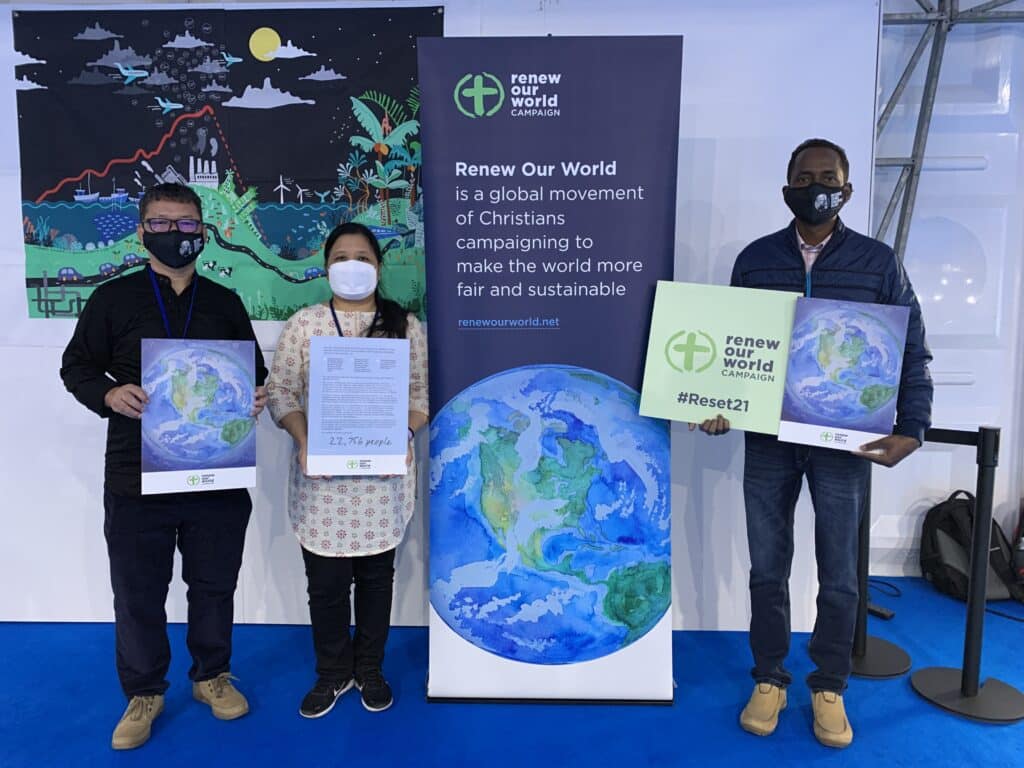
EFICOR is part of a global campaign called Renew Our World. The campaign states describes itself as “… a global movement of Christians who believe that since we are truly image bearers of God, we should act like it – living out love for one another in actions and in truth… we won’t stand by while our neighbours are trapped in poverty, and we won’t stay idle as creation is left untended, and inequality is left to fester.”[15]
As a network of Christians taking action and praying for a fairer and sustainable world, this campaign gives us an opportunity to motivate the Church in India to be part of this movement. It also provides a platform for us to campaign together as a faith community through specific movements, and tell our story in this journey of creation care.
Conclusion
Things have definitely changed, and sometimes the issues we face seem too large to address. While the problem can seem overwhelming, it is possible to make a difference. It must begin in our own understanding and attitude, and that change in understanding can last only if it comes from our conviction to participate with God in his mission. We can all respond by making wise choices which affirm what the Cape Town Commitment stated, “Creation care is… a gospel issue within the Lordship of Christ.”
It was the leaders of EFI, who from a faith conviction, commissioned the first disaster response. That developed into EFICOR’s work with at-risk communities, advocacy with governments and policy makers, and training of ordinary individuals like you and me. As a result of our actions, we hope that the next time we hear, “Things have changed,” it will be change for the better!
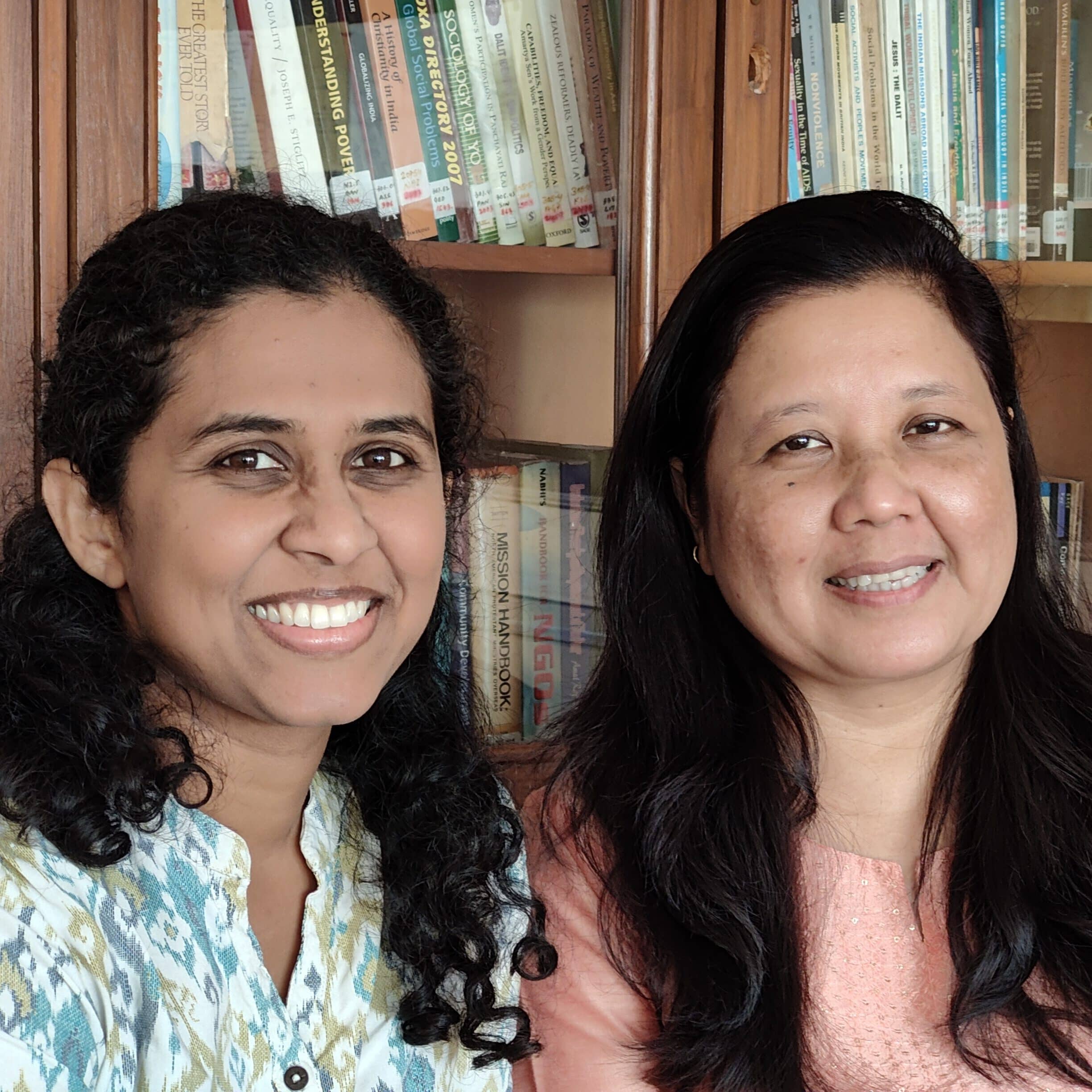
Kuki Rokhum (kukirokhum@eficor.org) serves on the leadership team of EFICOR. Kuki is passionate about issues of justice and is involved in teaching integral mission and issues such as HIV and AIDS, creation care and climate change, organisational development, etc.
Joylin Niruba (joylin@eficor.org) has a master’s in environmental engineering, worked with a tribal community in an EFICOR project in South India, and is currently working in the head office in climate related projects, and in training.
[1] Micah Global is a global Christian community of organisations and individuals currently with 626 members registered in 89 countries committed to integral mission, https://www.micahnetwork.org.
[2] “Micah Declaration on Integral Mission,” Micah Global, September 2001, https://micahglobal.org/page/resources-external.
[3] The Intergovernmental Panel on Climate Change (IPCC), an intergovernmental body of the United Nations, defines climate change as “a change in the state of the climate that can be identified (e.g., using statistical tests) by changes in the mean and/or the variability of its properties, and that persists for an extended period, typically decades or longer. It refers to any change in climate over time, whether due to natural variability or as a result of human activity.” Accessed on December 14, 2022, https://www.ipcc.ch/sr15/chapter/glossary/.
[4] More information on the Fourth Triennial Global Consultation: https://micahglobal.org/events/micah-network-global-consultation-creation-stewardship-and-climate-change.
[5] “Micah Network Declaration on Creation Stewardship and Climate Change,” Micah Global, July 17, 2009, http://www.worldevangelicals.org/pdf/mn_limuru_statement_final.pdf.
[6] C. J. H. Wright, ed., The Cape Town Commitment (Peabody, MA: Hendrickson, 2011), 1.7.A.
[7] The Lausanne Movement, “Creation Care and the Gospel,” Jamaica Call to Action, November 2012, https://lausanne.org/content/statement/creation-care-call-to-action.
[8] Self-help groups are informal groups of people who come together to address their common problems. An ideal SHG should have about 10 to 20 members. The women are mostly from a similar socio-economic background and are involved in undertaking small savings amongst themselves in a bank. This amount acts as the fund for the SHGs and is used to provide loans to its members.
[9] Farmer Managed Natural Regeneration is the systematic regrowth and management of trees and shrubs from felled tree stumps, sprouting root systems or seeds, or in woody thickets.
[10] Task force is a community-based organization which has 25 youth (boys and girls equally represented), who are trained to be able to respond before and during any disaster.
[11] Disaster Management Committee is formed by people (equal representation of men and women) in the community, keen on working for common good and who show leadership capability.
[12] The Core Humanitarian Standard on Quality and Accountability (CHS) sets out Nine Commitments that organisations and individuals involved in humanitarian response can use to improve the quality and effectiveness of the assistance they provide.
[13] Sphere standards are primary reference tools for national and international NGOs, volunteers, UN agencies, governments, donors, the private sector, and many others. Sphere is a worldwide community which brings together and empowers practitioners to improve the quality and accountability of humanitarian assistance.
[14] The Conference of Parties, known as COP, is the decision-making body responsible for monitoring and reviewing the implementation of the United Nations Framework Convention on Climate Change. It brings together the 197 nations and territories – called Parties – that have signed on to the Framework Convention.
[15] Renew Our World, accessed on December 14th, 2022, https://www.renewourworld.net/about.
EMQ, Volume 59, Issue 2. Copyright © 2023 by Missio Nexus. All rights reserved. Not to be reproduced or copied in any form without written permission from Missio Nexus. Email: EMQ@MissioNexus.org.