EMQ » January–March 2023 » Volume 59 Issue 1
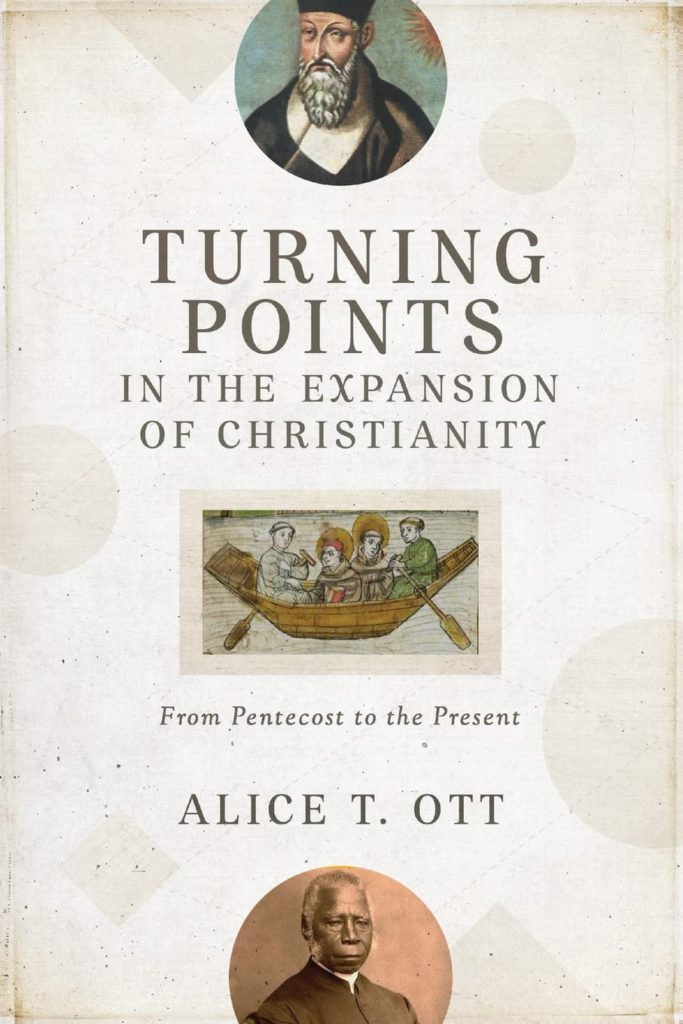
Turning Points in the Expansion of Christianity: From Pentecost to the Present
By Alice T. Ott
Baker Academic, 2021
298 pages
US$28.99
*As an Amazon Associate Missio Nexus earns from qualifying purchases.
Reviewed by David Greenlee, PhD, missiologist with Operation Mobilization based in Tyrone, Georgia, USA.
Alice Ott’s Turning Points offers in-depth “core samples” across the landscape of the expansion of Christianity. Focused on mission as intentional, boundary-crossing witness, she describes and analyzes breakthrough people, events, concepts, and places marking new directions in mission thinking and practice starting with the Jerusalem Council and ending with Lausanne ’74.
Between these consultations, Ott drills down at ten other points: Patrick; the East Syrian Mission to China; Boniface; Jesuits and the Chinese Rites Controversy; Zinzendorf and Moravian missions; William Carey; British abolitionism’s link to mission to Africa; Henry Venn and Three-Self Theory; mission, imperialism, and the Scramble for Africa; and the 1910 Edinburgh World Missionary Conference.
Ott’s focus is narrow, the description and analysis in depth. At times, she wrote of things I had earlier learned; frequently, though, I was surprised by a needed reminder or new insight. For example, Patrick, known for his evangelization of Ireland, was unique in his literal understanding of and obedience to the apostolic commissions (Matthew 28:16–20). Prior to Patrick “there was not one example during the Roman period of a bishop being assigned a specific task of evangelizing non-Christians outside the Empire.” (23, 24)
We know Zinzendorf as a missions pioneer. Surprising was his belief that “prior to the end times, only individual converts or ‘first fruits’ among the Jews and Gentiles could be expected. … Moravian missionaries to St. Thomas after 1740 were instructed to concentrate their efforts on those perceived to be ‘first fruits’ rather than on all baptized converts, to the detriment of the mission’s work.” (126, 127) As Ott notes in her conclusion, “theology matters.”
I was not surprised that Henry Venn’s Three-Self Theory faced obstacles early on. A new insight, however, was that Hudson Taylor and the China Inland mission were not vanguards of its implementation in the late 1800s. Instead, their focus on rapid, itinerant evangelism meant that leadership training was neglected “leading to a lack of self-governance. Furthermore, the ‘employment system’ for Chinese assistance led to dependency on Western funds, the antithesis of self-support.” (203)
Ott concludes by drawing out themes linking the twelve turning points. Open about failings across the ages, she reminds us also of “glorious moments of sacrifice for the sake of the gospel, languages learned and cultures understood, Scriptures translated and literacy taught, new and creative methods employed, physical and social wrongs resolved, and the gospel of Christ’s redemption preached and believed among all peoples and nations.” (278) This, she says, offers us confidence based on the promises of Jesus; he is with us and will build his church.
Turning Points is an excellent book. I found it best read chapter by chapter rather than in longer sittings. Repeatedly I noted ideas I wanted to raise with my colleagues, questions to help shape our missiology and practice. I warmly commend Turning Points for mission leaders, and for all who want to – who need to – take a deeper look at, and learn from, inflection points in the history of the expansion of Christianity.
EMQ, Volume 59, Issue 1. Copyright © 2023 by Missio Nexus. All rights reserved. Not to be reproduced or copied in any form without written permission from Missio Nexus. Email: EMQ@MissioNexus.org.