EMQ » January–March 2023 » Volume 59 Issue 1
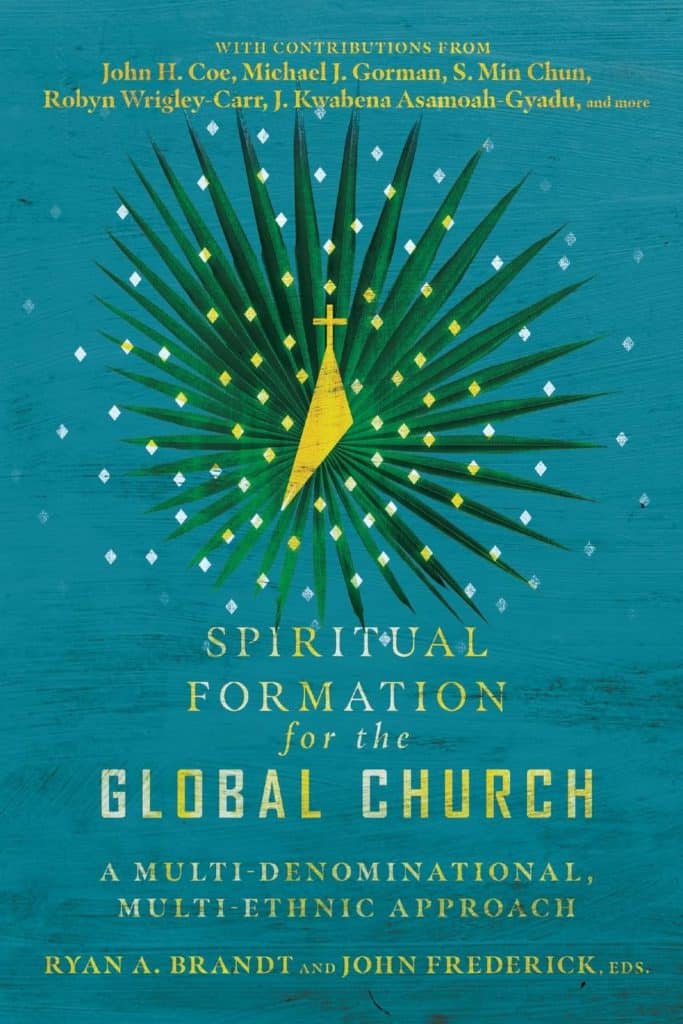
Spiritual Formation for the Global Church: A Multi-denominational, Multi-ethnic Approach
Ryan A. Brandt and John Frederick, eds.
IVP Academic, 2021
223 pages
US$28.00
*As an Amazon Associate Missio Nexus earns from qualifying purchases.
Reviewed by Brent H. Burdick, DMin, adjunct professor of missions, Gordon-Conwell Theological Seminary, Charlotte, North Carolina, and director of the Lausanne Movement’s Global Classroom.
Spiritual formation has become a topic of great interest in evangelical circles recently. Many books and dissertations can be found upon executing a search for the term in libraries and the Internet. However, because spiritual formation habits and ideas were developed historically in Western Christianity, much of the content written on it comes from there. As a result, spiritual formation theology and practice lack a global perspective. In this volume, Brandt and Frederick attempt to address the lack by inviting theologians and practitioners from around the world to share thoughts and perspectives on spiritual formation from the global church.
The book is divided into three parts. The first section looks at biblical and theological study as spiritual formation, with chapters on New Testament theology, theological education, biblical faithfulness, and spiritual theology as spiritual formation. The second examines acts and elements of worship as spiritual formation, with chapters on liturgy, the Eucharist, sacrifice and surrender, and the Beatific Vision as spiritual formation. The third section is about Christ, contemporary culture, and spiritual formation. It includes chapters on Old Testament ethics, 2 Peter and postmodernity, the Holy Spirit and supernatural interventionism, and failure and faithful perseverance as spiritual formation. Each chapter is written by a different global author.
Brandt and Frederick state clearly that the book “is an attempt to engage with evangelical voices from different cultures … to illuminate [the reader’s] own cultural and theological assumptions and spiritual blind spots” (5). However, the authors of the various chapters in the book, while they are people from other cultures, have done theological studies only in Western contexts (See contributors list, 225–227). This seems to imply that only theologians who have been trained in the West are interested in writing on spiritual formation.
The chapters, while excellent and insightful for general spiritual formation purposes, are theological treatments of spiritual formation from global voices that use Western theological categories rather than a discussion of spiritual formation insights arising from the Christianity of global cultures. Though some non-Western cultural examples are used to discuss the theology of spiritual formation and to make application within the respective cultures of the examples, the articles feel more Western than global. However, reading about spiritual formation from global authors does give them a voice that can be developed and heard in the future using their own cultural categories.
Other than leaving the reader desiring more global insights on spiritual formation, the book has much to commend for strengthening the awareness that spiritual formation is vitally important in today’s multicultural world.
For Further Reading
A Many Colored Kingdom: Multicultural Dynamics for Spiritual Formation, by Elizabeth S. Conde-Frazier, Steve Kang, and Gary A. Parrett (Baker Academic, 2004)
Intercultural Discipleship: Learning from Global Approaches to Spiritual Formation, by W. Jay Moon (Baker Academic, 2017)
EMQ, Volume 59, Issue 1. Copyright © 2023 by Missio Nexus. All rights reserved. Not to be reproduced or copied in any form without written permission from Missio Nexus. Email: EMQ@MissioNexus.org.