EMQ » January–March 2023 » Volume 59 Issue 1
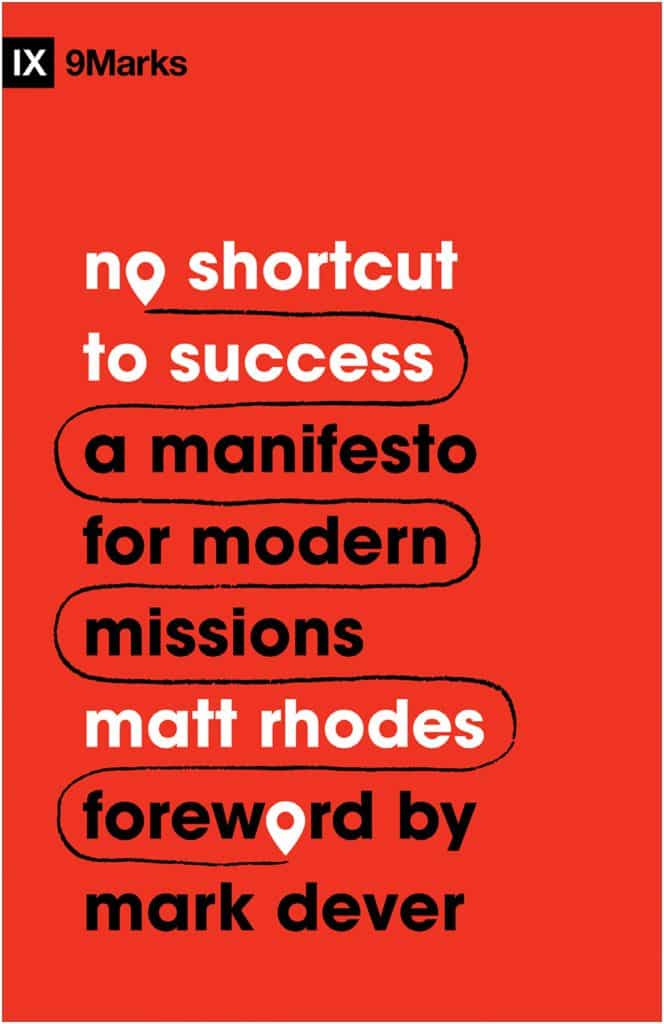
No Shortcut to Success: A Manifesto for Modern Missions
By Matt Rhodes
Crossway, 2022
270 pages
US$19.99
*As an Amazon Associate Missio Nexus earns from qualifying purchases.
Reviewed by David R. Dunaetz, former church planter in France with WorldVenture, and currently an associate professor of organizational psychology at Azusa Pacific University, and the books editor for EMQ.
In No Shortcut to Success: A Manifesto for Modern Missions, missionary Matt Rhodes persuasively argues that learning a culture and language is required for accurately communicating the gospel to unreached peoples and effectively helping them become disciples of Jesus. Much of contemporary mission thought focuses on disciple making movements (DMMs) supposedly led by non-residential missionaries who are only minimally familiar with the targeted culture and who may not know the language.
The author proposes helpful correctives to what he sees as destructive trends in modern missions, trends such as miscommunicating what it means to follow Christ, leaving disciples who don’t know what it means to follow the Lord, creating groups of unconverted people that are labeled churches in missionary literature, and promoting inappropriate and poorly trained leaders (e.g., an 8-year-old who supposedly started a church).
One of the most important chapters focuses on how many of the numeric claims made by proponents of DMMs are not credible and are most likely the product of unjustified assumptions combined with wishful thinking. Rhodes worked with demographic statistics for eight years before becoming a missionary and is well-qualified to discuss demography and statistics. Reasons for not believing the stories of millions of conversions and thousands of new churches include (1) the inability to verify these numbers in the Bhojpuri region of India or in Bangladesh where large DMMs are said to occur and (2) the testimonies of local leaders who are skeptical of such claims.
For example, the Indian Census actually shows a decrease in the number of Christians in the Bhojpuri region (Bihar and Uttar Pradesh) during the time this movement was supposedly taking place (1991–2011). Similarly, Rhodes could not find any evidence for hundreds of churches some missionaries have claimed to have planted by DMM in Sudan, a country where Rhodes has worked, nor could a colleague of his find evidence for the supposed thousands of churches planted in Ethiopia where he worked.
No Shortcut to Success will undoubtedly generate strong reactions from its readers. Although Rhodes recognizes many strengths of the current emphasis on DMMs, his skepticism and critiques will upset many who have invested much of their lives trying to start DMMs. His critiques of DMMs seem to be focused on the “first generation” of DMM authors. Rhodes does not seem to take into account more recent scholarship concerning DMMs such as the research associated with the Motus Dei network (see further reading). Nevertheless, this is one of the most important recently published books on missions. All missionaries involved in evangelism and church planting should read it to consider ways that their own ministry can be adjusted in light of the information the author presents.
For Further Reading
Motus Dei: The Movement of God to Disciple the Nations, edited by Warrick Farah (William Carey Library, 2021)
“Identifying Current Gaps in Church Planting Movements Research: Integrating First- and Second-Order Perspectives,” by Warrick Farah, in Great Commission Research Journal 13, no. 2 (2021)
EMQ, Volume 59, Issue 1. Copyright © 2023 by Missio Nexus. All rights reserved. Not to be reproduced or copied in any form without written permission from Missio Nexus. Email: EMQ@MissioNexus.org.