EMQ » January–March 2023 » Volume 59 Issue 1
By Katherine Lorance
After two years on the field, a young missionary couple looked forward to spending time at their home sending church. They arrived well before the Sunday morning worship service to have time to chat with more people. It was heartwarming to see familiar faces and encouraging to spot a few unfamiliar ones too. A church leader noticed the couple and walked over with a grin. He gave them hearty handshakes as he asked, “How’s Japan?”
The couple glanced at each other briefly. Which of them was going to explain that they had not been in Japan? Did this man have a moment of confusion or was he neglecting to follow their updates?[i]
While preparing to be sent forth by mission agencies or denominations, missionaries dutifully work to gain prayer commitments from churches, small groups, and individuals. The common requirement for missionaries to raise prayer support reflects an understanding and belief that prayer is important in missions.
Sadly, though, many missionaries post updates and send out prayer letters not knowing who will pray in response or even read them. Although missionaries who communicate digitally can see how many have engaged with an update, it can still be unclear how much prayer is happening. How can prayer support for missionaries be strengthened and reinvigorated? By embracing the relationship-based conversational nature of prayer, missionaries and their prayer supporters can journey together in growing in prayer and thus experience more vibrant and fruitful partnerships.
Conversing with Our Father
The persons of the Trinity are already in a conversation with one another before we begin to pray. In Hebrews 7:25 we see that Jesus “always lives to intercede” for those who come to God through him. Romans 8:27 says that “the Spirit intercedes for the saints in accordance with God’s will.” In other words, Jesus and the Holy Spirit are talking with the Father about us.
When Jesus taught his disciples how to pray and thereby join the divine conversation, he said, “This, then, is how you should pray: ‘Our Father in heaven …’” (Matthew 6:9). Addressing the king of the universe as Father indicates the kind of relationship we have with him, and the type of conversations he wants.
Missionaries and their prayer supporters may be tempted to elevate doing over being and to view prayer primarily as a means to fruitfulness. We may be tempted to outsource our prayer efforts to others, pray for the work but not for the workers, or think praying in a certain way will prompt God to give us the outcome we desire. If we give in to these temptations, then we turn prayer into a transaction and treat the Living One like a miracle machine. Instead, our Father wants to talk with us so that we think, act, and talk more like him.
Using the term father also reminds us that we are children learning to communicate. Like babies and toddlers, we observe, we imitate others, we make attempts to talk or gesture, and we adapt from mistakes. Just as loving parents neither scold nor withhold from toddlers for incorrect grammar or pronunciation, so our Father is patient and understanding with our prayers. Friends and family members of missionaries who doubt their ability to pray effectively can be encouraged that their willingness to grow in prayer will be met by God’s faithfulness to help.
The Lord being our Father reminds us that we pray and learn to pray, formally or informally, within a community, however big or small. A young child cannot learn to effectively express herself to others on her own. Her caregivers, siblings, friends, and teachers all contribute to her communication abilities and styles.
We can grow in prayer by learning directly from God, by following the examples of other believers past and present, by taking classes or workshops, by hearing others pray, and by praying with others. Many missionaries send prayer updates to churches, small groups, or other individuals they barely know. They can strengthen their connections with people receiving their prayer updates by suggesting shared activities focused on growing together with their ministry partners in prayer and developing friendships in the process.
The Bible as a Prayer Textbook
In John 15:7, Jesus said, “If you remain in me, and my words remain in you, ask whatever you wish, and it will be given you.” For missionaries and their supporters, reflecting on God’s character and past actions through Scripture informs and inspires prayers for current situations.
Examining how Jesus prayed with great variety – alone, with others, or for others and at different times of day in different places with different physical stances – can encourage missionaries to try different methods of inviting others into prayer. Prayer supporters can explore different prayer styles, formats, and postures. For example, Zephaniah 3:17 says the Lord “will rejoice over you with singing.” Inspired by this, some prayer supporters sing over the missionaries they support.
The prayers in the Bible also help us learn the language of prayer. Regularly reading, repeating, and imitating biblical prayers can help us acquire prayer vocabulary and practice attitudes of prayer. A wide variety of prayers are available to use in Scripture: the poetic prayers of the Psalms, prayers in the writings of the prophets, the apostles’ prayers in the epistles, and the many prayers of people, including Jesus, who appear within biblical narratives.
Prayer supporters who are unsure how to pray for their missionaries can turn to these prayers for guidance, especially prayers in the Psalms and epistles. Reading these Scriptures word-for-word or with slight adaptations is praying! This can help put people who feel uncomfortable praying aloud in a group at ease. When sharing updates, missionaries can reference scriptural prayers, key verses, Bible stories or people to help express their circumstances or their hopes to their prayer supporters.
Discussion Partners
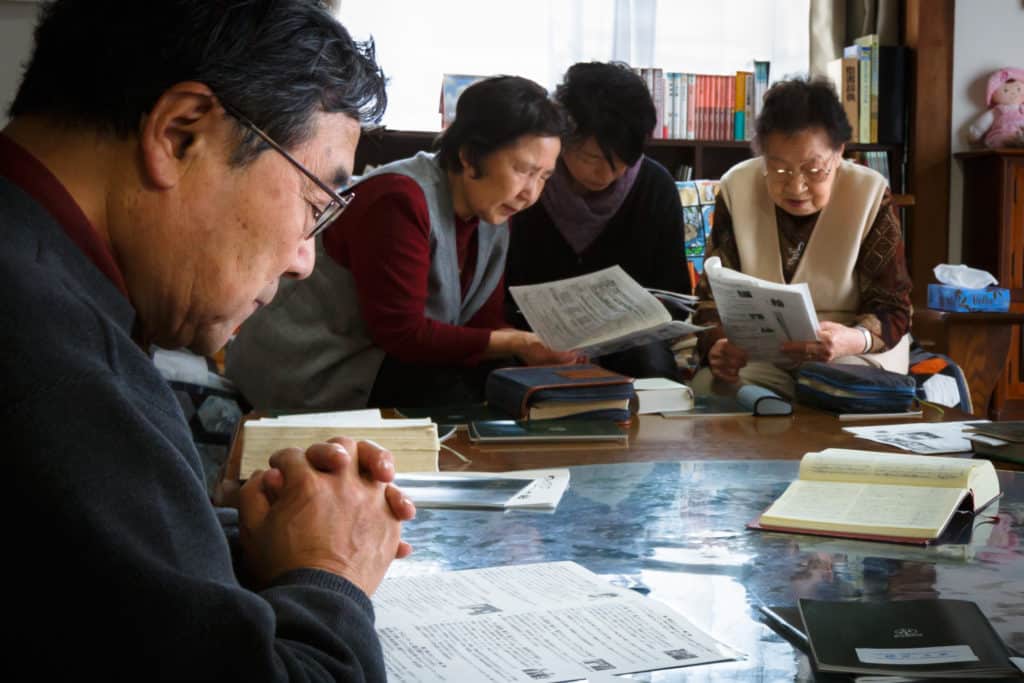
Using the prayers of biblical figures points to how consistently praying with others can help us grow in prayer. In Matthew 18:19–20, Jesus said, “Again, truly I tell you that if two of you on earth agree about anything they ask for, it will be done for them by my Father in heaven. For where two or three gather in my name, there am I with them.” This reveals his expectation that we’d pray together. Like discussions between friends, praying with others can broaden our perspectives and give us new, richer ideas. It may also help some people to focus.
Sara,[ii] a field worker who served in east Asia, had individual supporters scattered across multiple continents. When one supporter suggested that perhaps some of Sara’s supporters could pray together regularly, Sara asked her longtime friend, Mariam,[iii] to lead that effort as her prayer champion. Several of Sara’s other supporters scattered across Mariam’s continent were willing to pray together once a week for about an hour.
During conference calls over the phone or messaging apps, Mariam gave brief updates from Sara, the group invited the Lord to lead the time of prayer, and then they took multiple turns praying. They would end by praying briefly for divine protection over the group.
One week, Mariam reported Sara’s frustration in feeling she was going back and forth over the same spot, like someone rowing with an exercise machine instead of on water. When Mariam prayed with the group, she thanked God for his sovereignty as he weaves our stories into his story. Another group member noted that weaving also involves moving back and forth through the same area but produces something tangible. Mariam shared the group’s response with Sara, who was encouraged with a new perspective on her situation.
Like Sara, missionaries can encourage their prayer supporters to gather to pray, whether by phone, online, or in person. Praying with others for the same person or team can stir people’s thoughts and attention beyond “God bless [insert name]” or praying merely by reading the prayer request. Praying with others allows for God to be glorified by the group when they see specific answers. It also brings to the forefront what God is doing within the missionary – how Christ is being formed in their friend – which is an important part of God’s work.
Churches supporting specific missionaries can encourage small groups or Sunday School classes to adopt a different missionary each month/quarter/year. During each gathering, several people can voice brief prayers for the missionary or one of the stated needs. Churches can also offer to provide prayer champions, like Mariam, to organize times of prayer for any of the missionary’s supporters. One missionary team has twelve core prayer supporters who are arranged into six praying pairs, one pair for each day of the week except for a sabbath.
Some prayer supporters may be unable to commit to a weekly time of prayer but would be willing to be on call for prayer needs. For example, a group of single women in leadership met at a conference and stayed in contact afterwards through a messaging app. A pattern for prayer quickly emerged among them. When someone shared a prayer need, anyone who was available at that time would call to pray with her. Whether several women were available or only one, the group covered each other in prayer.
Because of Jesus’s promises in Matthew 18:19–20, we can celebrate and encourage having “two or three” pray together. Just as two friends can have an intimate conversation more easily than a large group can, prayer pairs, triplets, and other small prayer groups can nimbly delve deep with God.
Developing a Listening Posture
Like other conversations, prayer involves both talking and listening. Adopting a listening posture before the Lord is our humble recognition of who God is. The so-called gods of the world are unable to speak, “but the Lord is in his holy temple; let all the earth be silent before him” (see Habakkuk 2:18–20).
Moreover, a listening posture follows the example of the Trinity. Jesus said of the Spirit that “He will not speak on his own; he will speak only what he hears” (John 16:13). Jesus said to the Father, “I gave them the words you gave me” (see John 17:8). If Father, Son, and Spirit are listening to each other, how much more should we! By intentionally listening in prayer, we pursue clarity and agreement with God.
Listening can take many forms. Inviting the Lord to guide our prayers before or while praying for a missionary is a simple way to demonstrate our posture. Having moments of silence or listening to quiet worship music can give space for the Holy Spirit to impress a Scripture passage, an image, a word, or a song. When considering a prayer request or the missionary’s situation, people may be reminded of specific words, stories, or persons in the Bible, while others may hear a Scripture reference.
Groups can also participate in listening to God together. Providing group members with advance notice of listening activities can help everyone to fully participate. When listening as a group, it can be beneficial to include time for each person to share and then for everyone to discuss how different pieces shared might fit together.
Listening can take additional forms outside traditional times of prayer. One simple way is to observe how God has led in prayer. Prayer supporters can offer short summaries or highlights of their prayers. They can also write out or record audio/video prayers, with which the missionary or other supporters can then pray along. One group prays together by sharing recordings of their individual prayers with the group, which helps them agree in prayer asynchronously but also helps them stay accountable. Sometimes individuals or groups praying separately about the same topic discover that God has led them all to the same Scripture, image, or theme.
Missionaries and their prayer supporters can also listen and observe more by intentionally following up on prayer requests. We should expect God to respond, so we should also look for answers to our prayers. Some prayer supporters grow weary when missionaries do not share answers to prayer. By regularly giving updates to previous requests, missionaries invite prayer supporters to come alongside to rejoice, lament, or press in.
Prayer supporters who consistently ask what has happened with specific situations can help busy missionaries remember to pause and acknowledge answers. They may also perceive possible answers more easily than missionaries who can be caught in daily minutiae. Whatever way God responds, missionaries will be encouraged to know that others share their burden.
A final suggestion for including listening in praying for missionaries is to prayer walk. Steve Hawthorne and Graham Kendrick define prayer walking as, “praying on site with insight.”[iv] Prayer walks spur us to pay attention to the people and places around us and to seek God’s perspective.
Virtual prayer walks, while engaging fewer senses, can be more accessible and sometimes more secure than in-person prayer walks. One example of a virtual prayer walk is a live video call between missionaries as they walk and their supporters praying elsewhere. This kind of virtual prayer walk can be done even in restricted access nations with appropriate precautions, such as a separate briefing about the area and/or a pre-recorded video of the location.
Virtual prayer walks can also be conducted using a mapping app to facilitate a virtual visit of a location. Either missionaries can handpick strategic addresses and explain their significance or prayer supporters can explore the area on their own as the Lord leads. A virtual prayer walk, which is less dependent on the internet, can be done using travel guides, local newspaper clippings, or missionaries’ photos of an area.
Journeying Together
What might it look like for a missionary team and their prayer supporters to grow together in prayer? Adam[v] had been ministering among Afghans living in the United States for many years. When Adam’s team made a commitment to grow in prayer, Adam joined other missionaries in a prayer strategy training cohort[vi] that met once a month.
After the first training session, Adam’s team assessed their prayer patterns as individuals and as a team. As Adam continued sharing the training he was receiving, his team’s prayer patterns slowly began to include focused prayer walks and weekly fasting. They also started inviting their supporters to regular prayer video calls and occasional 24-hour prayer events where they modeled what they had been learning about prayer.
“We would add a prayer strategy that seemed extraordinary at the time, and we’d keep doing it until it seemed ordinary,” explained Adam. “Then we’d add another one.”
A little over a year into the team’s journey in prayer, the US government withdrew its forces from Afghanistan and a fresh wave of Afghans resettled in the US. It became clear that the Lord was preparing Adam’s team and their prayer supporters for this new season of opportunities.
A new season of opportunities is before many local churches as well. The increasing movement of people from everywhere to everywhere means more and more people are engaging with others cross-culturally. How can robust prayer support for missionaries make an impact in this changing mission reality?
After Jesus said, “The harvest is plentiful, but the workers are few,” he instructed, “Therefore pray earnestly…” (Luke 10:2, ESV). As missionaries and their prayer supporters pursue growing in prayer together, they grow in their relationships with each other as well as with God as co-laborers for Christ’s kingdom. Might we see God preparing some of these prayer supporters to labor in the harvest fields in additional, perhaps informal, ways? As they expand their engagement with the harvest, might these laborers, in turn, invite their own circles of friends to join them in the divine conversation?
Let’s join in the divine conversation, now:
Our Father, thank you for inviting us into this conversation with you. Thank you for stirring our hearts so that we want to grow in prayer. We welcome your Spirit to work within us and among us. Give us wisdom and creativity so that all missionaries can serve in their appointed fields, knowing that others are walking alongside them in prayer. What is the next step on this journey? Speak, Lord, for your servants are listening.

Katherine Lorance (kwlorance@gmail.com) serves in prayer leadership roles for the Lausanne Movement, Ethne Prayer Team, and Endiro Coffee. She and her husband, Cody, previously served as church planters among diaspora peoples in the Chicago (USA) area for about ten years. They and their three children continue to live in the Chicago area.
NOTES
[i] The names and details of people mentioned in anecdotes have been obscured or changed for security reasons.
[ii] Pseudonym.
[iii] Pseudonym.
[iv] Steve Hawthorne and Graham Kendrick, Prayer Walking: Praying On Site with Insight (Charisma House, 1996). The definition is in the book title.
[v] Pseudonym.
[vi] The Fellowship of Prayer Strategists (prayerstrategists.net) has a prayer strategy training program based on Discovery Bible Study sets.
EMQ, Volume 59, Issue 1. Copyright © 2023 by Missio Nexus. All rights reserved. Not to be reproduced or copied in any form without written permission from Missio Nexus. Email: EMQ@MissioNexus.org.