EMQ » July–September 2022 » Volume 58 Issue 3
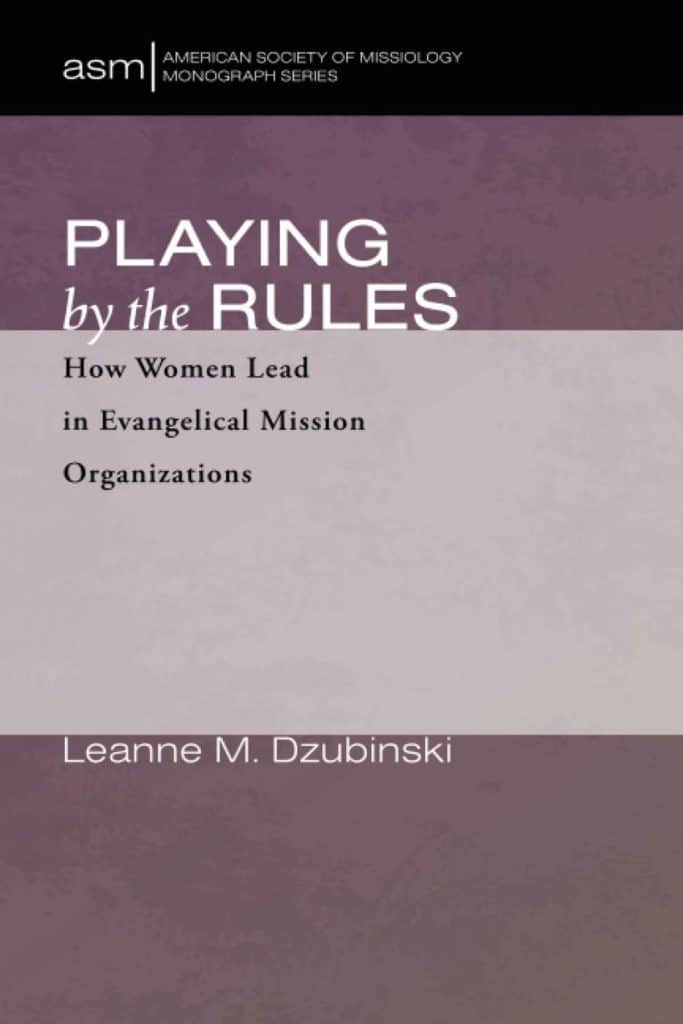
Playing by the Rules: How Women Lead in Evangelical Mission Organizations (find it on Amazon)*
By Leanne M. Dzubinski
ASM Monograph Series 52
Pickwick Publications, 2021
255 pages
US$32.99
*As an Amazon Associate Missio Nexus earns from qualifying purchases.
Reviewed by A. Sue Russell, professor of mission and contextual studies, Asbury Theological Seminary, Wilmore, Kentucky.
This year is the fiftieth anniversary of the passing of Title IX of the Education Amendments. It has provided women with opportunities to gain the training and expertise to become leaders in education, business, and other fields. However, an enormous gap still remains between men and women in the top leadership echelon of financial and educational institutions. This gap is also reflected in evangelical mission organizations where women comprise two-thirds of the mission workforce yet only a handful are in positions of leadership (3). In her book Playing by the Rules, Leanne Dzubinski sets out to discover how women become leaders in evangelical mission organizations, how they function as leaders, and the meaning that they give to their leadership (4).
Dzubinski starts by reviewing three bodies of literature that she uses to provide frameworks for understanding the barriers and cultural biases affecting women in leadership. In chapter 2 she highlights two competing perspectives on gender and gender roles. The first is gender essentialism in which gender characteristics are determined by biology. And the second is gender as a socially constructed category in which the meaning and characteristics of gender norms are embedded in and learned from society.
Both of these perspectives provide insight into the normative leadership characteristics that are biased toward men (27). She then turns to leadership studies and discusses what has been discovered about the barriers and obstacles that women face in leadership positions. Finally, in chapter 4 she discusses the power of gender essentialism in the evangelical world, based on theological interpretations of gender and gender roles. She concludes her discussion by noting that the concept of gender-role stereotypes offers a “cogent explanation for lack of women leaders near the top of organizations” (77).
The remainder of the book is dedicated to Dzubinski’s qualitative research of twelve women in executive-level leadership positions within evangelical mission organizations. She concludes that the women in her study did not try to change the gender role expectations in their organizations, but rather they “played by the rules.” They led by using behavior and practices that conformed to gender role expectations (138). However, they also found themselves in a double-bind where practicing normative male leadership behaviors conflicted with “the ideal of a good Christian woman” (139).
This book is a must-read for both men and women in evangelical organizations. One of the most striking findings is that all the women in her study were given their leadership roles by a male authority who supported and advocated for them (165). If we truly want to see change and women flourishing using their gifts, both men and women must understand the structures and practices that limit people from using their gifts to impact the world for Christ.
For Further Reading
Women in God’s Mission: Accepting the Invitation to Serve and Lead by Mary T. Lederleitner (InterVarsity Press, 2018)
Women in the Mission of the Church: Their Opportunities and Obstacles throughout Christian History by Leanne M. Dzubinski and Anneke H. Stasson (Baker Academic, 2021)
EMQ, Volume 58, Issue 3. Copyright © 2022 by Missio Nexus. All rights reserved. Not to be reproduced or copied in any form without written permission from Missio Nexus. Email: EMQ@MissioNexus.org.