EMQ » July–September 2022 » Volume 58 Issue 3
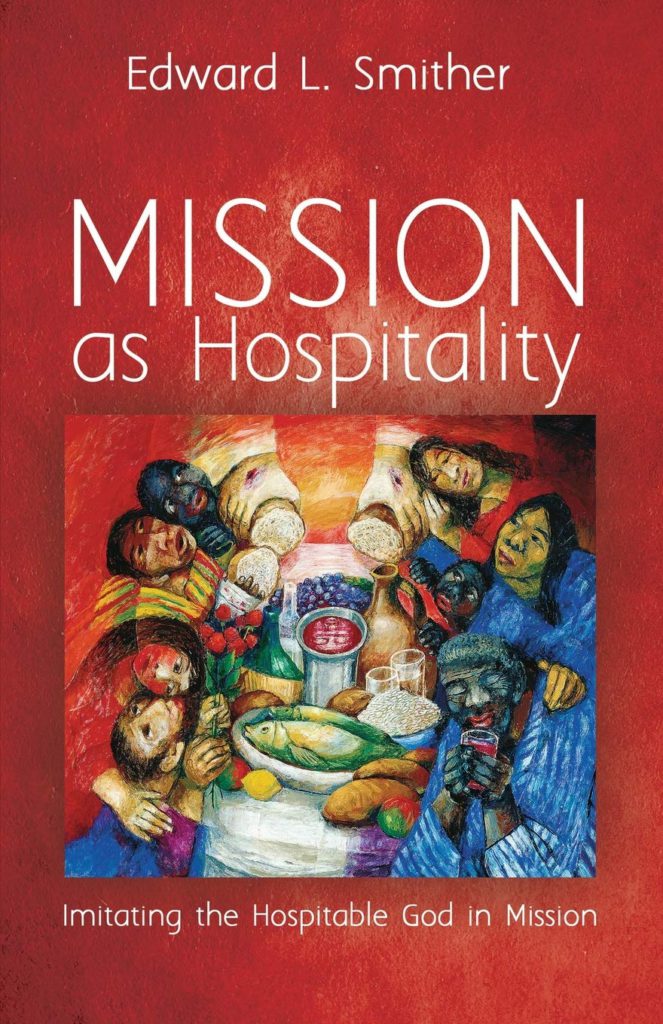
Mission as Hospitality: Imitating the Hospitable God in Mission (find it on Amazon)*
By Edward L. Smither
Cascade Books, 2021
135 pages
US$19.64
*As an Amazon Associate Missio Nexus earns from qualifying purchases.
Reviewed by Ed Scheuerman, professor of intercultural studies, Lancaster Bible College, Lancaster, PA, who previously served with Pioneers for 23 years in SE Asia.
“We’ve lived in America for 14 years, and today is the very first day we’ve ever been invited into an American’s home.” This was spoken by a Somali in International Project’s video, “The Foreigner Among Us” (https://www.youtube.com/watch?v=jikuQu2LL3A&t=17s).
Hospitality is not only a ministry strategy – it should also be a Christian discipline. In Mission as Hospitality, Edward Smither presents the case for Christians to see hospitality as a response to Jesus’ saying, “I was a stranger, you invited me in” (Matthew 25:35).
With a growing number of displaced people around the world, it is imperative for Christians to understand God’s heart for the vulnerable. As more and more refugees, immigrants, and international students are sovereignly brought into our lives, we need to be open to welcoming them and showing them the love of Jesus Christ.
Smither gives an extensive theological rendering of hospitality, including God’s showing “Israel his hospitality (in the wilderness) by providing shelter, protection from enemies, and nourishment” (15). He devotes a full chapter to both hospitality in the Old Testament and in the New Testament. Examples include those extending hospitality as well as those accepting hospitality.
Another highlight of the book is the chapter devoted to how the Lord’s Table is an act of hospitality. “The Eucharist is mission because the Gospel—the death, burial, and resurrection of Christ—is presented” (72). For those interested in seeing how this happens more overtly, “The mass means ‘sending’ (missa). We gather so we can be sent” (77).
Smither also covers the rich heritage of monastic movements as well as more recent variations around the world. One astute observation is how well Brazilians are able to connect with Arabs due to their cultures’ shared value of hospitality.
Hospitality involves being vulnerable. “We minister to others through our vulnerability” (120). We need to be vulnerable by allowing others into our homes and vulnerable to the point of being willing to enter others’ homes. Receiving others’ hospitality, for some, is a bigger challenge than offering it.
Perhaps what I most appreciate about Smither’s promoting hospitality as a means to mission is that he emphasizes that those being welcomed cannot be seen as a project. “Because mission as hospitality values relationships, hospitable acts should never be construed as a tool for sharing the gospel.” (122)
This book is a good introductory book for Christians, whether in church work or cross-cultural ministry, who have struggled with opening up to those around them. Misplaced fears and assumptions should be put aside to respond to those around our neighborhoods and around the world who are simply looking for an open home with open hearts.
For Further Reading
The Gospel Comes with a Housekey: Practicing Radically Ordinary Hospitality in Our Post-Christian World by Rosaria Butterfield (Crossway, 2018)
Making Room: Recovering Hospitality as a Christian Tradition by Christine D. Pohl (Eerdmans, 1999)
EMQ, Volume 58, Issue 3. Copyright © 2022 by Missio Nexus. All rights reserved. Not to be reproduced or copied in any form without written permission from Missio Nexus. Email: EMQ@MissioNexus.org.