EMQ » October–December 2022 » Volume 58 Issue 4

Applying Paul’s Paradigm
Paul sermons in the book of Acts provide five lessons for ministry among Gen Z in any global context: multigenerational leadership, contextualization, apologetics, influencing the Areopagus, and dialogue and proclamation.
By Hélder Favarin
My wife, Ana, and I were in our mid-twenties, recently married, and ready to be sent to Spain as missionaries when we found out that I had a cancer. During the months that followed, I underwent surgery and one dose of chemotherapy. At the same time, I worked on a dissertation focused on Paul’s evangelistic sermons in the book of Acts.
I had no idea at that point that in this period of uncertainty, God was preparing me in crucial ways for my future ministry. What I studied about Paul’s sermons then, tremendously influences my service to Generation Z (Gen Z), today. Paul’s ministry in Greece gives notable lessons we can learn from as we embrace it as a paradigm for our ministry among Gen Z in any context.
Let me highlight five of those lessons.
1. Multigenerational Leadership
According to Luke’s narrative, Silas and Timothy join Paul in his second missionary journey and go with him to Greece.[1] We are not told their ages, but other references to Paul and Timothy’s friendship reveal the fact that Timothy was young man.[2] They formed a multigenerational team.
Serious concerns for emerging generations often seem to be met by creating a youth department, commission, or area that is focused on serving them. That is undoubtedly important. But it is not enough; we can go further. What if our core leadership circles – boards, councils, elders, directors, etc. – that shape our organizations and churches could be formed by people from different generations?
Multigenerational leadership teams are more sensitive to the radical changes in our world because people from different generations have their fingers on different parts of the societal pulse. Each can share their perceptions and wisdom to shape the response of the church, organization, or project they are a part of. What are the ages of those placed in the most influential roles in your church, ministry, educational institution, or organization?
Our family recently went to a jazz concert in Granada, southern Spain, where we live. As we watched the band play, I reflected on how jazz demonstrates this concept. Traditionally, a jazz band is formed by four or five musicians who, although playing in the same rhythm, each get the chance to improvise and become the main protagonist in the ensemble. From the beginning, the jazz culture encouraged young musicians to play with more experienced ones to learn from them as they played together.
Perhaps when young people ask to participate in leadership, we should hear it as: “can we play with you?” Like jazz bands, when we can play together, we are much more likely to be heard by the complex world around us and respond more relevantly to Gen Z.
Today, when we think about God’s global mission we frequently talk about its polycentrism. But is it also time to intentionally consider its polygenerational aspects?
2. Contextualization
Chris Burnett describes Paul’s sermon in Athens (Acts 17:22–31) as “the quintessential contextualization study emerging from the New Testament.”[3] Dean Flemming agrees and labels it as “one of the most instructive case studies in New Testament contextualization.”[4]
It is important to remember, as Goldsworthy notes, that “the pre-eminent act of contextualization is God’s adaptation to our humanness in the incarnation.” Barbara Helen Burns, a missions professor in Brazil, credits the African scholar Byang Kato for the initial spread of the term contextualization among Evangelicals. Kato used the term in his plenary session at the First International Congress on World Evangelization, also called Lausanne 74.
Graham Johnston goes further affirming that “biblical communication to a postmodern culture should be approached in the same way that a missionary goes into a foreign culture.”[5] This applies to our ministry to Gen Z. If we love our traditions more than we love the younger generations, we will keep our traditions, but will lose the younger generations.
Interestingly, Paul was contextualizing as soon as he arrived in Athens, even prior to his discourse in the Areopagus. The apostle “reasoned in the synagogue with both Jews and God-fearing Greeks, as well as in the marketplace day by day with those who happened to be there” (17:17). The Greek word translated as reasoned in the NIV is dialegō (διαλέγω); it means to dispute, to reason, to discuss or to argue and generally involves a two-way communication with the aim of convincing the other part.
Luke uses the imperfect form of the verb dialegō (διαλέγω) and adds the apostle did so day by day. Paul practiced what John Stott later described as “double listening,”[6] that is, listening to the Word with one ear and to the culture with the other. Actually, Paul was only invited to preach at the Areopagus because first, for a period, he spent time listening, dialoguing, and reasoning in the synagogue and in the marketplace.
A seminary professor from Rio de Janeiro once told me that he used to drive daily past a sign that said, “Jesus is the answer.” One day someone had written with graffiti on top of the sign, “But what is the question?”. Paul saw the city (17:16), Paul dialogued with several people in Athens daily (17:17), he walked around the city (17:23), looked carefully at the Athenians’ objects of worship (17:23), he quoted Greek poets (17:28).
The apostle knew the questions of the people he wanted to reach. Do we? What are some of the questions that Gen Z is asking? Who is influencing the young people I am trying to disciple? Who are they listening to? What Netflix series are they watching? What sort of videos are they being entertained by on Tik-Tok? What are their dilemmas and dreams?
The apostle proclaims that in God “we live and move and have our being” (17:28). This is a quotation from a poem attributed to Epimenides the Cretan:
They fashioned a tomb for thee, O holy and high one –
The Cretans, always liars, evil beasts, idle bellies!
But thou art not dead; thou livest and abidest for ever;
For in thee we live and move and have our being.[7]
What Epimenides writes about Zeus, Paul says about the true and only God he is announcing. Commenting on Paul’s audacious connection, Flemming correctly remarks, “It seems Paul is willing to risk going to considerable lengths in order to identify with his audience and find common ground.”[8] The apostle does the same with Aratus, author of another Greek quotation he cites: “for we too are his offspring” (17:28). Aratus, a Stoic and one of the main Hellenistic poets, wrote these words in reference to Zeus in his poem Phaenomena, “one of the most widely read poems in the ancient world.”[9]
It is crucial to remember that the global youth culture is the most connected demographic in history. Globalization, technology, and social media shape Gen Z and create a set of common values among young people across the globe. Many are determined, engaged with social activism, and open to the transcendent.
Sadly, moral relativism, religious pluralism, and narcissism are also the habitat for many young people, no matter if they are in Angola, Spain, the United States, or Thailand. Therefore in order for our ministry to the younger generations to be contextualized, we need to begin further back.
In the early 1970s, James F. Engel developed a helpful scale[10] that can help us determine where to start. The scale describes the journey people experience in their relationship with Christ.
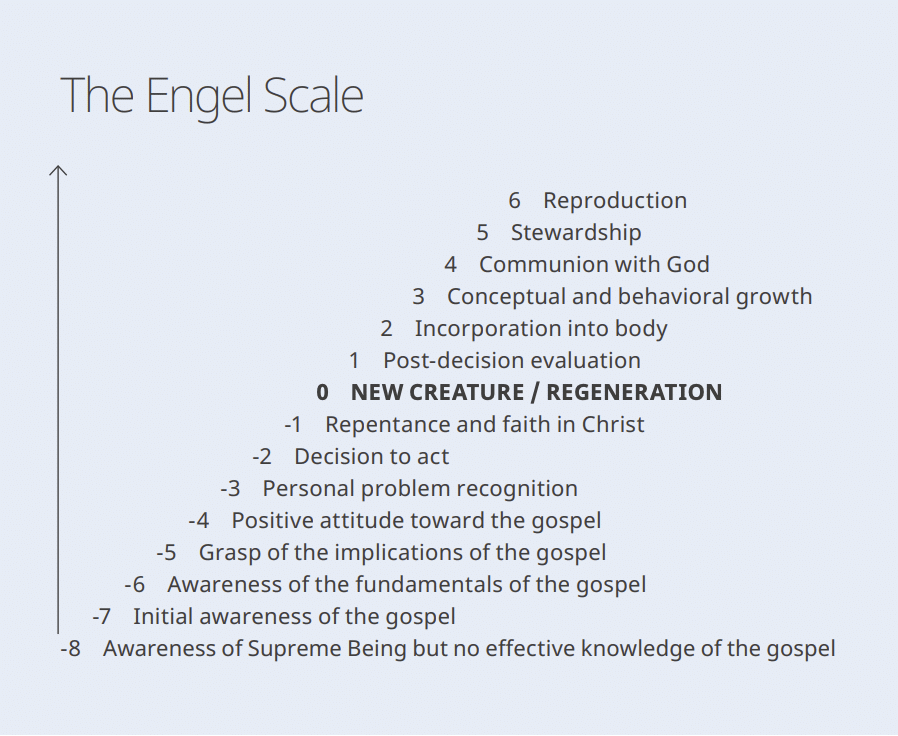
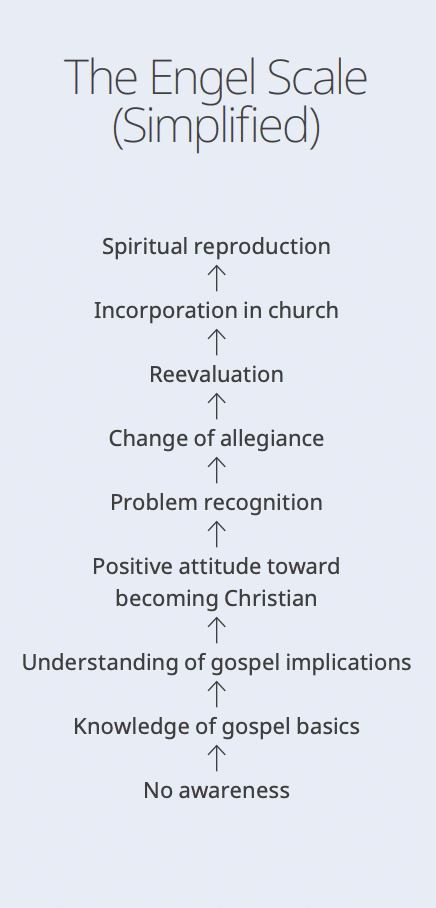
Engel later published a more simplified diagram which expressed the same conversion journey or pilgrimage of his first scale. It should be read from bottom to top.[11]
More recently, Gregory Ganssle proposed an updated scale. While based in Engel’s scale, The Diagnostic Scale focuses on what a person sees as valuable, rather than what a person understands. It shows the progression in relation to the influences and the ideas that a person goes through in the conversion journey (including the moment of repentance and faith in Christ).
The Diagnostic Scale[12]
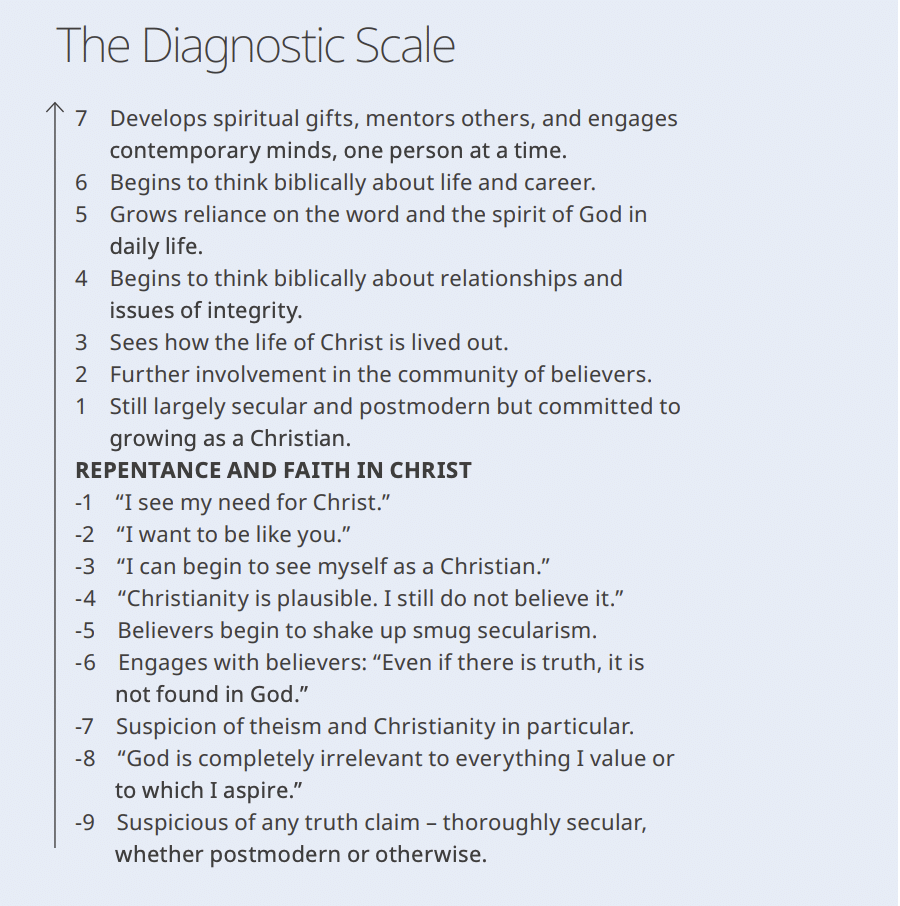
What I find interesting in this study is that much of Christian ministry (including among Gen Z) is directed to people further along in their spiritual journey. Contextualized ministry identifies the fact that many globalized Gen Z-ers (including those in the West) are further back in the discipleship journey than we realize.
A noteworthy connection can be made to two of Paul’s missionary sermons. In Acts 13 the apostle preaches to Jews who already believed in the existence of one God and embraced the divine authority of Scriptures (therefore further in their process according to the Engel or the Diagnostic scales). Hence, he preaches from Scriptures and uses it as his exclusive point of reference.
In Acts 17, the apostle is preaching to a pluralist society who did not embrace monotheism or the authority of Scriptures. Thus, the apostle begins further back in his sermon, with a necessary apologetics of the one true God and uses several cultural elements (such as their poets) as points of reference. Most young people from the globalized and interconnected Gen Z resemble the Athenian audience of Acts 17 more than the synagogue audience of Acts 13. However, ministry to young people seems to be more often directed to an Acts 13 audience rather than to an Acts 17 audience.
3. Apologetics
Paul gave an apologia, or reasoned for the faith, both during his daily conversations in Athens and during his remarkable speech in the Areopagus. Apologetics was part of Paul’s ministry in such a religiously pluralistic context with no biblical framework. Shouldn’t we follow his steps as we communicate and live out the gospel among Gen Z-ers? I think so.
The use of a metaphor can be illustrative here. Apologetics can be seen as removing rocks from the soil of people’s hearts and minds, so that the seed of God’s word can be planted in more suitable ground. Borrowing Netland’s terminology, we need a contextualized apologetics[13] that deals relevantly with the rocks of Gen Z’s soul. At the same time, we would do well to consider a holistic approach to apologetics that responds to the big questions of today’s youth. This kind of apologetics includes truthful ideas and arguments, but it is more comprehensive. We must also embrace an apologetics of love, hospitality, arts, aesthetics, health, community, and kindness.
The speech in Athens is marked by elements of identification and confrontation. The apostle begins where the Athenians were (the altar to the unknown god), but concludes where they should be: in Christ. As Conrad Gempf puts it, despite Paul’s winsome use of apologetics and contextualization, the speech is “a devastating attack on both the Athenians and their religion.”[14] Schnabel concurs: “Paul’s response to the religious beliefs and practices of the Athenians was, ultimately, not accommodation but confrontation…. Paul is unafraid to point to the resurrection of the dead….”[15]

4. Influencing the Areopagus
The historic Pauline speech in Athens was given at the Areopagus, a formal court in Athens and also the name of a hill where the court sometimes met. Interpreters disagree about which Luke was referring to. However, what’s important here is the fact that Paul communicated the gospel where ideas and worldviews were shaped in the world of his time.
What are the equivalents to the Areopagus in our days? Where are ideas articulated and shaped among young people today? Universities and social media are two of them. Our evangelistic efforts, discipleship, Bible engagement initiatives, teaching, etc. must be present at the Areopagus that shapes today’s youth.
It is also imperative to recognize that influence today is polycentric. Anyone from anywhere can create content that can potentially be seen by anybody in any part of the world. We must be extremely intentional in preparing followers of Christ in Gen Z to be salt and light in these environments. What needs to be reconsidered in the way we focus our time, energy, and resources to increase our impact in the various Areopagus of Gen Z?
5. Dialogue and Proclamation
Lastly, Paul’s ministry in Greece is a beautiful portrait of the blend between dialogue and proclamation in the mission of God. Paul begins his ministry in Athens dialoguing, listening, and participating in group discussions. He is then invited by the philosophers to speak at the Areopagus and gives one of the most studied monologues of history. In relation to this topic, the pendulum can easily move to one extreme in our work among young people. Paul’s activity in Athens reminds us that we should also embrace both forms of interaction with young people.
On the one hand, we must form communities where honest dialogue takes place and doubts can be expressed. In-person and online small groups that promote dialogue are essential for young people to open up and feel heard. They are critical for creating safe spaces where young people can express their views and questions about any topic whatsoever. I remember hearing on a podcast about a national survey in Australia that indicated that young people are ten times more likely to engage deeply with Scripture if they are in a peer community.
At the same time, we must not dismiss the uniqueness and power of verbal proclamation in salvation history. Some of the most fruitful ministries among young people hold proclamation by an individual in very high regard. Our appreciation for discourses is intrinsic to human nature, and Gen Z is not different. For example, one interesting phenomenon is the attention people like Jordan Peterson receive from so many young people. His thought-provoking two-hours classes have no visual aids. We indeed enjoy being part of a large group that is affected by a small group, or one single individual that presents or performs for us. We see this demonstrated in concerts, TED talks, comedy monologues, sermons, etc.
May we continue to communicate the word of God creatively and boldly to the younger generations. At the same time, may we continue to identify and equip those God is vocationally calling to the preaching and teaching of his Word.
Conclusion
Paul’s ministry in Greece may serve as a model for our ministry among Gen Z today. As the apostle engaged with God’s mission in Athens, he formed a multigenerational team, contextualized, applied apologetics, influenced the Areopagus of that society and did so dialoguing and proclaiming.
At the end of chapter 17, as Paul preached the resurrection of Christ, some rejected his message, others wanted to know more, and a few believed (17:32–34). The same will happen to us as we keep going to the whole world making disciples of Jesus among Gen Z.

Hélder Favarin (helder.favarin@communitybiblestudy.org) is the global youth and young adult initiatives director at Community Bible Study. He has a doctorate in preaching (Talbot School of Theology) and a master’s in biblical interpretation (London School of Theology). He speaks internationally in Spanish, Portuguese, and English. Hélder was born in Brazil and has also lived in Mexico, England, Scotland, and Spain; he holds an Italian nationality as well. He is married to Ana, and they have four children.
[1] See Acts 16.
[2] For example: “Don’t let anyone look down on you because you are young…” 1 Timothy 4:12.
[3] Chris Burnett, “How Would Paul Engage Today’s Secularizing Society?: An Exegetical Revisiting of Acts 17,” The Master’s Seminary Journal 30, no. 1 (Spring 2019): 166.
[4] Dean Flemming, “Contextualizing the Gospel in Athens: Paul’s Areopagus Address as a Paradigm for Missionary Communication,” Missiology 30, no. 2 (April 2022): 199.
[5] Graham Johnston, Preaching to a Postmodern World (Leicester, England: Inter-Varsity Press, 2001), 10.
[6] John Stott, The Contemporary Christian: An Urgent Plea for Double Listening (Leicester: UK, Inter-Varsity Press, 1992), 13.
[7] M. D. Gibson, Horae Semiticae X (Cambridge: Cambridge University Press, 1913), 40, quoted in F. F. Bruce, The Book of the Acts (Eerdmens, 1988), 359.
[8] Flemming, “Contextualizing the Gospel in Athens”, 204.
[9] Holladay, Acts, 345.
[10] James F. Engel and Wilbert Norton, What’s Gone Wrong with the Harvest? (Grand Rapids: Zondervan, 1975), 45, quoted by Gregory E. Ganssle, “Making the Gospel Connection,” in Come Let Us Reason: New Essays in Christian Apologetics, eds. Paul Copan and William Lane Craig (B&H Academic, 2012), 12–13.
[11] James F. Engel and William A. Dymess, Changing the Mind of Missions: Where Have We Gone Wrong?, 101.
[12] Ganssle, “Making the Gospel Connection,” 13–14.
[13] Harold Netland, “Toward Contextualized Apologetics,” Missiology 16, no. 3 (July 1988): 289–303.
[14] Conrad Gempf, “Athens, Paul at,” in Dictionary of Paul and his Letters, eds. Gerald F. Hawthorne, Ralph P. Martin and Daniel G. Reid (Leicester: Inter-Varsity Press), 52.
[15] Eckhard J. Schnabel, Paul the Missionary: Realities, Strategies and Methods (Downers Grove, IL: InterVarsity Press), 182.
EMQ, Volume 58, Issue 2. Copyright © 2022 by Missio Nexus. All rights reserved. Not to be reproduced or copied in any form without written permission from Missio Nexus. Email: EMQ@MissioNexus.org.