EMQ » July–September 2022 » Volume 58 Issue 3
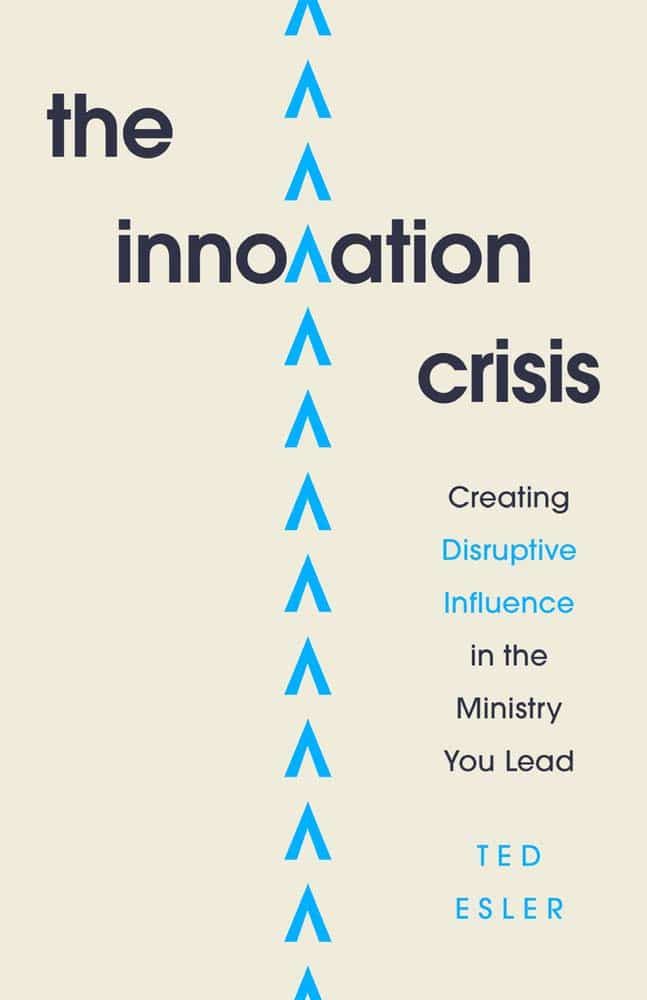
The Innovation Crisis: Creating Disruptive Influence in the Ministry You Lead
By Ted Esler
Moody Publishers, 2021
287 pages
US$16.99 (paperback)
Editor’s note: Ted Esler is the president of Missio Nexus, the publisher of EMQ.
Reviewed by David Haron (PhD) who serves, with his wife, as the director of Proyecto Puente in Barcelona, Spain. Together they train and equip Spanish-speakers for pioneer ministry among the unreached.
“I am sometimes asked why, after two thousand years, the Great Commission goes unfulfilled. From a human vantage point, I have concluded that a lack of creativity and risk-taking by God’s people are at the core of this failure. We are besieged by a poverty of imagination.” (Esler, Kindle loc. 242)
The Innovation Crisis is, at the very outset, a prophetic voice, a wake-up call for Christian leaders around the world to hold tradition less tightly, to re-evaluate what excellence looks like, and to pursue innovation, all for the glory of God. After Esler’s initial plea, most of the book serves as a practical resource and guide for those wanting to grow in their ability to leverage creative and critical thinking for organizational excellence and growth.
Esler covers a variety of topics like how to identify a problem worth solving, how to think big, the importance of empathizing with stakeholders, and how leaders can foster innovation. In each of these chapters, Esler refers readers to helpful resources, models, and frameworks for immediate application as well as for further growth in a particular area. Moreover, each chapter provides a summary, an application, and discussion questions as well as team exercises and homework.
One potential weakness of the book is that some readers may be left trying to figure out what is considered innovative and what is not. Though he defines innovation as “the use of something new to create solutions” (loc. 169), Esler also discusses how secular leaders tend to perceive a lack of innovation in Christian churches and ministries. Later, he describes how followers of Jesus have different values and that, consequently, innovation may look different from a Christ-centered worldview.
Though true and worthwhile, some readers may find the presentation of these ideas to be confusing. In my opinion the two greatest strengths of the book are both tied to its practical application. First, suggestions, case studies and tools are relevant for a broad range of applications and the book serves as a guide for action. Second, Esler provides brief synopses of numerous books, highlighting specific aspects of the innovation process. Readers will appreciate the short summaries of many excellent resources.
This book will most benefit leaders who are facing challenges and feeling stuck. For the leader who has no idea where to start in solving the problems faced by their ministry, Esler’s book will provide relevant tools and the know-how necessary to promote fruitful and disruptive changes. Those who have the courage and grit to seriously consider the weighty critiques explored in Innovation Crisis will likely find themselves both inspired and equipped to dream anew about how to establish God’s Kingdom here on earth.
For Further Reading
Ready or Not: Kingdom Innovation for a Brave New World by Doug Paul (100 Movements Publishing, 2020)
The Innovative Church: How Leaders and Their Congregations Can Adapt in an Ever-Changing World by Scott Cormode (Baker Academic, 2020)
Diffusion of Innovations, 5th ed. by Everett M. Rogers (Free Press, 2003)
EMQ, Volume 58, Issue 3. Copyright © 2022 by Missio Nexus. All rights reserved. Not to be reproduced or copied in any form without written permission from Missio Nexus. Email: EMQ@MissioNexus.org.