EMQ » July–September 2022 » Volume 58 Issue 3

Oral Bible Translation
Literacy does not need to be a necessary step for people to engage with God’s Word. Oral Bible translation enables more people to engage in translation and gives more communities access to God’s Word in their language faster.
By Swapna Alexander, Bryan Harmelink, and Youngshin Kim, with Jim Killam
“Reading is fundamental,” the public-service TV ads have told us for 50 years. Few would argue that point – though Bible translation leaders today would quickly add that literacy should never be a prerequisite to a person receiving and internalizing Scripture.
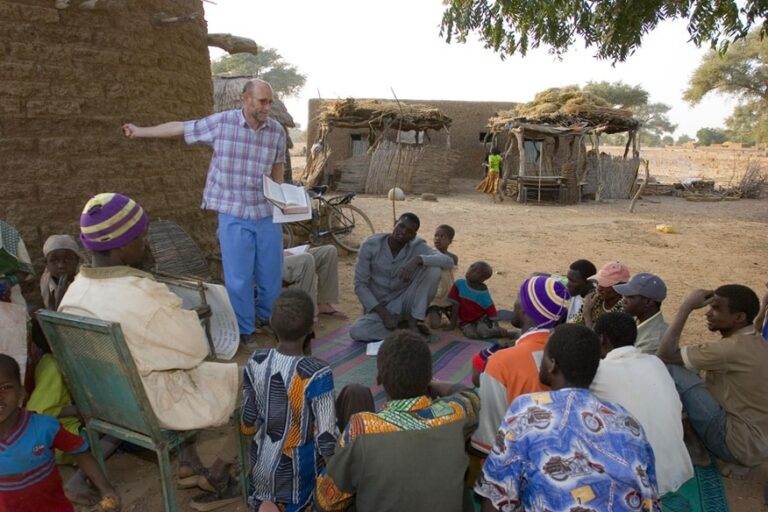
Of the world’s 7,378 living languages, there are still almost 1,900 language communities where Bible translation has not yet begun.[1] Most of the remaining language communities with no Scripture are oral cultures – societies with no written literature and where knowledge is shared primarily by word-of-mouth.
In the not-so-distant past, when an oral culture needed Scripture in their language, missionaries would go and spend decades there, developing an alphabet, a dictionary, and an orthography – that is, a set of writing rules for things like spelling, capitalization, and punctuation. Literacy was considered a necessary step for people to receive and engage with God’s Word.
That important language work still happens in many places, but initially receiving God’s Word doesn’t depend on it anymore. Enter oral Bible translation. The movement grew from what was originally called oral Bible storying. The two terms can be defined this way:
- Oral Bible storying (OBS): a Scripture engagement activity used to help introduce listeners to the Bible. A set of stories based on Scripture is crafted, learned, practiced, and ultimately shared.
- Oral Bible translation (OBT): Translating Scripture from an audio recording in one language to an audio recording in the target language – often with no writing required.
As OBS gained popularity, people became increasingly better at telling those stories in the exact words from Scripture. Methodology improved and consultant checking confirmed clarity and accuracy. The practice is increasingly seen as a way for Bible translation to emerge from Scripture engagement.
OBT is also viewed increasingly as the vehicle for Scripture to reach every remaining language (aside from sign languages, which have their own accelerating efforts under way). This does not mean that the Bible translation movement – which today includes hundreds of organizations, churches, and networks worldwide – is abandoning written work. It is not. Rather, OBT methodologies are being integrated into projects where printed Scripture is desired or where an audio version produced orally will be preferred. In some places, the printing and distribution of Bibles may be restricted by security concerns. In these settings, OBT may be the best way to make Scripture available.
OBT is also viewed increasingly as the vehicle for Scripture to reach every remaining language.
Common Misconceptions
Worth noting here: an oral culture does not necessarily equate to a non-literate culture, though it can. There is a common tendency to think about oral-versus-print culture or oral-versus-literate culture. But most of the world today deals with, and lives in the midst of, a mixture of messages that are communicated orally, in print, and visually. Even in the world’s most highly literate societies, people are reading less. An increasing proportion of their interaction is oral: radio, podcasts, television, music, YouTube, TikTok.
Bible translators know their work is likely to reach hybrid populations that will choose to encounter Scripture in different forms. Digital media already enforces or creates expectations of multiple modes of communication. You don’t get very far on YouTube, unless you’re just randomly clicking things, until you need some reading ability to choose the videos that you want. The same applies to smartphones. To find certain things, a person needs a certain level of reading and writing ability. But then their preference may be that once they find what they are looking for, then it’s all processed orally.
Oral, non-literate cultures also may be inaccurately characterized as less intelligent – unable to think in abstract concepts. That characterization needs to be challenged at every step. In our experience, incredible abilities and capacities can be found among all people – those who use written text and those who don’t. Very often, the recall, memory, and communication ability of oral communicators are phenomenal.
Very often, the recall, memory, and communication ability of oral communicators are phenomenal.
Internalizing Scripture
Though any Bible translation process carries spiritual value, OBT practitioners are finding that the step of internalizing Scripture creates a very different interaction with Scripture. When we internalize a passage and make it our own, it speaks to us differently than when we write it down. Internalization requires careful attention to multiple dimensions of the whole passage of Scripture in order to retell it orally. The passage has to become our own, and in the process we identify with it at a more embodied and emotional level.
One of the saddest comments that I (Swapna) heard from a translator long ago was, “I am translating the Bible, but it does not do anything to me spiritually. I am in no way edified.” When I relayed the comment to a senior translator, she was not surprised. But she said she had seen her team deeply impacted by OBT.
This is not always the case, of course. There are many translation teams working on written translations whose members have engaged deeply with Scripture, both intellectually and emotionally. Still, there is something different about OBT. One OBT translator said, “When we internalize stories, we get into the story and we become a part of the story. This is a very enjoyable experience.”
As we listen to translations done orally, we can feel the heart of the translator coming through. It is as though they are telling us their own stories. And then, even they themselves are surprised by the response of the people hearing those stories.
As we listen to translations done orally, we can feel the heart of the translator coming through. It is as though they are telling us their own stories.
One benefit of the conversation and discussion that are part of the internalization process is that they provide a more immediate spiritual experience for the translators and any other participants in that process. In contrast, in many written translation projects, a few people work on the translation while others have to wait until it is made available to them.
In the OBT process – and sign languages translations are similar in this way – much discussion occurs around questions that need to be answered in order to translate.
For instance: When you read, “Jesus wept,” the text doesn’t fully indicate the level of emotion attached. But when the verse is translated orally, the speaker has no choice but to give it some emotional feeling. Otherwise, the oral communication is incomplete. This and many other situations force translators to grapple with: What was the tone of voice? What was the person’s attitude? These are the types of questions that arise when creating an audio Scripture product. A print translation doesn’t always require this.
Ultimately, we believe this level of engagement may result in Bible translators changing the order of their process to place oral translation first – even among literate communities. Scripture engagement is always a primary goal with a group of people in a community, say, engaging with the story of Jesus and Lazarus. Out of that Scripture engagement activity, translation activity can emerge, with a better basis of understanding because of the level of engagement with Scripture. In that sense, this allows for much more direct spiritual engagement with people in the process of translation. In short, OBT is proving to be a more immediate way for people to gain access to and interact with the Scriptures.
More Than Narratives
One question that always comes up in discussions of OBT is, what about non-narrative sections of Scripture? How could it work for, say, the book of Romans? Or for passages like those in Exodus that give God’s instructions for building the tabernacle?
It is indeed possible to orally translate non-narrative passages. People talk all the time, and they talk in different genres, not just stories. The key to translating different genres orally is in identifying the genre and its function and understanding the content. Translation teams and advisors work together in a process we could call conversational discovery of meaning as they seek the best way to communicate the Scriptures effectively.
For those of us accustomed to reading the Scriptures, it may be challenging to grasp how teams are orally translating Paul’s letters successfully. As an example, there are people who have internalized whole letters like Galatians and are able to retell the entire book and perform it in an oral way. So it is possible, but we do face challenges that we don’t find with story.
While translating the book of Romans, we can start by talking about Paul’s arguments and his logic, then discuss the context and even create a dramatization together to help understand. In one project, we decided that another character is questioning Paul and asking questions like “What then? Shall we go on sinning so that grace abounds?” And Paul responds, “No way!” This helped us internalize Romans.
For those sections in Exodus, translation teams could start by talking about how to build a house, just to get into procedural text mode. Then they could talk about the content of the passage, and even act it out to build memory and clarify the action verbs. Then, they are ready to translate it orally. This is not easy, and it requires hard work by translators, but it is achievable. Actually, it’s more than achievable. The passage probably ends up better translated.
The question about non-narrative passages usually comes from someone who is primarily print-oriented and literate. It’s easy for those of us with those tendencies not to recognize the incredible memory capacity of those who live in a narrative, oral world. We tend to think we need extensive OBT methodologies for helping people remember, memorize, and internalize. But what we hear from people in oral cultures is more like: “Why do you keep repeating this? We already know it. You already told it to us once. Why are you repeating it three or four times?”
Even in literate cultures, we underestimate our abilities. We heard about someone who found a baseball card he collected as a child. And he was shocked that he could repeat, from memory, every statistic of that player from the card that he had studied decades earlier. Now, not everyone can function like a digital recorder and replay things they learned long ago. But we shouldn’t reason that, “If I can’t do it, then no one can.” Some people have incredible capacity that may seem impossible to us.
Reasons for the Surge
A series of factors have contributed to OBT’s momentum in recent years. Near the top of that list is the organization Faith Comes By Hearing and its development of the software Render. Translators listen to a Scripture passage in one language, study its meaning and internalize it. Then, they orally translate and record the passage in Render, in the target language.
Audio translation drafts are then shared, refined, and checked. Finally, the passage is recorded and distributed to the language community through phones, MP3 players, and other devices. People also memorize these audio passages and spread them through spoken word. In effect, they become walking Bibles. As further versions of Render and other programs are being developed for OBT, this process will only become easier for more translators to use.
There’s also been a groundswell of enthusiastic interest in OBT. People from multiple agencies or churches from multiple nations have gathered, first in person and then virtually during the pandemic. We have all realized together that OBT means more-immediate access for the Church to Scripture that will communicate widely to more people. In some places, this may not even mean audio recordings. It could be people in the churches who go from place to place, telling these passages of Scripture. Activities like discipleship and evangelism can benefit immensely by having live storytellers rather than a recording – even though the audio version plays an important role, too.
OBT means more-immediate access for the Church to Scripture that will communicate widely to more people.
The bottom line is this: Whether Bible translation is being done in written form, an oral, audio form, or in sign language – the best results come when translators thoroughly understand what they are translating. If a translator just kind of thinks they understand what Jesus was talking about, then their translation will only give kind of the idea of what Jesus was talking about. Of course, we can’t have 100 percent comprehension of every part of Scripture, but we can develop a thorough understanding through multiple hearings, readings, discussion, and by asking all kinds of questions.
This all sounds so simple. But sometimes, translators are still sitting down in front of a computer and beginning at chapter one, verse one, before they really have a grasp of what they are jumping into. There is great potential in some of the OBT processes to strengthen even the written translation practices. The more holistically developed our understanding can be of something like Paul’s relationship with the Philippian believers, the better the translation of Philippians. That is not found in word-by-word translation of those books. It is found by developing a more holistic understanding of things that even the epistle itself doesn’t say. For instance, we can know from the book of Acts about Paul’s relationship with that church, or the health of that church.
YWAM and a Big Plan
Finally, no 2022 discussion of OBT would be complete without mentioning YWAM (Youth With A Mission), a global ministry with multiple thousands of people – mostly young adults in discipleship training. YWAM has long supported the Bible translation movement, but now is poised to take on translation work. In 2021, 46 countries were identified as having five or more languages still needing Bible translation to begin, totaling 1,142 languages. YWAM has people in every one of those countries – including mother-tongue speakers for about 200 of the languages.
In late 2020, YWAM announced a huge goal: By the end of 2025, at least 1,000 of today’s remaining Bibleless languages will have, at minimum, 30 Taste & See Scripture passages and a single-voice narration of a gospel film – either the JESUS film’s narration of Luke or the LUMO narration of Mark (lumoproject.com).
YWAM has already partnered with the Jesus Film Project (jesusfilm.org) on 64 new translations over the past five years in the Melanesia region (mostly in Papua New Guinea, the Solomon Islands, and Vanuatu). Taste & See Scripture passages include 10 selections from the Old (Original) Testament, 10 from the Gospels, and 10 from the rest of the New Testament.
In both audio and text formats, they are intended to provide a comprehensive overview of the Biblical narrative in about 90 minutes. YWAM developed the Taste & See list in close consultation with leading Bible translation organizations to make sure the package meets Every Tribe Every Nation’s (eten.bible) goal of Scripture being accessible to all people by 2033.
YWAM’s OBT 1000 strategy is to mobilise 72 bases for training, including 33 hubs in strategic locations with a high concentration of Bibleless languages. Many of YWAM’s mother-tongue speakers in those targeted languages attended a 12-week Mega OBT School in the fall of 2021, where they were trained to equip others at their own sites.
The training was live in five locations around the world and virtual for those who could not travel. Eighty students and 12 YWAM staff from 16 nations attended. YWAM founder Loren Cunningham encouraged the students to take hold of this task and emphasized that it could lead to a great spiritual awakening in the world.

Bryan Harmelink (bryan_harmelink@wycliffe.net) serves as director for collaboration in the Wycliffe Global Alliance. He is currently involved in several initiatives in Bible translation, training, and quality assurance. He and his wife, Joan, live near Philadelphia, Pennsylvania.
Swapna Alexander (swapna@fcbhmail.org) is the lead Bible translation consultant at Faith Comes By Hearing. Swapna and her husband, Alex, spent several years with a people group in India, helping them translate the New Testament into their previously unwritten language. Swapna works with three OBT teams in Bangladesh.

Youngshin Kim (youngshin.kim@uofn.edu) is a YWAM leader in OBT training and the OBT 1000 initiative. She is based at University of the Nations in Kailua-Kona, Hawaii.

Jim Killam (jim_killam@wycliffe.net) is the managing editor for the Wycliffe Global Alliance.
A version of this article was first published on Wycliffe.net. The material is used here with permission.
NOTES
[1] “2021 Scripture Access Statistics,” Wycliffe Global Alliance, accessed February 15, 2022, https://www.wycliffe.net/resources/statistics.
EMQ, Volume 58, Issue 3. Copyright © 2022 by Missio Nexus. All rights reserved. Not to be reproduced or copied in any form without written permission from Missio Nexus. Email: EMQ@MissioNexus.org.