EMQ » July–September 2022 » Volume 58 Issue 3
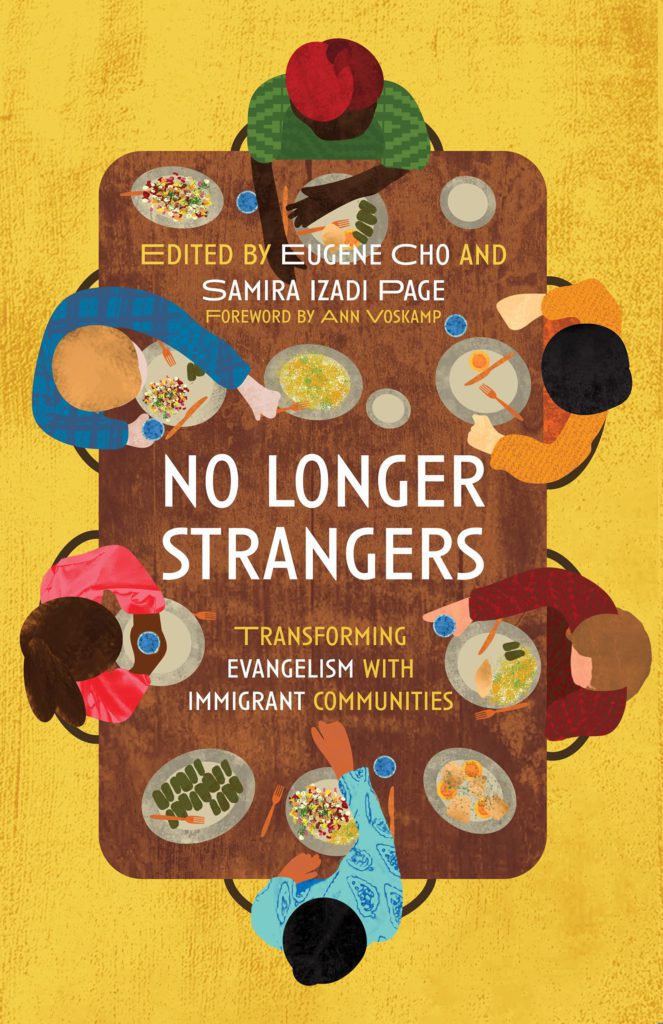
No Longer Strangers: Transforming Evangelism with Immigrant Communities
Edited by Eugene Cho and Samira Izadi Page
Eerdmans Publishing, 2021
187 pages
US$19.99
Reviewed by Ryan Klejment-Lavin, director of Footstool Missions Center, Seoul, South Korea.
At a point in history where there are more refugees and displaced persons than any time previously, No Longer Strangers: Transforming Evangelism with Immigrant Communities is a gem for equipping local churches to express the love of Christ to their recently arrived neighbors.
In this edited work, experts from a variety of disciplines discuss evangelism among immigrants, asylum seekers, and refugees in a North American context. A number of the contributors have personally experienced being an immigrant or refugee, giving the book both insight and weight. Power and privilege are recurring themes throughout the book, important phenomena in the experience of refugees and immigrants. Each chapter ends with a personal story from an immigrant, humanizing the concepts and grounding them in the lives of real people.
The authors’ individual contributions are synthesized into a coherent argument that evangelizing the foreigners among us should be done in a cruciform manner, emulating Jesus’ self-sacrificial love and his laying down of power and privilege as displayed on the cross. Other important components of evangelism that are highlighted are incarnation, mutuality, reconciliation, and a relational focus. The book warns that ignoring power dynamics and being blind to the trauma that immigrants and refugees experience inhibits the ability of Christians to love and express the gospel. Specific recommendations based on the lessons learned from years of experience are made for individuals, churches, and non-profits working with immigrant and refugee communities.
There is little to criticize in this book. As the book is written for North American Christians, and in a time where immigration and asylum have become political hot topics, this book lands squarely on middle ground. Perhaps those on the far right may accuse it of promoting the social gospel, while those on the far left may complain that there is not a strong enough call for political advocacy.
The contributors come from diverse backgrounds. This diversity, for the most part, succeeds in presenting a multi-faceted view of the topic. A slight criticism would be that the shift between the authors’ voices can be jarring, particularly between authors who have been immigrants or refugees and those who had not. However, these instances do not detract from the book as a whole, which, for the local church and laity, permits a discussion on immigrant and refugee issues that is both rooted in scripture and the experience of the immigrant. The book succeeds in humanizing the plight of immigrants and refugees, while simultaneously skirting the political minefield by focusing on what local churches can do.
This overtly evangelical book successfully argues that reaching out to the immigrant and the refugee is precisely the type of ministry that evangelism-focused communities should be undertaking.
For Further Reading
The God Who Sees: Immigrants, the Bible, and the Journey to Belong by K. González (Herald Press, 2019)
Welcoming the Stranger: Justice, Compassion & Truth in the Immigration Debate, rev. ed., by M. Soerens (InterVarsity Press, 2018)
EMQ, Volume 58, Issue 3. Copyright © 2022 by Missio Nexus. All rights reserved. Not to be reproduced or copied in any form without written permission from Missio Nexus. Email: EMQ@MissioNexus.org.