EMQ » July–September 2022 » Volume 58 Issue 3
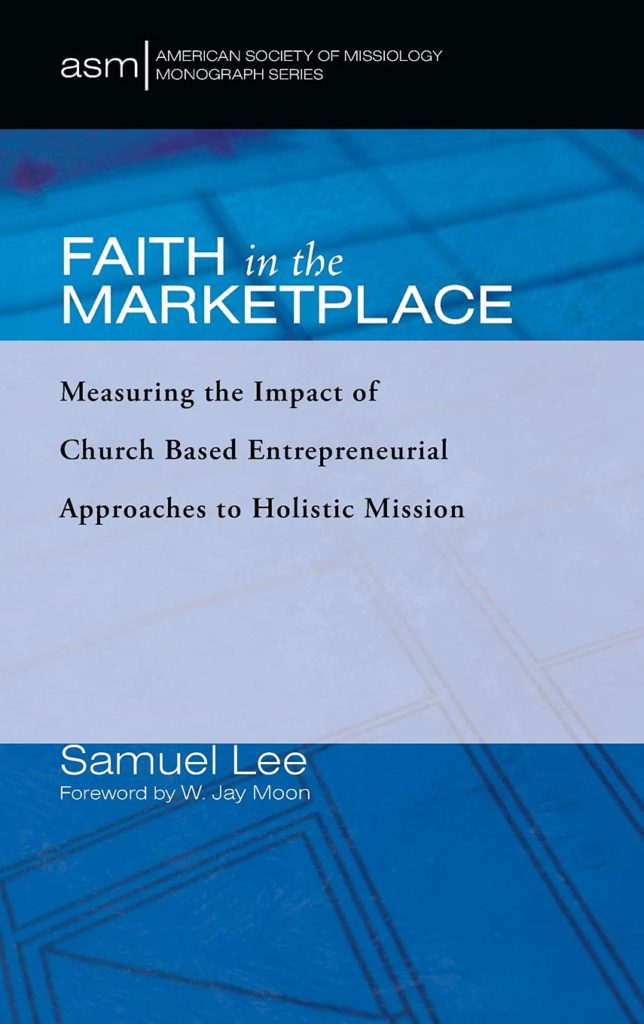
Faith in the Marketplace: Measuring the Impact of Church Based Entrepreneurial Approaches to Holistic Mission
By Samuel Lee
American Society of Missiology Monograph Series
Pickwick Publications, 2021
247 pages
US$32.00
Reviewed by Nathaniel (Than) Veltman who currently serves as mission scholar in missiology and community development with United World Mission’s Theological Education Initiative at the Ethiopian Graduate School of Theology in Addis Ababa, Ethiopia.
Combining business and mission is not new. Indeed, this integration can be traced back to the Apostle Paul’s participation in “manual work, discipleship/teaching, as well as church planting” (21). Furthermore, discussion of the processes, goals, and outcomes of church planting methods is common. What is often missing, however, is an in-depth analysis and discussion of the metrics utilized to measure the effectiveness and success of integrating business and mission.
Samuel Lee’s dissertation research published in this volume aims to address this gap. Faith in the Marketplace: Measuring the Impact of Church Based Entrepreneurial Approaches to Holistic Mission offers a conceptual framework “which attempts to provide theoretical and theological concepts to be measured by which entrepreneurial church planters could measure their performances” including “indicators of change” for assessing church planting outcomes (158).
Lee develops this framework through case studies of three Entrepreneurial Church Planting sights (ECPs): Meridzo Ministries in Lynch, Kentucky; Blue Jean Church and Arsenal Place Accelerator in Selma, Alabama; and Redeemer Church in San Francisco, California. Taken together, these case studies encapsulate historical models of missions and business for missional practice, which can be described as tentmaking, business for economic development, or holistic transformation business (31–40). In conducting these case studies of ministry which included interviewing business participants, Lee identifies core goals and outcomes of each ECP.
What quickly becomes evident is a lack of measurable metrics to assess the degree to which these goals and outcomes are attained. Lee’s subsequent analysis utilizes a “bonsai tree model” to identify key concepts relevant to measurement that enable effective and successful ECPs. These include personhood, in-between-ness, entrepreneurship, and oikonomia (146–153). For each, Lee further identifies “indicators of change” to assess overall performance and impact (153–157). The result is a practical tool for ECPs in measuring their effectiveness and success in bringing about holistic transformation.
This work makes a significant contribution to the discussion of integrating business and mission in the context of church planting. Most significantly, Lee’s conceptual framework and indicators provide church planters and missional entrepreneurs with specific metrics for measuring their impact towards holistic transformation in their respective communities. Although the research focuses on three ECPs in the United States, thereby limiting its focus, this framework offers a starting point for engaging ECPs around the world to strengthen and extend the conversation globally.
Church planters and entrepreneurs will not find any analysis or evaluation of organizational leadership or specific skills necessary for sustaining ECP success. Nonetheless, readers will find useful theoretical and theological tools for holistic transformation in their respective communities through the integration of entrepreneurship and mission. Teachers and students of church planting, as well as entrepreneurs and those engaged in business as mission, will find this book useful because it presents an additional component of church planting: measuring the impact of church-based entrepreneurial approaches to holistic mission.
For Further Reading
Business as Mission: A Comprehensive Guide to Theory and Practice by Charles Neal Johnson (InterVarsity, 2009)
Global Church Planting: Biblical Principles and Best Practices for Multiplication by Craig Ott and Gene Wilson (Baker Academic, 2011)
The Minister as Entrepreneur: Leading and Growing the Church in an Age of Rapid Change by Michael Volland (SPCK, 2015)
EMQ, Volume 58, Issue 3. Copyright © 2022 by Missio Nexus. All rights reserved. Not to be reproduced or copied in any form without written permission from Missio Nexus. Email: EMQ@MissioNexus.org.