EMQ » April–June 2022 » Volume 58 Issue 2
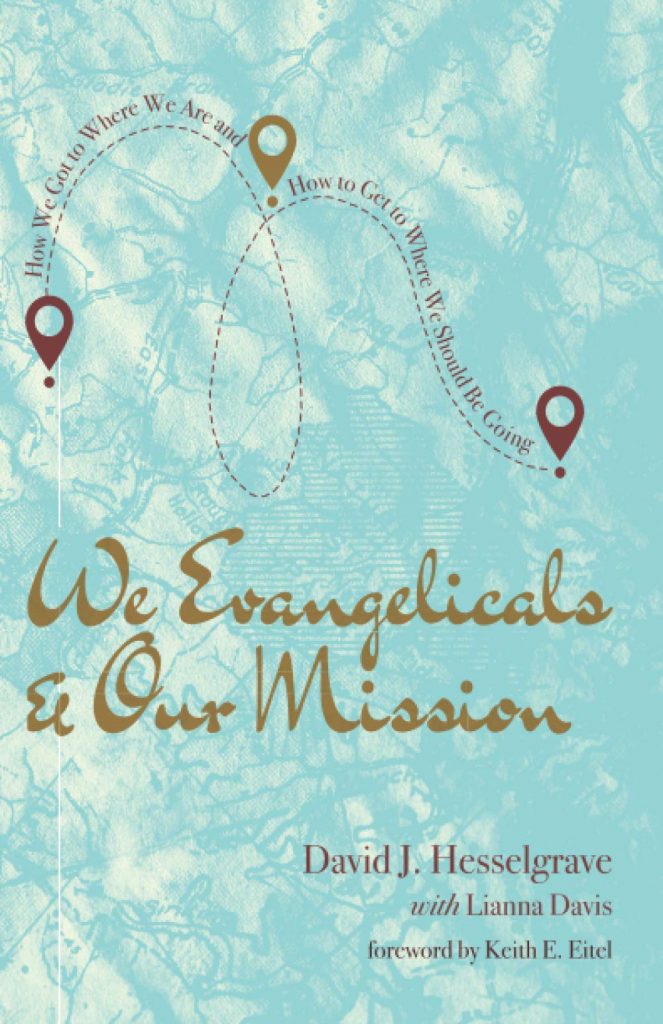
We Evangelicals and Our Mission
By David J. Hesselgrave, with Lianna Davis
Cascade Books, 2020.
158 pages
US$21.00
Reviewed by Richard Cook, associate professor of Church history and missions at Logos Evangelical Seminary in El Monte, California. Richard served as a missionary in Taiwan for over ten years and has a PhD in modern Chinese history from the University of Iowa.
David J. Hesselgrave (1924–2018), for many years a Professor of Mission at Trinity Evangelical Divinity School, was intimately involved in the resurgence of Evangelicalism beginning in the 1950s. He maintained an abiding passion for the health of the movement until his death. This book, published posthumously, is a concise treatise on the inestimable value of the historic Evangelical movement and a call for its preservation. Hesselgrave fearlessly confronts issues evangelicalism faces today that might destroy both the movement and the powerful missionary enterprise that has flowed from it.
The book contains nine chapters, divided into four parts. Part 1 presents the rich heritage of Evangelicalism, with chapters on classic Christian orthodoxy from the early centuries of church history, the Protestant Reformation, and the Great Awakening. Hesselgrave contends this is a legacy worth safeguarding. In part 2, Hesselgrave introduces the traumatic trial that split evangelicalism in the early twentieth century, a battle pitting Fundamentalism against Conciliarism and Ecumenism. He then traces the birth of neo-Evangelicalism in the 1940s, and he concludes this section by looking in detail at several evangelical organizations: the International Mission Board (IMB) of the Southern Baptist Convention, the Lausanne Committee for World Evangelization (LCWE), the Evangelical Missiological Society (EMS), and Missio Nexus.
Part 3 addresses controversies facing evangelicalism, centering around the trustworthiness of the Bible, the necessity of orthodox creeds/confessions, and the meaning of mission. In chapter 7, he provides his personal insight on the debates over biblical inerrancy at, for instance, Fuller Seminary and Trinity Evangelical Divinity School. Concerning how mission should be understood, in chapter 8, he presents “three divisive proposals” from evangelical heavyweights George Eldon Ladd, Kevin Vanhoozer, and Ralph Winter. In each case, Hesselgrave expresses concern that the proposals might undermine evangelicalism by disconnecting the movement today from its historic connection to the early church, the Reformers, and the Evangelical Revivals.
Part 4 concludes with thoughts about the future. Hesselgrave expresses concern that rather than strengthening its historic roots, such as the International Council on Biblical Inerrancy did (which dissolved after a brief life in the 1970s and 1980s), evangelicals instead have promoted these three movements: praise and worship, small group Bible study, and short-term missions. Again, his concern is that Evangelicalism is losing its historic moorings.
David Hesselgrave effectively defends the integrity and continued relevance of Protestant evangelicalism. By rooting evangelicalism within the New Testament, early Christianity, and the Reformation, he demonstrates that it is a precious tradition worth preserving. I found the ideas familiar, as Hesselgrave deeply engraved these themes into my mind when I was a young seminarian at Trinity. His voice, I am convinced, needs to be heard by a new generation of seminarians and missionaries. His concerns are not only valid for North America, but his plea should be heard in the global church. Further, as new clouds and challenges are emerging in the 2020s, evangelicalism, when properly rooted in historic Christianity, encompasses all the qualities necessary to offer the gospel of Jesus Christ to this generation.
EMQ, Volume 58, Issue 2. Copyright © 2022 by Missio Nexus. All rights reserved. Not to be reproduced or copied in any form without written permission from Missio Nexus. Email: EMQ@MissioNexus.org.