EMQ » April–June 2022 » Volume 58 Issue 2
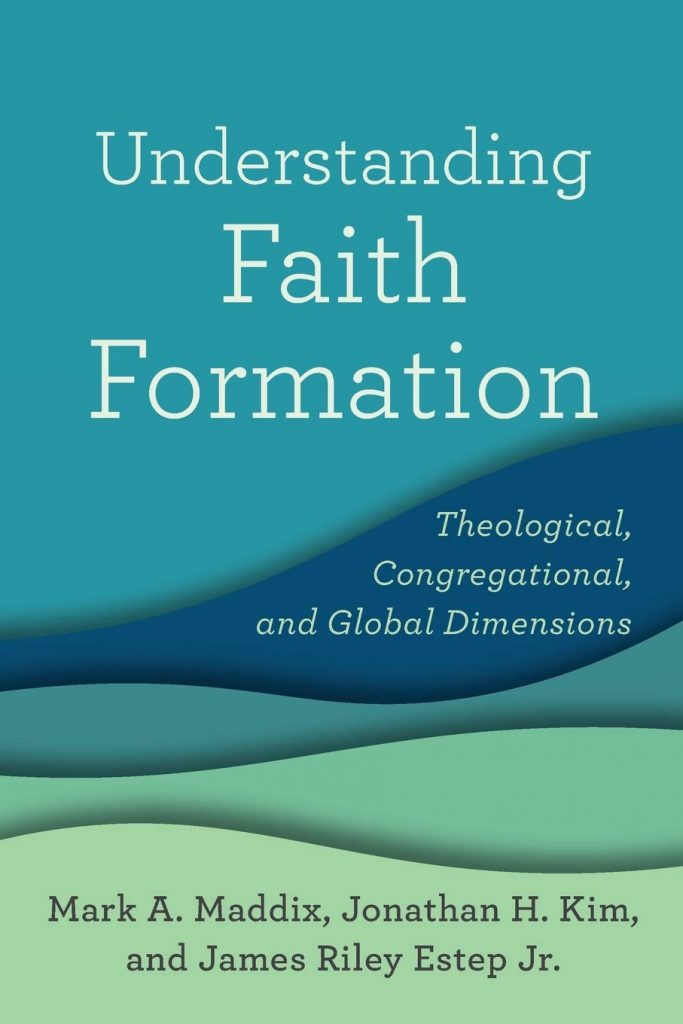
Understanding Faith Formation: Theological, Congregational, and Global Dimensions
By Mark A. Maddix, Jonathan H. Kim, and James Riley Estep Jr.
Baker Academic, 2020
192 pages
US$24.99
Reviewed by Ryan Gimple, who served 19 years in East Asia before becoming a professor of mission and church planting at Charleston Southern University, South Carolina.
Moving to Asia and sharing the good news of Jesus cross-culturally stretched my faith and pushed me to desperate dependence on God. Studying the Scripture with Asian believers opened my eyes to understand and apply God’s Word in transformed ways. Understanding Faith Formation is the first book I have encountered that recognizes that serving cross-culturally in missions and in multi-ethnic contexts plays a significant role in faith formation.
The authors begin theologically by defining the concept of faith within Scripture. The second chapter examines several theological questions regarding faith formation and provides brief synopses of positions held throughout history in a variety of traditions. Is faith a gift of God or a work of humanity? How does faith relate to reason, and to good works? What is the relation between the Word and Spirit in faith formation? The authors present a strong critique of James Fowler’s human-centered model of faith development and also interact with James Loder. The book proposes a new model of faith formation that resulted from a qualitative study. The new model is congruent with evangelical theology, in contrast to Fowler’s model of faith development.
The second section of the book acknowledges that faith formation occurs in a community and social context. Faith formation is discussed within the context of post-Christian secularizing culture and the decline of biblical literacy. The nones of western culture reject faith and religion but embrace spirituality. Even as our culture is hyper-individualizing, the role of community is essential in faith formation. The authors summarize and interact with a variety of books from the mid-nineteenth century to the present that emphasize the community in faith formation. Worship, fellowship, preaching, mission, and justice shape faith within community. Scripture is honored as essential for faith formation. Scripture is formational for our faith, not only informational. A highlight of the book is the prominence given to Scripture for faith formation.
In the third section of the book, the authors show that crossing cultures and service in missions contribute to faith formation. Short-term mission trips create cognitive dissonance, which leads to transformation and faith formation. The authors apply their proposed model of faith formation to multiethnic contexts. Globalization and diaspora communities throughout the world push the faith of Christians out of a monocultural understanding and into a global Christian consciousness.
A model of faith formation for our globalized era is needed. Unfortunately, the proposed model of faith formation in the book is somewhat difficult to follow. As much as I want to accept the authors’ model of faith formation, the model needs more clarity. I certainly welcome a new model of faith development that maintains a high view of Scripture and acknowledges God’s active presence in the process. I hope that more work is done to develop this evangelical, theologically faithful model of faith formation. The book initiates a discussion of the global dimension in faith formation and is suited for anyone interested in crossing cultures and faith formation.
For Further Reading
Wilhoit, James C. Spiritual Formation as if the Church Mattered. Baker Academic, 2008.
Kane, Nancy. Stages of the Soul: God’s Invitation to Greater Love. Moody Publishers, 2019.
EMQ, Volume 58, Issue 2. Copyright © 2022 by Missio Nexus. All rights reserved. Not to be reproduced or copied in any form without written permission from Missio Nexus. Email: EMQ@MissioNexus.org.