
EMQ » April–June 2022 » Volume 58 Issue 2
By Rosie Button

The biblical and theological foundations for staff care and wellbeing (otherwise known as member care) exist. However, all too often, member care literature draws on only a handful of key biblical themes or passages. A more comprehensive, or systematic theological approach is needed which provides a framework for this practice of drawing on specific passages and examples of care in the Bible. Additionally, a whole-Bible approach, seeing the whole of scripture speaking into staff care, rather than just specific passages or verses would provide a further biblical context and support.
[memberonly folder=”Members, EMQ2YearFolder, EMQ1YearFolder, EMQLibraryInstitution”]Existing Biblical Approaches
Most existing member care writing on biblical foundations tends to fall into four categories:
They look at passages or themes which give general principles for care. For example, Redcliffe MA student Janet Dallman wrote a paper on the recurring imagery of the shepherd throughout the Bible, as the basis for a member care model.[1] This image is clearly the basis of the term pastoral care and the word pastor. Her writing spoke into both the role and the characteristics required of a carer.
- They explore passages or themes which speak to particular aspects of member care. The Le Rucher booklet, The Emmaus Rd, a Biblical Model for Debriefing[2] does this. It uses the Emmaus road incident in Luke chapter 24 as a template for debriefing.
- They spotlight biblical characters as givers of care. Ronald Koteskey in his online book, Missionary Member Care,[3] discusses people who gave care to Paul, including Stephanas, Fortunatus, and Achaicus. These men, who Paul said, “refreshed my spirit” (1 Corinthians 16:17–18), acted as Paul’s member care team.
- They share examples of biblical characters as receivers of care. The passage about the prophet Elijah receiving care at God’s hands after the confrontation with the prophets of Baal (1 Kings 19), is often used as a pattern for debriefing a burned-out worker. One instance of that is in Debbie Lovell-Hawker’s chapter on debriefing in Doing Member Care Well.[4]
All these approaches rely on finding stories and passages in the bible to support member care rather than seeing these within a wholistic biblical framework.
Member Care, the Missional Hermeneutic, and the Missio Dei
This perspective has been reflected across mission studies. However, in the last fifteen years or so, this shifted. Mission studies started moving from looking at biblical foundations for mission, to looking for the missional foundation of the Bible. In other words, rather than seeing the Bible as the basis of mission, we look at mission as the basis of the Bible. This is known as the missional hermeneutic.
While he was not alone in thinking along these lines,[5] this was the seminal idea of Chris Wright’s 2006 book, The Mission of God.[6] Instead of looking for the biblical passages which speak to mission, Wright and others talked about viewing the whole Bible through the lens of mission and seeing the whole Bible as a product of God’s mission to the world (missio Dei). Furthermore, they considered the Bible’s whole story as one of that mission and of salvation with the Bible itself being a tool or means of mission that also equips us to be part of that mission.
Could we make a similar shift in the way we think about member care? Could we look at the whole Bible through the lens of member care? Even if not, member care seems to fit naturally into the missional hermeneutic. For example, where the Bible speaks into the care of Christian workers, it appears to be a crucial part of equipping us for mission.
Towards a Theological Foundation
The Bible bursts with examples of and teaching about God being a loving God who cares for his people. The Great Commandment (Matthew 22:37–39) is that we should love God with our whole heart and love our neighbour as ourselves. Member care is clearly a manifestation of that love that we are to show one another.
In member care literature, there are a handful of sources which seek to give foundational ideas for a theology of care. One such idea is that member care lies in the crux of the Great Commission and the Great Commandment. This is David Pollock’s view, in chapter 2 of Doing Member Care Well.[7]
Stating that the Great Commission and the Great Commandment lie at the heart of the New Testament, he posits that we can only fulfil the one by fulfilling the other: we spread the gospel and win disciples by demonstrating God’s love. Pollock points to the early church doing just this and states that by practising member care we are doing this as well. It is not just about reducing attrition but about loving each other and thus demonstrating and furthering the gospel. This locates member care clearly within the missio Dei as being one of the ways in which God’s mission is accomplished.
The Le Rucher booklet, Biblical Member Care, by Erik Spruyt and Renee Schüdel,[8] gives a bigger picture. They start by quoting 2 Timothy 3:16–17:
“All Scripture is God-breathed and is useful for teaching, rebuking, correcting and training in righteousness, so that the servant of God [member] may be thoroughly equipped for every good work.” What is member care if not equipping people for “every good work?”
Then the authors ask, “Who are the people we are caring for, and why?” and, “What kind of member care is specifically needed in order to fulfil who we are in God and what we are purposed to do in Christ’s name?” Here they place member care in its place in God’s mission, but this time as equipping people to fulfil their role in that mission. Author’s Spruyt and Schüdel go on to assert that member care providers must have a solid biblical understanding of the big picture of mission.
We also affirm this at All Nations Christian College, UK. In fact, students in our Staff Care and Wellbeing MA program are required to do core missiology modules as well as member care modules. This equips program graduates with a thorough missiological training that serves as a foundation to their other coursework.
Spruyt and Schüdel’s approach asserts that the goal of member care is forming Christlike missionaries who, like Christ, are image-bearers, salt and light, and resilient in the face of suffering even to the point of death. They call this cruciform member care.
In the paper “Biblical Foundations for Member Care,”[9] Annemie Grosshauser looks to the model Jesus lived as he cared for his disciples. She says: “His primary goal was not to make them effective but to live out of fellowship with Him, and to develop a godly character and inner strength to face adversities and persecution.”
Both Spruyt and Schüdel’s booklet and Grosshauser’s paper depict Jesus as both the model of care and the goal of care (by which I mean, Christlikeness is the goal). Furthermore, both show that our relationship with Jesus is the source of care. So we can say that Jesus is at the very centre of member care as the source, the model, and the goal. Or in the interest of being rightly trinitarian, we might prefer to place the triune God in the centre rather than specifically Jesus.
We can look further back in the Bible, to the Old Testament, to see God as the originator of all care for his people. Rhiannon Gibson, in her paper entitled SIL Care and Wellbeing Missiological Reflection Questions,[10] explains that the Old Testament, particularly Deuteronomy, demonstrates God’s care for his people and provides the beginnings of a theology of member care.
Lina Miller also saw a model for God’s care in the Old Testament. In her 2017 dissertation,[11] she argued that through the Jewish feasts, God created a rhythm of care which included times for community, celebration, commemoration, confirmation, and cessation (rest). Combined, these concepts form a potential basis for member care.
We have traced a basis for staff care throughout the Bible: rooted in the care of God for his people as shown in the Old Testament, borne out again in Jesus’ care for his disciples, and continued in the lives of the early Christians as, filled with the Holy Spirit, they lived out what they had been taught. The source of all of this care is the Trinity.
In his book, Enhancing Missionary Vitality, Glenn Taylor explains that “a theology of care reflects the relationship between the members of the Trinity, the care of God for us, and the expectation that we will care for one another.”[12] He goes on to emphasise that whereas God through his Spirit is the source of care, God normally works through us caring for one another – hence the importance of what we refer to as mutual care. He concludes saying as carers, we must first receive comfort, building up, growth, correction, and so on from the Holy Spirit in order to do the same for those in our care.
A New Framework
Now that we have explored the different theological and biblical approaches to member care, let’s look at what a framework for the theology of care could look like. Underlying the framework is the understanding that Jesus Christ is the source, the goal (as in, Christlikeness being the goal), and the model of care.
Christ being the source of care indicates that member carers have to be receiving from Christ. This needs to happen in tandem with helping people receive care from Christ to enable and empower them in mission. One way this happens is by encouraging and teaching Spiritual Formation practices.
Christ as the goal of member care means that member carers support and equip Christian workers to become like Christ. They come alongside to help them live as he lived, even to the point of being willing to sacrifice everything.
Christ being the role model for care giving, implies that we must learn from how he cared for his disciples as seen in the gospels. It also means looking at how he demonstrated his self-care throughout his ministry and learning to follow his example.
With that paradigm in mind, the following diagram visualises our framework:
Figure 1.1 – Relation of Missionary, Member Carer, and Mission of God
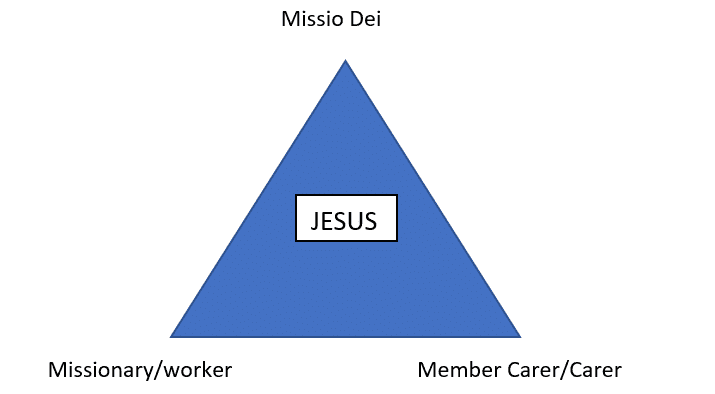
The diagram in figure 1.1 shows, firstly, that the missionary and the member carer both need to be understood in relation to the mission of God and to each other. Secondly, it illustrates how Jesus is at the centre of all three corners as source, goal, and model.
As member carers looking at this diagram, we must respond by asking the following theological questions, amongst others:
- About the missio Dei: Do I have an understanding of the missio Dei?
- About the member carer: How does member/staff care fit into the missio Dei? Who am I specifically and what is my role in relation to it (gifts, capacity, calling)? And how do I look to Jesus as the source, goal, and role model of my care-giving?
- About the missionary/Christian worker in my care: Who are they in relation to the missio Dei? Who are they specifically as an individual or family unit (their calling, gifts, background)? How can I help them fulfil their role?How can I help them relate to Jesus as their source of care?
With the help of a member carer, a missionary or Christian worker looking at the diagram, could asking these questions (amongst other things):
- About the missio Dei: How do I relate to the missio Dei?
- About member care: How do I relate to member care, make sure I receive the member care I need? How am I receiving care from Jesus Christ?
- About fellow missionaries or Christian workers: How can I encourage my colleagues as one of their peers in their place in the mission Dei, in their role, or in their calling? How can I remind them to look to Jesus as their source of care?
Another more Trinitarian approach could be to put the Trinity at the centre of the triangle, rather than Jesus alone. That could help us think through how each member of the Trinity relates to the missio Dei, the missionary, and the member carer.
The final layer of the framework looks at the missionary/Christian worker. Figure 1.2 illustrates the context of an individual with the various factors suggested, as well as their place of belonging in the various communities suggested, and more.
Figure 1.2 – Context Diagrams of an Individual and Communities
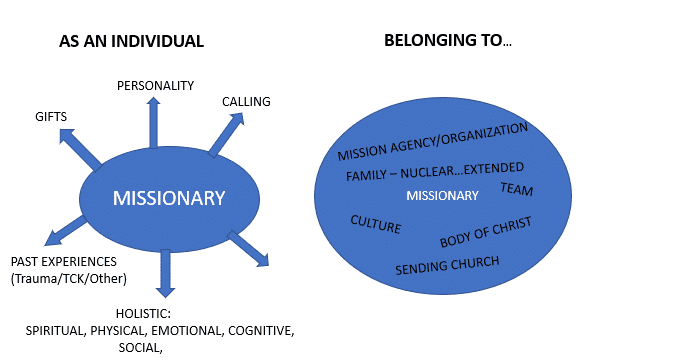
This is where we can move from the bigger picture theological understanding of member care to applying the many and various specific biblical themes and passages referred to above.
Conclusion
Member care needs deeper theological reflection and a whole-Bible view in order to draw together the multiple strands of current biblical writing on member care. It is my hope that the framework I provided here will lead to that. I also desire that those involved in the care of Christian workers, including both member care workers and missions leaders, will have an enriched theological understanding of their work and be affirmed in viewing their role as an integral part of the missio Dei.

Rosie Button (r.button@allnations.ac.uk)is a lecturer for All Nations Christian College, UK’s staff care and wellbeing (member care) MA. She previously helped lead the MA in member care at Redcliffe College after working many years as a missionary lecturer in Zimbabwe and then Uganda.
[1] Janet Dallman, “A Study of the Implications of Biblical Shepherd Imagery for Member Care in OMF Japan” (independent study module paper, Redcliffe College, 2018).
[2] Erik Spruyt, et al, The Emmaus Rd, a Biblical Model for Debriefing, Le Rucher Ministries.
[3] Ronald L. Koteskey, “Is Missionary Member Care in the Bible?” in Missionary Member Care (2013), http://missionarycare.com/ebooks/Member_Care_Introduction_%20Book.pdf#page=12.
[4] Debbie Lovell-Hawker, “Guidelines for Crisis and Routine Debriefing” in Doing Member Care Well, ed. Kelly O’Donnell (Pasadena: William Carey, 2002).
[5] See, for example, Richard Bauckham, Bible and Mission: Christian Witness in a Postmodern World (Carlisle, UK: Paternoster Press, 2003), and more recently, Michael Goheen, ed., Reading the Bible Missionally (Grand Rapids, MI: Wm. B. Eerdmans Publishing Co., 2016).
[6] Christopher J. H. Wright, The Mission of God: Unlocking the Bible’s Grand Narrative (London: IVP Academic, 2006).
[7] David Pollock, “Developing a Flow of Care and Caregivers” in Doing Member Care Well, ed. Kelly O’Donnell (Pasadena: William Carey, 2002).
[8] Erik Spruyt and R. F. Schüdel, Biblical Member Care, (Le Rucher Ministries, 2012).
[9] Annemie Grosshauser, Biblical Foundation for Member Care, paper delivered at 7th European Member Care Consultation, Pensicola, Spain, March 23–27, 2010.
[10] R. Gibson, “SIL Care and Wellbeing Missiological Reflection Questions Paper,” 2019.
[11] L. Miller, “Looking at Member Care through the Lens of the Biblical Feasts” (MA diss., Redcliffe College, 2017).
[12] G. Taylor, “A Theological Perspective on Member Care,” in Enhancing Missionary Vitality: Mental Health Professions Serving Global Mission, ed. John R. Powell and Joyce M. Bowers (Palmer Lake: Mission Training International, 1999).
EMQ, Volume 58, Issue 2. Copyright © 2022 by Missio Nexus. All rights reserved. Not to be reproduced or copied in any form without written permission from Missio Nexus. Email: EMQ@MissioNexus.org.



One Response
Great write-up! A comprehensive framework of Biblical foundation for member care to delve into and to share with sending entities.