EMQ » April–June 2022 » Volume 58 Issue 2
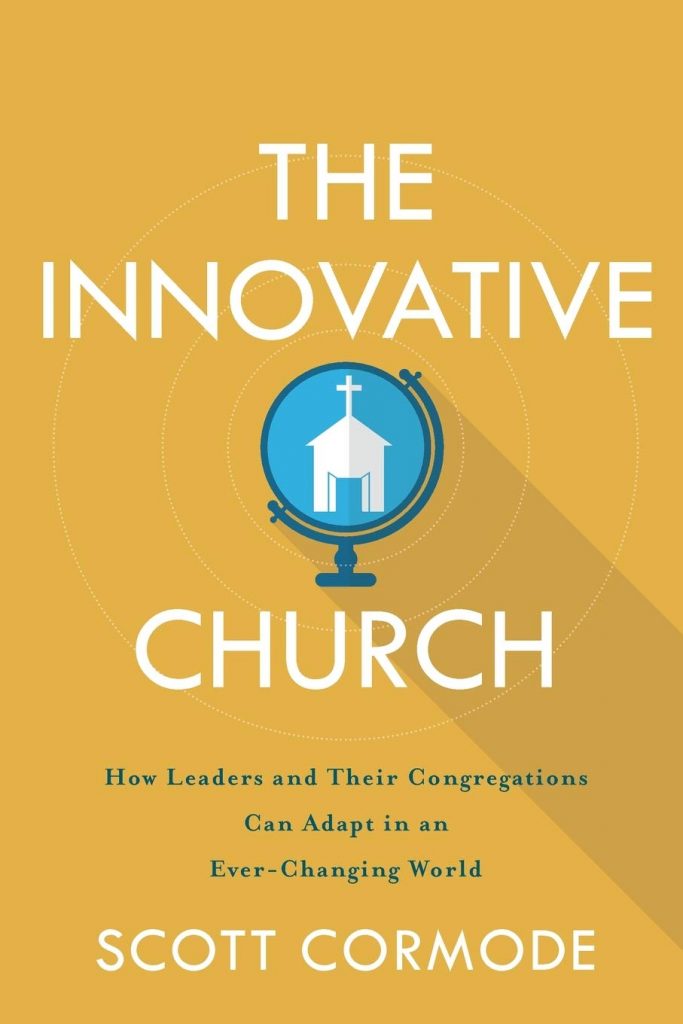
The Innovative Church: How Leaders and Their Congregations Can Adapt in an Ever-Changing World
By Scott Cormode
Baker Academic, 2020
288 pages
US$26.99
Reviewed by Dennis J. Horton, associate professor of religion and director of ministry guidance, Baylor University, Waco, Texas.
Global pandemics require innovative responses. Although Scott Cormode did not know about the massive changes that would occur when he was doing the foundational research for The Innovative Church, its publication could not have come at a more appropriate time. In this book, Cormode addresses the central problem for the church today: Most churches are “calibrated for a world that no longer exists” (1).
The world and its many cultures are constantly changing, but churches are often slow to adapt. The author’s objective is to answer this key question: “How do we maintain a rock-solid commitment to the unchanging Christian faith while at the same time finding innovative ways to express that faith in an ever-changing culture?” (3). Cross-cultural workers ask the same question, using slightly different terminology: how do we contextualize the gospel for those within a particular culture without compromising the gospel?
Cormode offers an answer through his explanation of the steps necessary for innovative ministry. The first half of the book focuses on understanding the needs and problems of those within a particular cultural context by listening empathetically to them. Then leaders must work to reinvent Christian practices that enable the gospel to address those needs and challenges. The reinvented practices lead to stories of hope which in turn help congregations gain the momentum they need to break free from the old patterns which are no longer working.
The second half of the book describes the process for innovation and how to help congregations organize for innovation. Readers learn to incorporate innovation as an ongoing work to help the church continually adapt the gospel to an ever-changing world. The process consists of empathetic listening, divergent ideation (gathering ideas), convergent deciding (determining which ideas to pursue), and experimental prototyping. To foster this process, leaders must create an environment where they welcome ideas, view failure as a learning process, and test prototypes in subdued settings. Cormode also provides helpful strategies to lead a group through these challenging adaptations.
In addition to his years of experience consulting with churches, Cormode bases his well-researched work on findings derived through participant groups in over 100 congregations. The resulting book provides a proven process for facilitating innovation and agility within a church context. The book is highly readable with excellent use of repetition and illustrations to clarify the concepts. He simultaneously offers an abundance of concrete ideas to facilitate each step of the innovation process.
While missions is not the central focus of the book, Cormode’s principles and strategies for innovation apply equally well to cross-cultural ministry. Building relationships and ministering across cultures requires innovation to be effective, especially during a pandemic. Those hoping to contextualize the gospel without compromising the gospel will find this book to be a valuable resource.
For Further Reading
Bolsinger, Tod. Canoeing the Mountains: Christian Leadership in Uncharted Territories. IVP Books, 2015.
Bolsinger, Tod. Tempered Resilience: How Leaders Are Formed in the Crucible of Change. IVP Books, 2020.
Rainer, Thom. The Post-Quarantine Church: Six Urgent Challenges and Opportunities That Will Determine the Future of Your Congregation. Tyndale Momentum, 2020.
EMQ, Volume 58, Issue 2. Copyright © 2022 by Missio Nexus. All rights reserved. Not to be reproduced or copied in any form without written permission from Missio Nexus. Email: EMQ@MissioNexus.org.