EMQ » April–June 2022 » Volume 58 Issue 2
By Pam Arlund, Mary Ho, and Peggy Spiers

Imagine this conversation with your elderly mother after a recent follow-up visit with her new doctor.
“How do you like your new doctor, Mom?”
“Oh, I really like him. He turned his chair to face me and asked how I was feeling. He asked if I was having any side effects from the new medication. He wanted to know if I had any questions or concerns. It was amazing! He remembered everything I told him during the last appointment without checking the computer screen. He had all the time in the world for me. Then he asked how your dad’s garden was doing and if you were back from your trip yet. We had a really nice conversation. He is a wonderful doctor!”
How did your mother determine the doctor’s qualifications? She undoubtedly has not seen his medical school records or spoken with his other patients. She determined the care she will receive based on the time and attention he gave her. He was not reading a computer screen or typing while your mom talked. The doctor gave her his undivided time and attention. He remembered what she told him on her last visit. And he even showed interest in her family!
[memberonly folder=”Members, EMQ2YearFolder, EMQ1YearFolder, EMQLibraryInstitution”]This care is individualized and holistic. It cares deeper than a patient’s obvious symptoms. When caretakers – doctors, nurses, therapists, and counselors – consider the whole person, there is a higher probability of restoring that person to health sooner rather than later. A health professional offers far better care by focusing on seemingly secondary concerns, such as possible side effects, mental or emotional trauma, eating and sleep patterns, and family and work dynamics.
This type of care is unique to each patient. It is not a standardized cookie-cutter service that everyone receives. This type of care takes more time and often involves more people. At first glance, it appears to be an inefficient use of time and resources. But in the end, it will keep the patient in better health for a longer time.
Oikos Care: “Discipling Through” Versus “Discipling At”
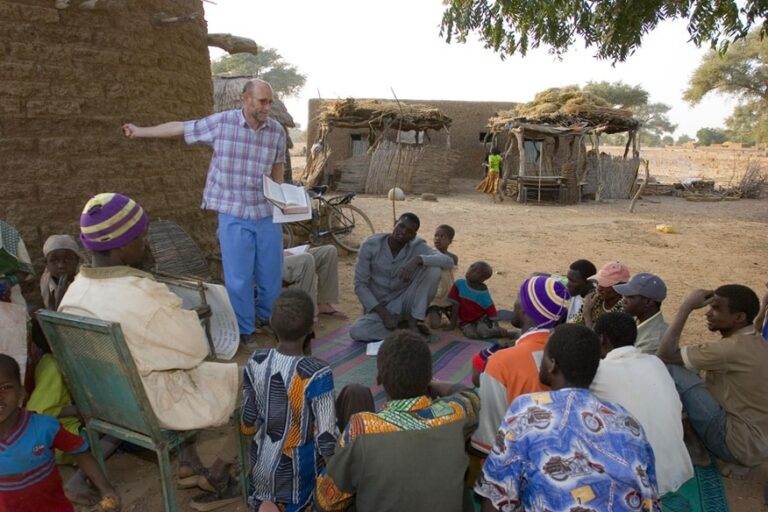
We call this kind of holistic care, oikos care. In missions and evangelistic outreach, Jesus instructed us in Luke 10 to find a friend or contact who is a person of peace in a new people group. Jesus describes the person of peace as the one who opens his or her oikos or social network to the church planter. An effective church planter does not focus on reaching only one individual – a method we call disciple at, by focusing on winning one individual in isolation. Instead, we should disciple through them to include their neighbors, friends, families, and social network. This wider method has proven to produce more disciples who will, in turn, make even more disciples.
On the front end, this method of discipling through a person to reach their entire social network seems like an inefficient use of time and resources. It may appear that the church planter is not focused. However, he or she is intentionally focused on reaching the whole person and the whole community for Jesus. This is how the gospel spreads, within social networks.
Oikos Care
Let us apply these same principles to member care. What would member care look like if we, as senders and member care givers, see beyond the surface needs of our missionaries to care more holistically for them? We know they are dealing with fundraising, culture shock, and language learning. What else may be affecting their well-being? It could be that parents are not releasing them to go. Friends may be fearful for them. The stress may be damaging their health.
Holistic care also extends beyond just the individual missionary. We need to explore who is in our missionary’s oikos, his social network. Caring for everyone in the missionary’s life is to care for him as a whole person – as a husband, student, father, son, employee, neighbor, disciple maker – and not just as a missionary. His role as a missionary is only one aspect of who he is.
As we meet the missionary’s oikos, we begin to learn about these people, pray for them, and maybe even get to know them personally. We are coming alongside our missionary, sharing his joys and burdens. We may begin with the goal of caring for our missionary, but the emotional, spiritual, and practical ways we care for the people closest to him will increase his emotional, mental, and physical capacity to focus on his ministry. He will be more fruitful in the long run.
Figure 5.1 – Oikes Care: Caring for Our Missionaries by Caring Through Our Missionaries
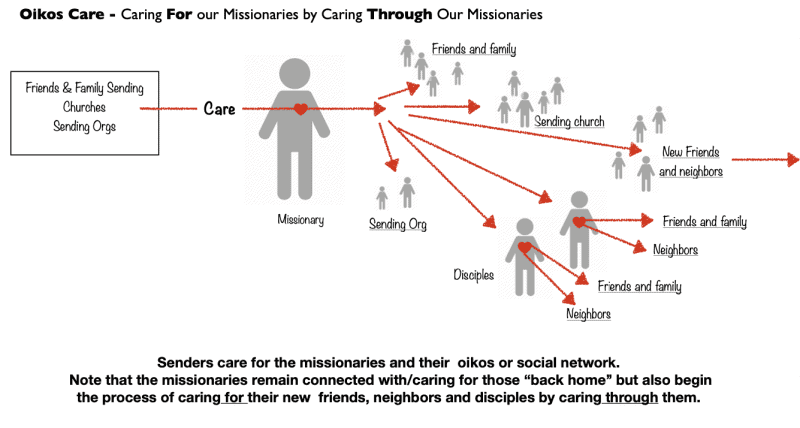
In the diagram (see figure 5.1), we see how senders and member care workers start by caring for the missionary, but don’t stop there. The care continues as they care for the missionary’s network of friends, family, sending church or agency, and extends to their new disciples, friends, and neighbors.
This tapestry of intentional care builds stronger connections. Not only does he and his friends and family receive thoughtful care, but it also demonstrates to pre-believers that he is living out God’s intent on how we are to treat “one another.” We embody Jesus’ incarnational presence.
Team Care for Oikos Care
How is it possible to care for so many people? We need to learn from the medical professionals who work together and call in other specialists to provide holistic care. Yes, each of them is a specialist trained and hired to provide optimum care and expertise.
Let’s put a call out for more caretakers in the Church! Make it a personal invitation, not an email. Yes, this will take more time but it’s worth it. Then train for excellence. It does not have to be complicated. Anyone can do it. We can all “send them on their way in a manner that honors God” (3 John 6). Oikos care is multi-dimensional, not corporate. It is personally customized, not cookie-cutter.
The younger ones in your church or family can train the older ones to download and use Zoom, Marco Polo, etc. Former missionaries can share stories about what meaningful care was for them (or what they wish they had), what culture shock felt like, what they missed from home, and what furlough should look like. You can have small groups read a book together, such as Foreign to Familiar by Sarah Lanier or Praying for Your Missionary by Eddie Byun.
To equip the sending oikos, All Nations International developed a training for local churches, called Sender’s University (Sender’s U), to equip lay people to send well. Attendees learn the reality of the need for both the goers and senders to accomplish the Great Commission. The facilitators share stories about the realities of missionaries’ lives and give practical ideas of how to get involved in new ways.
How to Start Oikos Care?
Here are a few ideas for you to get started in oikos care:
Caring for the Child Missionaries
- Invite your missionaries over for a casual meal. Get out (or borrow) Legos® or wooden train sets for the kids to play through dinner. What a gift for your missionaries when they know you have prepared to host their children too. The relaxed setting is in itself a gift!
- During your agency’s training or church mission conference, run a parallel training/conference for children rather than just offering childcare. We are equipping child missionaries, not babysitting missionary children.
- Keep in touch directly with children through video chats (Marco Polo) or texts. Get your own children or Sunday school class involved. What a great way to train children in member care!
- Read and send video record stories for child missionaries to play over and over again.
Caring for the Parents of Missionaries
- Try to meet the missionaries’ parents and relatives before the missionaries leave for the field.
- Find out where the parents live and go visit them. If they live a long distance from you, invest the time and money to visit them.
- If they are local, invite them to your family’s events (e.g., holiday dinners, tee ball games, etc.).
- Invite parents to prayer times where their kids will be prayed for. Pray also for the parents and acknowledge their sacrifice.
Caring for the Sending Agency and Church
- Get to know each other. Take the initiative to meet the missions pastor, missions committee, sending team, and agency staff. Invite yourself for a visit. Invest the time to communicate and establish trust. This will help the missionary know that his people are all on the same page.
- Host trainings together.
- Invite the agency and church to prayer times where the mutual missionary will be featured.
Caring for New Friends, Neighbors, and Unreached Peoples
- Ask your missionary about their new friends so you can get to know them.
- Pray for specific people by name. Ask about them regularly.
- Visit. Do prayer walks. Meet your missionary’s new neighbors, friends or disciples, and colleagues.
- Send people from the sending church, sending team, or agency to help in times of natural disasters to care for the community (rather than just evacuating the missionaries).
Conclusion
We often say that it takes a community to raise a child, which includes a lifetime of welcoming a child’s friends and family. It also takes a community to care for a missionary. But we gain the most in the process. By caring for the missionary’s oikos back home and in the new host country, we gain new friends and communities of friends. As we care for entire oikos, our reach extends from home through the missionary to discipling the nations!
Mary Ho (mho@allnations.international) is the international executive leader of All Nations (allnations.international), a global Christian missions organization with workers in 45 countries. She is passionate about finishing the Great Commission in this generation by sharing the love of God among every people and where the name of Jesus Christ is little or not known. In 2016, Mary received her doctor of strategic leadership from Regent University, Virginia.
Peggy Spiers (pspiers@allnations.international) is a member of the global support team for All Nations International. She works to develop and sustain healthy partnerships between goers, senders, home churches and agencies. Peggy helped to develop the Sender’s U training which helps to equip local churches to send and care for workers on the field well.

Pam Arlund, PhD, (parlund@allnations.international) serves on the All Nations International Leadership Team. Pam trains local churches and missionaries around the globe on effective disciple making principles. She received her PhD in Linguistics in 2006 and spent ten years in Central Asia as a church planter and Bible translator. She is the author of many articles and books on missions. She trains and encourages local churches and missionaries worldwide through on-site trainings and Perspectives classes.
EMQ, Volume 58, Issue 2. Copyright © 2022 by Missio Nexus. All rights reserved. Not to be reproduced or copied in any form without written permission from Missio Nexus. Email: EMQ@MissioNexus.org.