EMQ » April–June 2022 » Volume 58 Issue 2
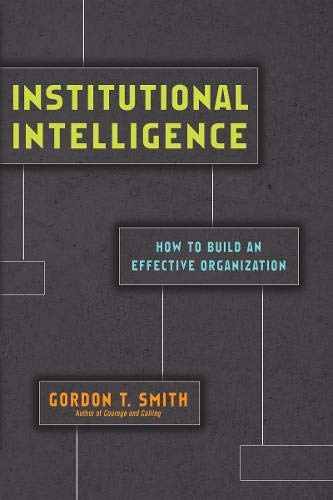
Institutional Intelligence: How to Build an Effective Organization
By Gordon T. Smith
InterVarsity Press, 2017
225 Pages
US$25.00
Reviewed by Tim Pewett who has been serving for almost a decade in theological education and mission agency leadership with Avant Ministries in Spain. Tim is also a doctoral student in intercultural studies at Columbia International University (CIU).
What kind of intelligence is requiredto build a healthy institution? According to Gordon T. Smith, many practitioners focus on the what. In other words,intelligence focused on the essential building blocks of an organization (e.g., mission, vision, values, HR, and finance). However, Smith’s argument and thesis are rooted in the who. That is, effective and healthy institutions are constructed by members who think and act with institutional intelligence, “the wisdom of working effectively within an organization” (3). Smith is eminently qualified to write on this topic. He has served as a Pastor, but the bulk of his experience has been at the senior administrative and executive level within religious-academic institutions. He has served in institutions across North America, the Global South, and Asia.
The opening chapter serves as an introduction to institutions, addressing traditional questions and frequent resistance directed towards them. Over the next nine chapters, he unpacks what members with institutional intelligence “will have,” “will understand,” “will recognize,” “will appreciate,” and “will contribute” in seven key organizational areas (15). While members will possess institutional intelligence in all the areas, Smith particularly emphasizes two, Mission Clarity and [Policy] Governance, respectively (together occupying around 40% of his work).
In regards to mission clarity, a member with institutional intelligence will not only understand the uniqueness of their institution (its business or industry, its multiple beneficiaries/customers/stakeholders, its niche in a particular time and situation) but also how his or her specific role contributes to mission fulfillment. With regards to [Policy] Governance, members will not only understand the structures and systems present within an organization, but they will also understand how power and decisions are exercised and what contributions can be made in ways appropriate to their specific role. The remaining five elements include people, organizational culture, finances, space (buildings), and partnerships/affiliations. The ability for members to act with institutional intelligence in these remaining five areas is repeatedly tied back to a presumptive recognition, appreciation, and possession of mission clarity and effective governance.
Many of the chapters have practical questions and exercises listed at the end that the reader can do. Moreover, I appreciated the section, “Institutions are Good for the Soul” (Appendix B) – a helpful and important perspective to keep in mind after many chapters which can feel weighty at times. If there is any quibble with the book (from a missions point of view), it would have to be with the fact that the author (though possessing experience living outside of North America) seems to have written largely for a Western-minded practitioner. Those interested in intercultural studies are likely familiar with the related concept of Cultural Intelligence and will find cultural dimensions (orientations, differences, and values) in Smith’s work that often seem to align with a more North American viewpoint.
Organizational leaders (from the Board to Directors) will benefit from Smith’s broad, yet carefully laid out, treatment of institutionally intelligent members/employees. In particular, leadership teams would be aided by reading and discussing the book together. Smith’s work could also be included as part of an organization’s internal leadership development program or curriculum.
For Further Reading
Trebesch, Shelley. Made to Flourish: Beyond Quick Fixes to a Thriving Organization. InterVarsity Press, 2015.
Livermore, David A. Cultural Intelligence: Improving Your CQ to Engage Our Multicultural World. Baker Academic, 2009.
EMQ, Volume 58, Issue 2. Copyright © 2022 by Missio Nexus. All rights reserved. Not to be reproduced or copied in any form without written permission from Missio Nexus. Email: EMQ@MissioNexus.org.