EMQ » April–June 2022 » Volume 58 Issue 2
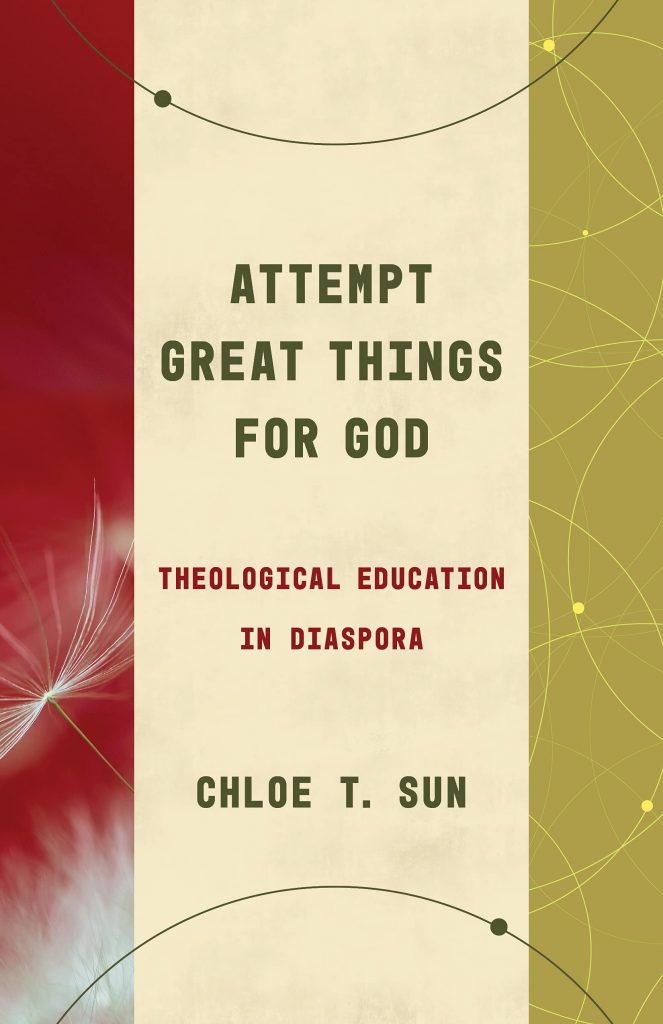
Attempt Great Things for God: Theological Education in Diaspora
By Chloe T. Sun
Wm. B. Eerdmans Publishing Co., 2020.
176 pages
US$19.99
Reviewed by Bob Bagley, associate executive director of Global Partners. From 1982–2020 Bob served Global Partners with a focus on theological education and leadership development.
Using a case study approach, Chloe T. Sun explores the challenges of providing effective theological education for churches in diaspora communities. As a professor of Old Testament at Logos Evangelical Seminary, a Mandarin-language theological school in California, Dr. Sun provides a firsthand perspective on an institution specifically established to serve the Chinese diaspora church.
The book begins with the story of Felix Liu, a Taiwanese immigrant to the United States, who became the founder of a denomination (the Evangelical Formosan Church) and subsequently the founder of Logos Evangelical Seminary. Liu’s theology of ministry, outlined in the first chapter, became foundational to the educational philosophy of the seminary.
Sun then moves on to explore distinctives of the seminary, including a focus on developing servants rather than developing leaders, the use of Mandarin as its instructional language, the centrality of the MDiv degree for pastoral ministry, support of women in ministry, and a commitment to enable students to graduate with minimal debt.
With diversity valued so highly in education, including theological institutions, Sun devotes the next section of the book to discussing how an institution that limits itself to serving the Mandarin-speaking community can at the same time embrace diversity. She argues that diversity should not be “defined solely by having students and faculty of many different races and ethnicities” (103), but that it “can be achieved through gender, age, generations, economic status, denominational background, physical and mental ability, and cultural contexts.” (102)
The book concludes with reflections on the unique contributions Logos makes to the broader community of theological schools in North America, in some respects making a plea for “diasporic theological schools and ethnic programs [to] have a place under the sun.” (121)
The book is not merely a defense of distinct theological education institutions and programs for diaspora communities. Sun does not shy away from the challenges. Instead, she closes with a series of questions that Logos and other similar programs will need to answer, including (a) Should they stick to using Mandarin since it limits them to first generation immigrants and separates them from the wider community?, (b) How should they balance between supporting a specific cultural identity and embracing a global perspective?, and (c) What is the impact of limited racial and ethnic diversity on students and ultimately on the churches they will serve?
Two specific audiences will find Sun’s work a rich source of reflection – individuals ministering among diaspora communities as well as those engaged in mainstream theological education. She has much to say to both. Her volume is a welcome addition to the growing collection of writing on diaspora missiology.
For Further Reading
Tira, Sadiri Joy and Juliet Lee Uytanlet, eds. A Hybrid World: Diaspora, Hybridity, and Missio Dei. William Carey Library, 2020.
Wu, Jeanne. Mission Through Diaspora: The case of the Chinese Church in the USA. Langham Monographs. 2016.
EMQ, Volume 58, Issue 2. Copyright © 2022 by Missio Nexus. All rights reserved. Not to be reproduced or copied in any form without written permission from Missio Nexus. Email: EMQ@MissioNexus.org.