EMQ » April–June 2022 » Volume 58 Issue 2
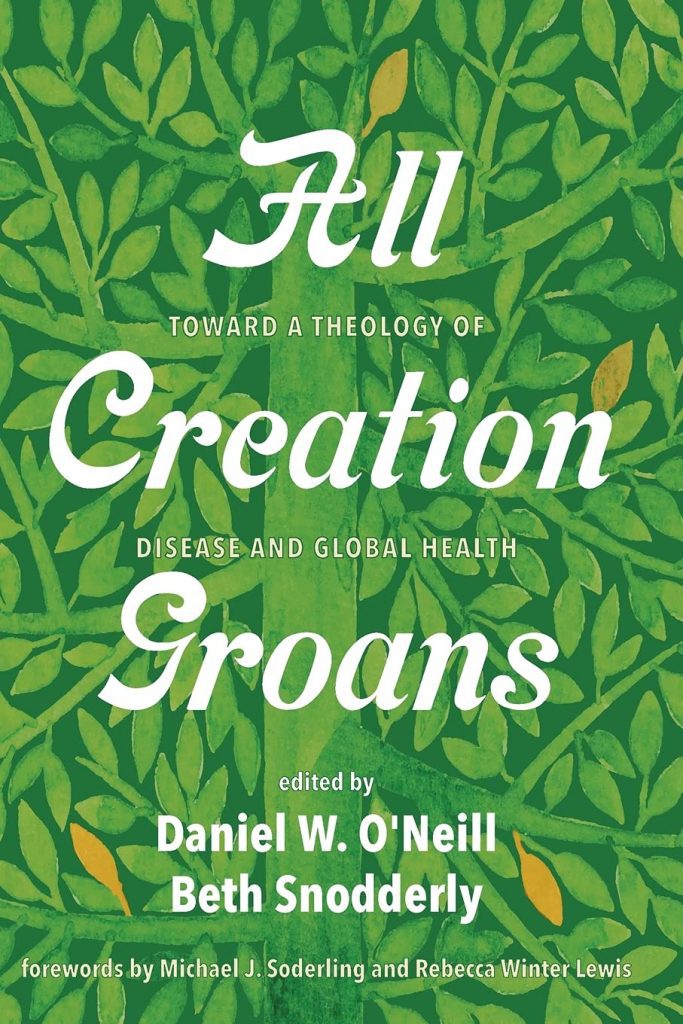
All Creation Groans: Toward a Theology of Disease and Global Health
Edited by Daniel O’Neil and Beth Snodderly
Wipf and Stock Publishers, 2021
300 pages
US$36.00
Reviewed by Mark A. Strand, professor, North Dakota State University, Fargo, North Dakota.
Until the late 1800s, medical work was seen by global mission organization leaders as inferior to preaching. They considered medical work to be a support service to keep the expatriate missionaries healthy. By the turn of the century, it was recognized that medical missions was a key component in building goodwill in communities and establishing credibility for evangelistic and church planting endeavors. So, treating disease became a key part of cross-cultural missions.
Fast forward to the fundamentalist-liberal controversies of the 1920s, and once again, medical missions was mischaracterized along with other social service ministries as being a component of the social gospel, and treated as inferior to evangelism. That is until the Lausanne Covenant was drafted in 1974, which contained a distinct section titled “Christian Social Responsibility,” reestablishing the legitimacy of service ministries, including healthcare.
So, the conversation about the role of healthcare in ministry, and the theological justification for treating disease as a gospel-focused activity, has gone on for a long time. The book being reviewed here, All Creation Groans: Toward a Theology of Disease and Global Health, attempts to strengthen the theological justification for healthcare ministries in the cause of global missions. The editors set out to develop a contemporary biblical theology of disease in order to understand what God would have believers do in the world to partner with him in the battle between good and evil, health, and disease. It is a welcomed addition to the literature.
The editors and several contributing authors acknowledge their debt to two twentieth century missions legends, Ralph Winter, founder of the former U.S. Center for World Missions (now Frontier Ventures), and Daniel Fountain, author of the seminal work Health, the Bible and the Church. I had the privilege of meeting both individuals and can attest to their intellectual prowess and spiritual humility. Both of them increased my passion for developing a theological approach to healthcare ministries, which went beyond the opportunism which characterized some medical missions efforts. This volume attempts to build upon the prior work of these two giants. With 19 chapters and an epilogue, this book will be appealing to persons serving in healthcare-related ministries. It is heavily footnoted and includes both a general index and a scripture index, allowing for the reader to dig deeper into any topic of personal interest. For an edited compilation of essays, the focus and depth of treatment are relatively consistent throughout.
The thesis of All Creation Groans is that “nature as we now find it has been corrupted by rebel spirit-agents, … which produces a multitude of organisms that afflict both humans and animals with disease.” (214) This is called the Corruption of Nature (CON) hypothesis, by contributing author Gregory Boyd (chapter 19). To his credit, Boyd addresses the most common objections to the CON hypothesis, in an even-handed manner, providing a summary that is humble and fair. However, that all disease is the work of the enemy is not the only way to interpret biblical teaching on this issue, nor it is the only justification for serving in healthcare ministry globally. I would like to address two issues of concern.
First, theologically, is every sickness from Satan? And is every malady an enemy of God’s goodness? Certainly, God’s attitude toward Job was that he was worthy of being afflicted with disease because he was righteous; his perseverance in the face of it was a sign of his trust in God. So, while disease and suffering are contrary to the design in God’s kingdom, it is also possible to see them as a necessary element in a contingent world, and which God ultimately redeems in the eschaton, and we as his ambassadors, strive to ameliorate in the way we serve people in need while on earth.
Second, biologically, while inconvenient, and responsible for suffering and death, neither organ damage (leading to chronic disease), nor an invasion of the body by infectious agents (leading to infectious disease), must be seen as the direct action of the evil one. It could also be seen as a way in which the biological world is designed, such that God’s glory can still be revealed despite it. As Paul writes in 2 Corinthians 12:9–10, “‘My strength is made perfect in weakness.’ Therefore most gladly I will rather boast in my infirmities, that the power of Christ may rest upon me. Therefore I take pleasure in infirmities, in reproaches, in needs, in persecutions, in distresses, for Christ’s sake. For when I am weak, then I am strong.” Furthermore, the line between pathogens that are necessary for human life, such as bacteria in the microbiome that helps digest food, and those that are disease-causing, such as E. coli, is very fine. So, I am still wrestling with this question, and thank the editors for stimulating my thinking.
Despite my misgivings about the preceding points, that disease is the work of the enemy is not necessary to justify healthcare ministries, because pain, suffering, and death are all things that Christians are called to work against as they serve their fellow humans. I commend the editors for advancing our understanding of a theology of disease and global health. And to be fair, in their subtitle they acknowledge that this effort is toward a theology of disease, not the theology of disease. The editors and contributing authors are to be commended for addressing important issues in theological justification for global health ministries and provoking needed conversation about it. I highly recommend this book and encourage readers to read it in groups where discussion can occur.
For Further Reading
Long, W. Meredith. Health, Healing and God’s Kingdom: New Pathways to Christian Health Ministry in Africa. Regnum Books, 2000.
Grundmann, Christopher H. Sent to Heal: Emergency and Development of Medical Missions. University Press of America, 2005.
Swartly, Willard M. Health, Healing and the Church’s Mission: Biblical Perspectives and Moral Priorities. IVP Academic, 2012.
Myers,Bryant. Walking with the Poor: Principles and Practices of Transformational Development. Orbis Books, 2011.
Strand, Mark A., and Andrew M. Cole. “Framing the Role of the Faith Community in Global Health.”Christian Journal for Global Health 1, no. 2 (2014): 7–15. https://journal.cjgh.org/index.php/cjgh/article/view/19/93.
EMQ, Volume 58, Issue 2. Copyright © 2022 by Missio Nexus. All rights reserved. Not to be reproduced or copied in any form without written permission from Missio Nexus. Email: EMQ@MissioNexus.org.