EMQ » April–June 2022 » Volume 58 Issue 2
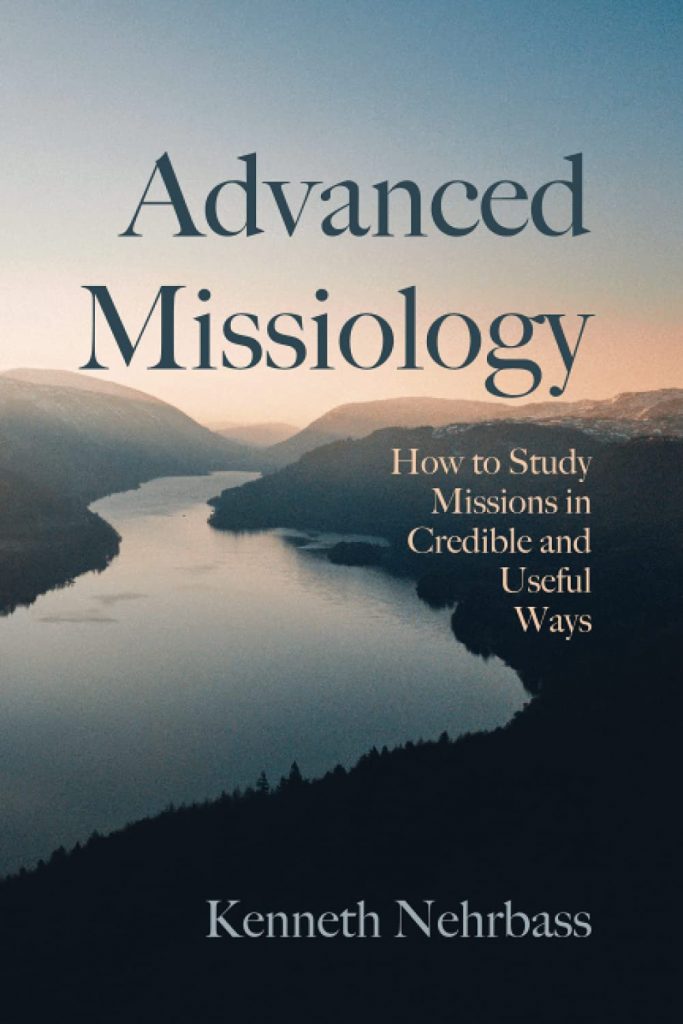
Advanced Missiology: How to Study Missions in Credible and Useful Ways
By Kenneth Nehrbass
Cascade, 2021
332 pages
US$39.00
Reviewed by Cameron D. Armstrong, International Mission Board, Bucharest, Romania.
The study of missions can be an elusive task since there are thousands of directions from which the student may begin or end up. Kenneth Nehrbass funnels the conversation in Advanced Missiology, reminding readers that the core of missiology involves the use of academic disciplines to make disciples across cultures. Nehrbass charts a course forward by describing missiology’s multi-layered past, present, and future.
Nehrbass’ first chapter presents the mental image of missiology as a river with multiple tributary-disciplines flowing in and out of the river, which contrasts with the concept of missiology as a three-legged stool built on theology, history, and the social sciences. Part 1 of the book addresses these and other potential tributaries, namely anthropology, intercultural studies, development theories, and education. Missiology is at its best, Nehrbass argues, when the study of these various disciplines uses actual data to generate theories for how the world’s cultures work. Part 2 of Advanced Missiology explores the “distributaries”, meaning key areas where the missiology river winds. Prominent theories and models are evaluated for long-term effectiveness. A final chapter considers future directions in missiology.
Advanced Missiology offers two strengths worth noting. First, it helpfully reorients missiology back to the Great Commission task of making disciples across cultural boundaries. Such a corrective provides much-needed grounding for a discipline with such diversity and possibility. Second, the vast array of theories, models, and pioneer missiologists discussed makes the book nearly exhaustive in scope. Readers will find Nehrbass a steady guide as he traverses missiology’s multiple tributaries.
One weakness, related to the book’s vast scope, is that at times theories and models are underdeveloped. For example, Nehrbass claims throughout the book that orality is becoming a major distributary, going so far as to propose it as a “theoretical sphere” that future missiologists ought to explore (295). However, orality is only cursorily addressed as a narrative, storytelling model for “pre-literate” peoples (247–249). Interestingly, the chapter on education’s impact on missiology (penned by Rebeca Burnett and Leanne Dzubinski) notes oral strategies are much broader than those involving storytelling and not only for low literate groups.
Still, this weakness does not negate the potential Advanced Missiology possesses as an upper-level inquiry. Nehrbass succeeds in demonstrating that missiology is a river with a multitude of theoretical and methodological tributaries and distributaries, whose waters coalesce around the commandment to make disciples across cultures. I expect this book will become a hallmark among evangelical graduate programs in missiology and intercultural studies.
For Further Reading
Nehrbass, Kenneth. God’s Image in Global Cultures: Integrating Faith and Culture in the Twenty-First Century. Cascade, 2017.
Terry, John Mark, ed. Missiology: An Introduction to the Foundations, History, and Strategies of World Missions. Revised edition. B&H Academic, 2015.
EMQ, Volume 58, Issue 2. Copyright © 2022 by Missio Nexus. All rights reserved. Not to be reproduced or copied in any form without written permission from Missio Nexus. Email: EMQ@MissioNexus.org.