EMQ » October–December 2021 » Volume 57 Issue 4
[memberonly folder=”Members, EMQ2YearFolder, EMQ1YearFolder, EMQLibraryInstitution”]By Brent McHugh
Over the last six years, I and a number of my colleagues have had the privilege of working out of our office location in the Business and Innovation Center of Europe (BICEURONOVA) in Málaga, Spain. Recent articles have called the Málaga Valley the next Silicon Valley – and for good reasons. I’m thankful for the privilege of collaborating there with some of the leading global thinkers and practitioners in innovation.
As we seek to fulfil our vision of cultivating Christ-honoring transformation among least-reached peoples using a holistic approach, I have witnessed many of my colleagues work to bring the best ideas and solutions to address numerous challenges facing Europe and the world today. As I’ve watched their presentations, have been part of discussions and seen them deploy durable solutions, it has become clear that having the mind of Christ is central to effective efforts to capture the day and bring innovation to the forefront.
From hackathons centered around creating tools to make resources accessible to refugees, to calls for action that rally individuals and organizations around pressing issues, to participating in social challenges, to address unemployment in the migrant community, creative processes have led us and many others to durable solutions that allow church-planters and disciple-makers to engage in least-reached communities. In our local context, these efforts have not only helped refugees and migrants navigate life in an unfamiliar place and provide for themselves and their families, but have prompted many of these least-reached people to put down roots in our city instead of continuing on the refugee highway. This breakthrough has led to more sustainable church-planting opportunities in our community.
We seek these solutions not merely to address the problems at hand, but with a greater purpose informed by the unique mindset we have as people transformed by the gospel. In 1 Corinthians 2:16, Paul quotes Isaiah 40:13 and then makes a statement concerning all believers: “We have the mind of Christ.” I believe having the mind of Christ involves sharing the plan, purpose, and perspective of Jesus, and it is something that all of His followers possess.
Having the mind of Christ means we understand God’s plan in the world to bring glory to His name, restore creation to its original splendor, and provide salvation for sinners. It aligns us with Christ’s purpose “to seek and to save what was lost” (Luke 19:10). And it also requires that we share Jesus’ perspective on humility and obedience (Philippians 2:5–8), seek to minister with compassion (Matthew 9:36), and prayerfully depend on God (Luke 5:16).
This mindset is our distinct advantage; and I believe we the church, should, and can, leverage this advantage for the sake of Christ. As Gary W. Oster writes in Christian Innovation Descending into the Abyss of Light,
Scripture and the personal experience of Christians worldwide show that God uses innovation for humans to know more of Him, to communicate with Him, and to ultimately accomplish His earthly will for mankind. … Innovation is Christian when it is ultimately aligned with God’s purposes and methods.[1]
The academic, business, and scientific fields have given us tremendous resources to facilitate innovative thinking. These tools can equip us to tackle issues beyond common, everyday challenges. They are processes designed to address the wicked problems – those that are hard to define and difficult or impossible to solve – described by Horst W.J. Rittel and Melvin M. Webber, professors at the University of California at Berkeley.[2] The potential of these innovative tools renders them vitally relevant to our tasks of fulfilling the great commission (Matthew 28:16–20) and obeying the Great Commandment (Matthew 22:36–40).
An Active Process
Through a quick Google search, you can find hundreds if not thousands of platforms and processes designed to ignite innovative thinking that leads to the development of durable solutions. Many people, however, think of innovation as akin to finding a needle in a haystack or waiting and waiting and waiting for the aha moment; but in reality, it is a far more active endeavor. Innovation creation is an iterative process that can be synthesized into four identifiable phases.[3]
- Analyze Current Realities. Seek to understand the context of the problem based on experience by studying the situation or by reframing an existing challenge. This involves identifying how differences in the environment are related to the challenges a community is facing. An adapted version of Porter’s Five Forces Analysis[4] is a beneficial tool in this process.
- Reframe the Problem. Create a structure, visualization, or framework to organize your insights about the context and stakeholders, drawing from personal experiences to gain multiple perspectives about the problem. The Kansas Leadership Center encourages us to “hear from unusual voices” during this stage, and this process is laid out well in the book, For the Common Good.
- Envision the Alternatives. Develop new ideas through reflection and mapping to bring clarity and synthesize new pathways. The use of tools like mind mapping is highly effective in clustering and visualizing concepts toward your pathway. I recommend using MIRO’s mind map template[5] for this process.
- Prototype and Experiment. Apply the new visions that emerge, ensuring that the solutions are purposefully built around peoples’ experiences and can provide the best outcomes. Once you have developed a prototype, test it in several places or situations before putting your full weight behind that particular solution. A short read on this approach is John Kotter’s book, Our Iceberg is Melting.
I believe this last phase – the iterative approach – is the key to creating the farthest-reaching and most durable solutions to the challenges before us. It is also a stage in which having the mind of Christ is particularly vital as it requires both humility and a willingness to fail. For mission and church leaders specifically, “when you are willing to fail on the road to innovation, it makes your successes more meaningful, makes you more relatable, and inspires others to take the risks that truly lead to innovation. Second, these tremendous gains in innovation and authenticity happen only by getting over the fear of failure.”[6]
It is often said that we should fail fast and reiterate, learning from what doesn’t work to guide us toward effective solutions. This is consistent with principles espoused by The Lean Startup approach by Eric Ries as well as by my colleagues at the Politecnico University of Milan, one of the seventeen organizations participating in the SISCODE project; “an EU funded project aimed at stimulating the use of co-creation methodologies in policy design, using bottom-design-driven methodologies to pollinate Responsible Research and Innovation, and Science Technology and Innovation Policies.”[7] The visual guide[8] developed as part of this project is a valuable resource in approaching the processes of failing fast to innovate well.
Examples of Effectiveness
I can personally attest to the effectiveness of these processes in our local context, most recently as our team has sought to address the challenges faced by unreached migrant agricultural workers in southeastern Spain. This population has grown exponentially over the last ten years, resulting in an isolated community of thousands of people lacking basic human necessities such as sustainable housing. A group of local community advocates, government actors and missiologists is developing a long-term solution that seeks to bring about transformation within this entire group. I encourage those who are interested in this approach to come and see the doors that God is opening for the proclamation and demonstration of the gospel among the least-reached people He has brought into our midst.
Similarly-motivated innovations are leading to many other effective strategies and solutions that address pressing needs while furthering God’s Kingdom. The 2021 BAM Global Congress provided numerous examples as it reflected on breakthroughs in bringing about Christ-honoring transformation through the Business as Missions movement over the past quarter century. For instance, one participant is addressing the need for jobs among pastors of small churches in frontier locations by creating e-commerce entities specific to each individual’s passions and interests as well as to location. Though this is certainly not a one-size-fits-all solution, it has the ability to pivot to current realities in diverse communities. Using techniques deployed by trained facilitators through organizations such as Itzinya Malaga,[9] companies like these are providing sustainable income for over one hundred families.
The startup model used by these organizations can easily be reproduced to create jobs where they are needed, both in the locations in which we currently serve and in the communities in which we seek to minister. Maximizing this approach requires living out the compassion and humility inherent in the mind of Christ, taking into account the current realities and trends that affect the livelihoods of millions of unreached people. The World Bank’s 2017 study “Trouble in the Making? The Future of Manufacturing-Led Development” underscores the importance of understanding the environment as it urges us to consider economies’ competitiveness, capabilities, and connectedness against shifting international trade patterns, market demands and financial strengths.[10]
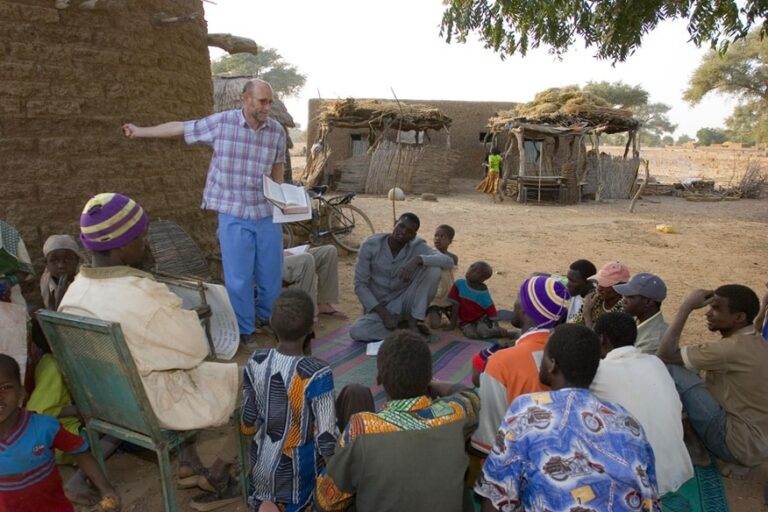
A recent issue of EMQ pointed out the necessity of viable income opportunities for pastors in the developing church in Niger. This reality is described as “On his day off, he sells chickens at the market to support his family and his ministry,” as if it is a surprise to many readers that he must provide in that way. Yet having the mind of Christ means understanding realities like this and deploying innovative processes to create jobs for pastors, cross-cultural workers and members of developing church communities in places like Niger.
Adapting to Current Realities
The church and mission landscape is changing under our feet. The opportunities and processes related to accessing countries of service are shifting rapidly, as are the lifestyles and economic and educational circumstances of the people groups we are seeking to reach. One example is that we are experiencing the largest movement of people in our generation according to the UNHCR.[11] We must think and act innovatively to adapt to these current realities.
In a series for Fuller Seminary, Dan Steigerwald described six challenges to missional church planting. In discussing the second challenge, “Missional activity at the expense of both proclamation and a holistic discipleship stance,” he presents the following challenge:
Being on mission for Christ means we both proclaim Jesus – giving account for the hope within us, while also cooperatively serving alongside those gifted in evangelism – and also demonstrate as best we can what humanity is intended by God to look like. That word and deed stance takes our ongoing immersion in the gospel story as well as a keen sense of our own story. And it takes discerning hearts to see opportunities to share Christ with those who have yet to hear and with those who have been misinformed or hurt by poor portrayals of the gospel.”[12]
It is in this stream of thought that I believe innovative practices can help us to discern the best means to proclaim and demonstrate the gospel today and in the future. They enable us to live out the message we are proclaiming through effective and compassionate strategies that address the pressing needs of people who haven’t yet been transformed by the good news. And, they adapt to any local context as we seek to innovate with the mind of Christ.
May God lead us to breakthroughs in the fields in which we collectively minister with this shared mindset.
Brent McHugh is the author of many articles on innovation including some in Forbes magazine. He and his wife Kim served in the Middle East among Iranian asylum seekers for nearly ten years. He also served as Affinity Director for workers in the region. Currently, as International Director of Christar, Brent provides spiritual, visionary, executive and developmental leadership for Christar workers.
[1] Gary W. Oster, “Christian Innovation Descending into the Abyss of Light,” Regent Global Business Review (2009): 17–22.
[2] Horst W. J. Rittel and Melvin M. Webber, “Dilemmas in a General Theory of Planning,” Policy Sciences 4 (1973).
[3] Adapted from the SISCODE Toolbox, https://siscodeproject.eu/wp-content/uploads/2019/09/toolkit-27092019-1.pdf.
[4] “The Five Forces,” Harvard Business School, https://www.isc.hbs.edu/strategy/business-strategy/Pages/the-five-forces.aspx.
[5] “Mind Map Template,” Miro, https://miro.com/aq/ps/templates/mind-map/.
[6] Jim Ludema and Amber Johnson, “Failure Is 99% Of The Work: How To Fail Fast On The Way To Spectacular Innovation,” Forbes (2019), https://www.forbes.com/sites/amberjohnson-jimludema/2019/02/18/failure-is-99-of-the-work-how-to-fail-fast-on-the-way-to-spectacular-innovation/.
[7] “Co-Design for society in innovation,” https://siscodeproject.eu/about/.
[8] “Resources,” SISCODE, https://siscodeproject.eu/resources/.
[9] Itzinya Málaga, https://malaga.itzinya.org.
[10] “Trouble in the Making? The Future of Manufacturing-Led Development,” The World Bank (2017), https://www.worldbank.org/en/topic/competitiveness/publication/trouble-in-the-making-the-future-of-manufacturing-led-development.
[11] “Global Trends: Forced Displacement in 2021,” UNHCR (2021), https://www.unhcr.org/flagship-reports/globaltrends/.
[12] Dan Steigerwald, “Six Challenges of Missional Church Planting (Part 1),” Fuller School of Intercultural Studies Blog (2017), https://sparks.fuller.edu/global-reflections/2017/08/07/six-challenges-of-missional-church-planting-part-1/.