EMQ » July–September 2020 » Volume 56 Issue 3
By Sam George
This article is an abridged version of my presentation given at the annual consultation of COMMA in 2019 in Orlando, Florida. Looking through the lens of diaspora missiology, I present five challenges of missional engagement with Muslims in the Western context. Each reflection is drawn from diverse locations in the world and includes practical missional insights and lessons for ministry among Muslims in North America.
Committing to Pray for Muslims
A few months ago, I was in the city of Dubai in the United Arab Emirates and had the opportunity to go to the top of the tallest building in the world. Before coming into ministry, I studied engineering and worked for a design engineering firm that specialized in skyscrapers. I have visited many tall structures and was excited about its technical features built by a Chicago firm. As I reached the top of the world, however, a powerful spirit of prayer came over me to intercede for the nations of the Middle East. In the last few years, from the vantage point of the highest floor of the tallest building in the world, I gazed as far as I could and used the Operation World app on my phone to pray for the nations in that part of the world.
I had visited many nations in Europe, the Middle East, Africa, and Asia to study the current refugee crisis. Many refugees acknowledged seeing dreams, experiencing healing, and supernatural events.[1] When I enquired scholars and practitioners about why this happening now, their unanimous reply was prayer. More concerted efforts are being taken to intercede for Muslims, particularly during special seasons of the Islamic calendar. Prayers are yielding great results among Muslims everywhere. Let us resolve to pray more for the Muslim world.
Understanding Muslim Migration
God is sovereign over human dispersion and has brought many Muslims to live in Europe and North America for a greater purpose. More Muslims are being displaced than ever before in history and more are becoming Christians in foreign lands and becoming a credible witness of the gospel to others in their host nations.
Two years ago, I took a team of doctors from Chicago and New York to serve refugees arriving in the city of Athens, Greece. For a morning devotion, I took them to the historic site of Acts 17 and shared about Paul’s second missionary journey.[2] As we were about to leave, a Middle Eastern man approached to enquire what I was talking about. After a quick prayer, instead of sharing the sermon, I decided to introduce Apostle Paul to him saying something like, “A man who met Isa on the road to Damascus stood right here …” He interrupted me and said that he is from Damascus and had seen a dream of Isa a month ago.[3]
Most Muslims in the United States came after the immigration reforms of 1965 and as of 2017, their population is estimated at 3.45 million. 58% of them are foreign-born and 60% are under the age of 40 while their origin varies widely. Asians constitute the largest share of the foreign-born Muslims, while US-born are mostly black. Most Muslim immigrants (20%) came from South Asia and another 14% hail from the Middle East or North Africa. Persians, Arabs, and Middle Easterners are considered white in this study. [4]
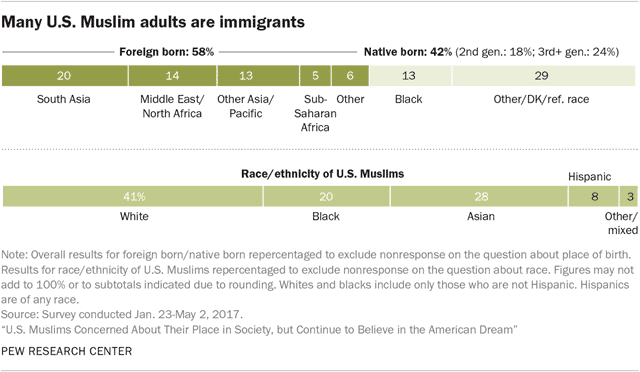
Islamic societies in many parts of the world are in crisis such as terrorism, wars, political instability, lack of educational and economic prospects, ecological crisis, etc. As a result, many have migrated to the West and elsewhere for livelihood and safety. The epicenter of the recent refugee crisis is in Syria and Iraq, from where millions have fled to neighboring nations and Europe. The United States has been a popular destination for refugees and asylum claimants in the past, but lately, policies have reversed that. Canada is now more welcoming to Muslims from South Asia, Middle East, and Africa. Understanding Muslims and their ethnic origin and immigration journey are vital to effective missional engagement.
Navigating the Geopolitics Wisely
Last summer, I talked with Pakistani lawyers in the United Kingdom about Blasphemy laws in regard to religious persecution against minority Christians in their home country. They were advocating with lawmakers and British Asian Christians to secure asylum for a high-profile case. There are fundamental variances between secular democratic principles and Islamic rule. Usually, Muslims hold a sense of ideological superiority over Christians and are troubled at the loose moral of the West concerning sexuality, abortion, and other issues. The evils of the West are frequently cited by Muslim clerics and immigrants to persuade people to choose their religio-cultural values over the prevailing norms of the host nation.
Generally, Christians and Westerners are naïve about the complex sociocultural history and contemporary geopolitical realities of the Muslim world. During my recent travels, I was amazed how much coverage is given to events in the United States and the West in many Islamic countries. There is a definitive surge in anti-American sentiments in many parts of the world and Christian faith is often intertwined with the political rhetoric, foreign policies, and media bias. Christian witness in such a complex world requires high contextual awareness and sensitivity. We must refrain from getting sucked into geopolitical quagmires and hold nationality and political views secondary to the kingdom citizenship and mission. Our life, speech, and character must be above reproach and worthy of emulation by Muslim friends.
Since 9/11, the Muslims in the United States have suffered severe discrimination both against them and their religion. Most are drawn by educational and employment opportunities in the West and remain optimistic and have received friendly treatment in their host nations. Some of them have been secularized while most remain concerned about linking extremism to their faith. Women have found greater freedom in the West than in their ancestral Islamic societies but are troubled with ultraliberal Western moral values. They often view host nations as Christian and try to maintain a professional relationship with colleagues at work and minimal interactions with neighbors.
Reaching the Next Generation
The generation of Muslim immigrants who were born or raised in the United States and Canada face unique challenges. Some of them have grown up in religious homes while but have been substantially westernized through schooling, college, and workplaces. They struggle with hybridized notion of identity on account of cultural assimilation and experienced racism from the majority cultures. They lose linguistic skills and feel alienated from their ancestral lands. Many struggle to find their place in the world and reject their parent’s faith and cultural values.[5] While immigrants clutch to the ancestral faith in a foreign land, the next generation is more open to the gospel and it is strategic to reach them in the western contexts because, in turn, they can become a more powerful witness to their parents and the immigrant generation.
Several South Asian second-generation life stories have been recorded and proven to be powerful tools to share the gospel with Muslims everywhere. Some examples include writings of Nabeel Qureshi (Pakistani American Muslim apologist), Dilip Joseph (Indian American doctor who was captured by Taliban in Afghanistan) and Rifqa Bary (Sri Lankan American girl who ran away to become Christian).[6] In particular, I remember talking with Nabeel in Atlanta a few months before his hospitalization and eventual death. His lifelong journey growing up in a South Asian immigrant household, trying to be a good Muslim, and his pursuit of God resonates well with many American born and raised Muslims.
Uprooting of the Rooted Religion
The migratory displacement is a fundamentally disruptive process to our ontological sensibilities. The diasporic dissonance creates a crisis of faith and ultimate allegiance as migrants continually compare and contrast the two worlds in which they try to live concurrently. The alienation from ancestral homelands creates a strange fondness to the world they left behind while feeling like a stranger in a world they have settled in. Culture and religion play an essential role in this transition even as lived religion undergoes profound changes adapting to new contexts. Muslim migrants have globalized their faith in new ways and borrowed practices from host nations.
Islam is a rooted religion and its geographical center remains immovable. The religious requirement to face a fixed locale and untranslatable scriptures causes Islam to remain entrenched within a particular geo-cultural and linguistic embodiment. A core tenet of Islam requires its adherents to go on pilgrimage to the holy city at least once in their lifetime, which keeps the faith deeply rooted. Much of the Islamic growth and expansion have resulted from biological reproduction and conquest. In contrast, the center of Christianity has always been on the move, as it can never be held captive to any people, culture or geography. At its very core, Christianity is a missionary faith par excellence as its tenets and practices are not static or confined to any geography, but are dynamic, translatable and unceasingly moving. Its scriptures are continually being translated and the mobility of its adherents is vital to preserving its translatability.
While Islam has a legacy of geographical and linguistic permanence, Christianity has abandoned the idea of divine territoriality or vernacular exclusivity. The human attempts to domesticate God and enshrine it within our cultures, keep such faith tribal or parochial in nature. At the beginning of the twenty-first century, Christianity is the most diverse and most global faith and well-timed for a significant breakthrough as it enters into a new era of “from everywhere to everywhere” mission all over the world.
As the uprooted people get further away from its religious axis, they become less drawn to its gravitational pull while also exposed to other viable alternatives. They are more open to the gospel claims of Isa in foreign lands and daring to investigate them without societal pressure for conformity and religious retribution. Thus, the large-scale migration of Muslims to foreign lands and many Christians to Islamic nations presents an unprecedented missional opportunity. God is moving powerfully among them in some remarkable ways everywhere.
Sam George, PhD. serves as the director of Global Diaspora Institute at Wheaton College and as a global Catalyst of the Lausanne Movement. He lives in the northern suburbs of Chicago with his wife and two boys. He is of South Asian origin and has lived in the United States for nearly three decades. His recent writings include Refugee Diaspora: Mission amid the Greatest Humanitarian Crisis of our Times (William Carey, 2018); Diaspora Christianities (Fortress Press, 2018) and Desi Diaspora (SAIACS Press, 2019).
Notes
[1] Sam George and Miriam Adeney, Refugee Diaspora: Missions Amid the Greatest Humanitarian Crisis of the World (Littleton, CO: William Carey Library, 2019).
[2] Sermon at Areopagus or Mars Hill (Acts 17:22–34).
[3] For a recent documentary film on refugee conversions, see Jesus in Athens (2019). www.JesusinAthens.com (Accessed Apr 1, 2020).
[4] “Muslims in America,” Pew Research (2017), accessed Apr 1, 2020, https://www.pewforum.org/essay/muslims-in-america-immigrants-and-those-born-in-u-s-see-life-differently-in-many-ways/.
[5] See more about South Asian second generation in my book Understanding the Coconut Generation (2006); Coconut is a popular metaphor (Brown on the outside and White on the inside) for South Asian Americans.
[6] Nabeel Qureshi, Seeking Allah and Finding Jesus (2014) and No God but One (2016); Dilip Joseph, Kidnapped by the Taliban (2014); Rifqa Bary, Hiding the Light (2015).
References
Bary, Rifqa. 2015. Hiding the Light: Why I risked everything to leave Islam and follow Jesus, Colorado Springs: WaterBrook Press.
George, Sam. 2006. Understanding the Coconut Generation: Ministry to the Americanized Asian Indians. Niles, IL: Mall Publishing.
George, Sam and Miriam Adeney, editors. 2019. Refugee Diaspora: Mission amid the Greatest Humanitarian Crisis of Our Times, (Pasadena: William Carey Press).
Joseph, Dilip. 2014. Kidnapped by the Taliban: A Story of Terror, Hope, and Rescue by Seal team Six, Nashville: Thomas Nelson.
Qureshi, Nabeel. 2014. Seeking Allah and Finding Jesus: A Devout Muslim encounters Christianity. Grand Rapids: Zondervan.
Qureshi, Nabeel. 2016. No God, but One: A former Muslim investigates the evidence of Islam and Christianity, Grand Rapids: Zondervan.
EMQ, Volume 56, Issue 3. Copyright © 2020 by Missio Nexus. All rights reserved. Not to be reproduced or copied in any form without written permission from Missio Nexus. Email: EMQ@MissioNexus.org.